Author Matthew Hubbard opens up about his new book, chosen family and fighting for LGBTQ+ rights
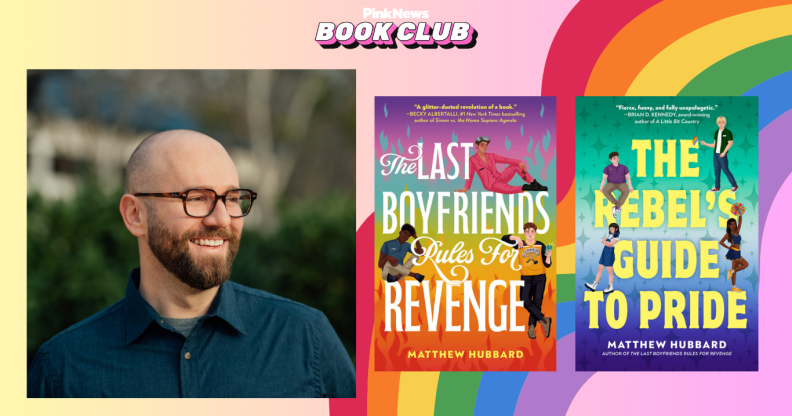
Matthew Hubbard is the author of The Rebel’s Guide To Pride and The Last Boyfriend’s Rules For Revenge (Delacorte Press/Random House Children’s Books)
If you’re looking for empowering, LGBTQ+, joyful young adult reads, look no further: Matthew Hubbard is your new favourite author.
His first two novels, The Last Boyfriend’s Rules For Revenge and upcoming The Rebel’s Guide To Pride, are politically-charged, funny and full of heart.
We spoke to Matthew to find out more about his upcoming release, the inspiration behind his work and why he thinks it’s so important to empower readers in a time of massive political unrest for LGBTQ+ people.
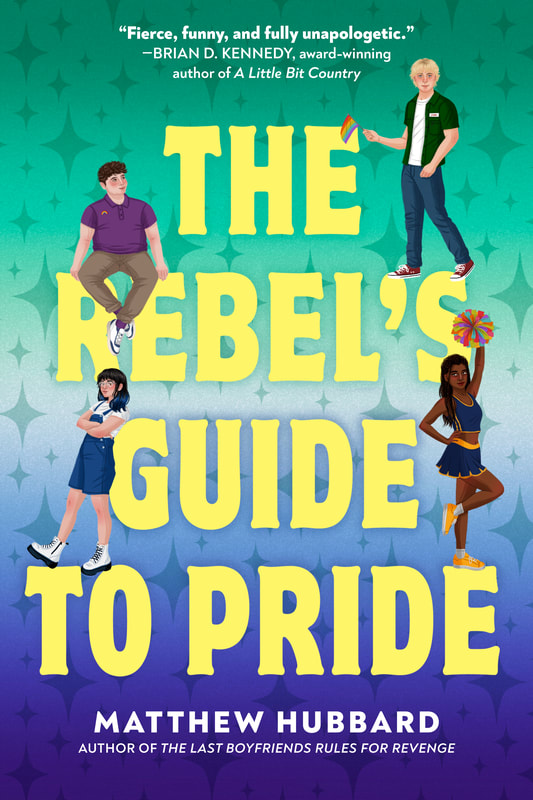
You’ve said you write the stories you wish you had growing up. What kind of impact do you hope RGTP has on young queer readers, especially those in small towns?
Matthew Hubbard: My first book, The Last Boyfriend’s Rules For Revenge, is all about finding your place in the world. Even if you live in a small town, you still get to exist. The Rebel’s Guide To Pride is about demanding to exist. You’re fighting for your space.
I would want readers in small towns to know that they deserve to take up space and that their identity matters. It’s worth fighting for. Stand your ground 100%.
I think that really resonates with Zeke’s story throughout the book. Did your own experiences influence his story in Rebel’s Guide To Pride?
Matthew Hubbard: There’s an infamous shoe box that Zeke has in the very beginning of the book. That shoe box is exactly what growing up felt like to me in small town Alabama. I was putting myself and all the things I was scared of into this metaphorical shoe box and hiding it so I didn’t have to look at or deal with it. It really influenced Zeke’s story. He is unpacking himself, his identity and throughout the book he lets these parts of himself hold space in his new life.
I’m sure it’s a very universal feeling for queer people, not feeling like you belong. But when you finally get to that place, you start to unpack everything you’ve been afraid of. That really helped me catapult Zeke’s journey throughout the Rebel’s Guide To Pride.
So, obviously, rebellion is a massive theme in the book. What drew you to this and how did it evolve when you were writing Rebel’s?
Matthew Hubbard: I started writing my first book over the Florida House Bill, or Don’t Say Gay. I was upset and angry. They want us to feel helpless, like we can’t do anything, when things like that happen. And I did. So I wanted to do something that I could control. That turned into Last Boyfriend’s Rules For Revenge. So many more people felt like they didn’t have a voice in that moment, and that shaped me into who I am as an author.
With Rebel’s Guide To Pride, I got a little bit more political than I expected through writing about how you can enforce change in your community through local elections and finding allies in those safe spaces. It isn’t something I touch on in Last Boyfriend’s.
The Rebel’s Guide To Pride is showing that you can fight and demand to exist. You can be seen and actively fight back in your community. It’s about what comes next after you’ve realised you deserve to be there.
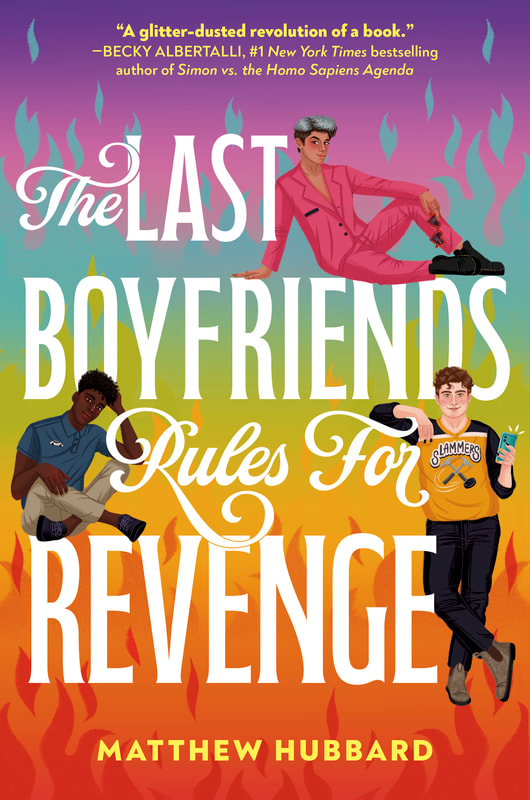
Both of your books are Young Adult, but the things they deal with are quite grown up. What made you tell these stories through the lens of teenagers?
Matthew Hubbard: Going back to when I was a teen, everything felt like life and death. Everything was dramatic. If you didn’t get asked on a date it felt like you were dying inside. And that’s what it feels like with the current situation in the US. Putting it through the lens of a 17-year-old boy shows how it affects his life. It has the biggest impact because of his age. It kind of helped maintain the momentum of what’s destroying our community. He can see it. He can feel it. Throw in some teen angst, ex-boyfriends and all the heightened emotions of being a teenager and it feels like the appropriate catalyst to tell the story.
And you see that life and death mentality in the book through Zeke’s relationship with his mother. Zeke is dramatic whereas his mother is going through the separation from his father and trying to rebuild her life. There’s a difference in their mentalities. She’s concerned about safety and has more perspective on the situation whereas he’s much more keen to make things happen.
Matthew Hubbard: Yeah, his mother definitely thinks first and Zeke thinks second. He acts, or reacts, and she thinks before acting. Realising that I’m old enough to have a 17-year-old really changes the game when you’re writing Young Adult. So I got to put myself in her position and show how important it is that Zeke sees his mother as a human being. She makes mistakes. She’s learning this new way in life as well. It’s two different trajectories for them, but it ends up in the same space. It’s showing how different things affect different people, how they process it and how they react to it was really important to me.
You can definitely see that as they develop through the book. Zeke’s relationship with his parents is a massive part of the development of his character. They both have very different views on, not just his identity, but the decisions he is making about his life and future. How did you develop this when you were writing?
Matthew Hubbard: In my first book, the main character had a very supportive father. I felt like that was important to highlight because I don’t feel like a lot of young adult queer characters have that, especially from the south. And then in Rebel’s, I wanted to flip the script.
What happens when you don’t have that support and you turn to your friends? When your reliance is on having friendships and peers as opposed to adults. His mother isn’t perfect. She’s like, 20 steps behind, but she’s trying. And the father, who I call Jackass using his initials, is the other end of the spectrum. I wanted to show how different parents react to your identity.
100%. You touched upon it a little there, but found family is a massive part of this book. A big part of queer life is finding those people who support your identity. Was that an important thing for you to showcase in The Rebel’s Guide To Pride?
Matthew Hubbard: Absolutely it is. Speaking for myself, I feel like I found my family when I hit my 30s. I have people around me who consider me an uncle to their kid, not by blood but through those friendships that last a lifetime. It’s so important. Sometimes, in our community, people don’t grow up with that support. It isn’t pre-built like with cis-hetero identity. I’m not saying they take it for granted, but I think it’s hard to realise when you don’t have it. Having love be conditional is so important because when you finally meet the people where love is unconditional, it is life saving and life changing.
You mentioned how, in your first book, the father is very supportive of his son. I loved that. As someone who has a very supportive father, it was refreshing to see that dynamic. I think it’s quite rare to see it that way.
Matthew Hubbard: Thank you. That’s what I wanted to do. Because, especially where the story is set, you have what people call ‘blue collar workers’. ‘Toxic masculinity’ is usually associated with them, so I wanted to show you a character who wasn’t toxic and who supported his son. That was crucial for me.
No, thank you!
Zeke struggles with what it means to be a ‘good gay’ in The Rebel’s Guide To Pride’. Why is that something you chose to explore?
Matthew Hubbard: There was a whole joke with my editor that we should call this book ‘Bad Gays’ when I was writing it. But that whole topic came about while editing my first book. My editor and I were talking about zodiac signs and astrology because I made a joke about it in Last Boyfriend’s. She called it out and said ‘I don’t know what that means, but then again, I feel like a very bad gay because I don’t understand astrology.’ It put the idea in my head of those preconceived notions and what it means to be the stereotypical queer person.
Whenever it involves politics and fighting for what you want, either you’re not saying enough or you’re saying too much. You’re not fighting for what the majority wants. You’re being selfish. All those things are being lobbed at you and you don’t know how to react. Seeing the politics and bills being passed, they have these really confusing ways of being named and numbered. What would it feel like if you were forced into these positions where you had to start paying attention to these things before you were ready? A 17-year-old isn’t ready to bear the weight of what politics can do to cause harm to his community, and he’s trying to figure that out.
We see that Zeke’s best friend, Sawyer, has that all figured out. She kind of looks through the lens of him being a bad gay. Now she never calls him that in the book, someone else does, but you kind of see that Zeke sees her as the epitome of a ‘good gay’. I think we all have that one person that we idolise and look up to.
Zeke tries but fails, then gives up, which I think is really common in the queer community. Especially when politics are involved. He deals with the concept of being a ‘good gay’ versus a ‘bad gay’ and how, really, we’re all just people who exist. I think his mom tells him: ‘As long as you’re trying, that’s all that matters.’
The whole ‘bad gay’ arc in The Rebel’s Guide To Revenge does such a good job at showing that there’s so much more to figure out after you come out. It goes back to what you were saying about writing through a YA lens and how everything feels so heightened.
You mentioned navigating politics there, but with everything going on in the world at the moment, with pride events being cancelled, our rights being stripped from us, how did you balance telling a story about that whilst still managing to be empowering?
Matthew Hubbard: Well, I had a completely different idea for this book. I was getting ready to turn my pitch in when I read an article about the state of Tennessee wanting to ban pride and drag performances. And that rooted itself in my head. I’m a huge fan of The Great Gatsby, not the author but the story itself. That wormed its way in my head, how it almost feels like things are no different 100 years later. We’re still being forced to live through a different kind of prohibition. The prohibition of your identity and being able to express that.
I woke up the next day and decided to add another pitch for book two because I had to get it written down. I wrote it in five minutes, sent it in, and that’s the book my publisher wanted me to write. And then I had to think about it. Think of the queer joy and the empowerment that ties in with it. Highlighting the relationships with his peers and allies and showing that, even though there’s bad in the world, there will always be good. And when you focus on the bad, it’s hard to see that.
What better way is there to show queer joy than say, a group of teenagers rebelling to throw speakies is just like underground clubs? That whole concept seemed like a really fun way to make the topic accessible.
Sawyer says it in the book: ‘The first Pride was an uprising. If you haven’t noticed, we’re still having to fight.’
What was your favourite scene to write? Did you have one that you found more difficult?
Matthew Hubbard: My gut instinct is to say in the second half of chapter two, when Zeke is unpacking the shoe box. It was both joyful and difficult for me to write. I had to process my own internalised fears, what things scared me, and how I think Zeke was ashamed and afraid of the Pride flag for so long.
I think one of the fun scenes to write was Zeke trying on his mother’s dress. He expects her to get onto him but she zips him up, compliments him and puts on a necklace.
I loved that part. Finally, can you tell us a little about what you’re working on next?
Matthew Hubbard: My third book, Drop Dead Handsome, will be coming out next year. It’s inspired by Miss Congeniality and Drop Dead Gorgeous. It isn’t as politically forward as my first two books. I kind of view it as the logical next step in the trajectory. When you have Last Boyfriend’s which is getting to the starting line to fight for your rights, Rebel’s is demanding to exist and making the change. So what do you do after? How do you live your life despite what people are saying? That plays into the story of Drop Dead Handsome. And it’s full on romance.
The Rebel’s Guide To Pride is out on May 6 2025. You can preorder it here.