
Gay, lesbian and bi people at greater risk of self-harm and suicide, new figures show
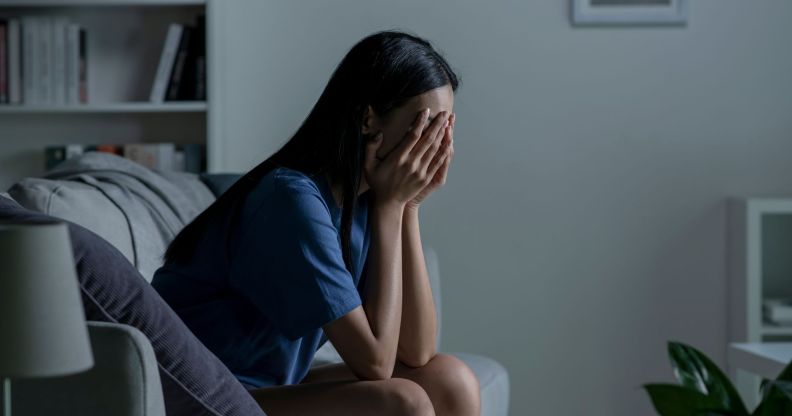
Both trans and cis people are facing abuse and exclusion following the Supreme Court ruling. (Getty)
Content warning: This article addresses issues such as self-harm and suicide. Reader discretion is advised.
Gay, lesbian and bisexual people are twice as likely as their straight peers to attempt suicide or have thoughts of taking their own life, new figures have revealed.
Data published by the Office for National Statistics (ONS) on Thursday (9 April) revealed that not only is suicidal ideation higher among LGB+ people, but also that the risk of intentional self-harm is almost three times as high.
The ONS did not consider people with trans or non-binary identities in its analysis.

Age-standardised figures showed that 50.3 per cent of LGB+ individuals per 100,000 people considered or attempted suicide between 2021 and 2023, compared with 23.1 per cent per of the same number of straight people.
The figures revealed that 1,508.9 LGB+ people per 100,000 had self-harmed, compared with 598.4 of their straight counterparts.
Bisexual people were slightly more likely to consider intentional self-harm compared with heterosexuals. Those identifying as bi were also 2.4 times more at risk than gay men or lesbians, who were 2.2 times more likely to do so.
Both LGB+ and straight women were found to be more likely to experience suicidal ideation than men, according to the report, while 16 to 24 year olds were revealed to be at more risk of self-harm.
Samaritans call on UK government to improve mental-health support
The Samaritans assistant director of influencing, Jacqui Morrissey, told PinkNews that the figures should act as a call to “action” for the government to improve access to mental-health support for LGBTQ+ and young people in the UK.
While the data was “hugely important,” it was unlikely to paint the full picture both because of a reluctance among members of the public to share their sexual orientation and fears about disclosing thoughts of self-harm or suicidal ideation, she warned.
“Urgent action is needed across healthcare to tackle the barriers that LGBTQ+ people face getting the support they really need. Local community spaces by and for LGBTQ+ people can also be a lifeline but far too often fill the gaps in statutory services. More investment is needed now.”

One person, who has used the Samaritans helpline in the past, said the statistics made for “difficult reading” because of his own experience and because he had friends who have taken their own life.
“As a teenager, my struggle to accept my sexuality, as well as feeling discriminated against, affected my mental health,” he said. “It led to depression and anxiety, and I’ve struggled with my mental health all my adult life.”
Accessing support that addressed issues to do with sexuality had been “very difficult,” and statutory services had shown a “lack of respect, dignity, sensitivity and care”, he added.
“I was lucky I found voluntary organisations that support the LGBTQ+ community and I had three years of therapy that got me to a good place.”
He “felt listened to” rather than “judged”, by the Samaritans.
Suicide is preventable. Readers who are affected by the issues raised in this story are encouraged to contact the Samaritans on 116 123 (www.samaritans.org), or Mind on 0300 123 3393 (www.mind.org.uk). Readers in the US are encouraged to contact the National Suicide Prevention Line on 1-800-273-8255.
Share your thoughts! Let us know in the comments below, and remember to keep the conversation respectful.