
No, trans women haven’t been banned from single-sex spaces – at least not yet
Hong Kong judge rules that trans women should have the right to use women’s bathrooms. (Getty)
Despite the UK Supreme Court’s ruling on the definition of a woman – and what right-wing pundits would have you believe – transgender women haven’t been banned from single-sex spaces.
Last week’s ruling left trans and non-binary people devastated after it deemed the definition of “woman” and “sex”, in terms of the 2010 Equality Act, were based on biology.
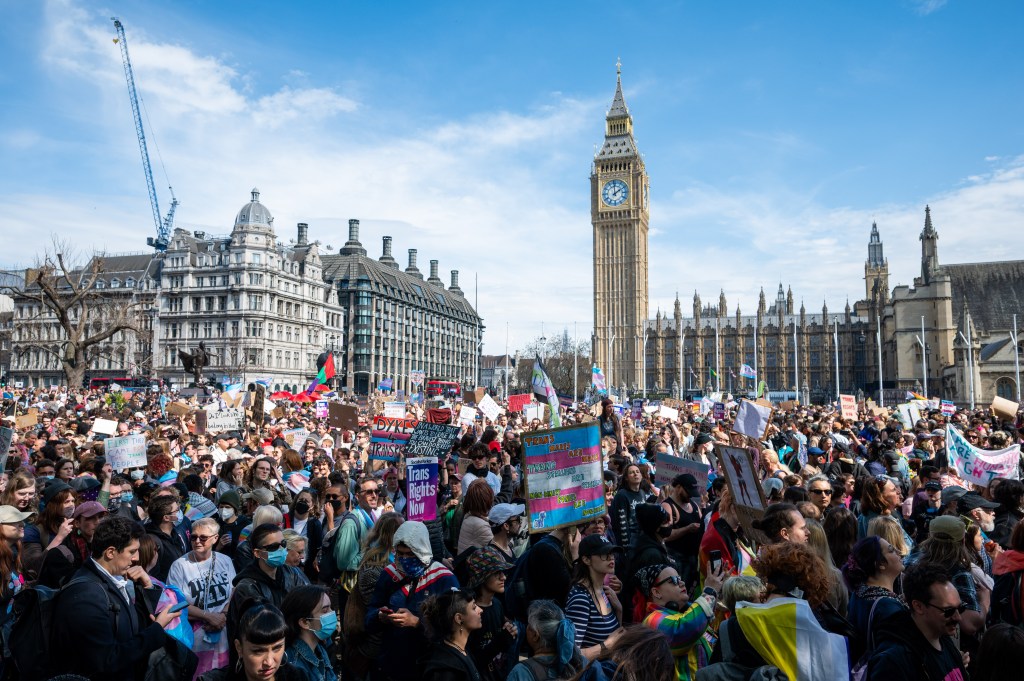
The ruling prompted protests over the weekend and could have wide-ranging implications for the way single-sex spaces and venues can, or choose to, accommodate transgender people.
Stonewall chief executive Simon Blake told PinkNews this was an “incredibly worrying [time] for the trans community and all who support them”.
However, claims that trans women are now no longer permitted in single-sex spaces are incorrect.
Writing in the Daily Mail on Monday (20 April), Katherine Lawton proclaimed that “trans activists” had “defied” the ruling. The article cited two social media posts by transgender influencers Joss Prior and Sophie Molly, both of whom pictured themselves in a public female toilet, with the latter writing: “F**k the Supreme Court. This woman will use female spaces.”
Other pundits claimed the women were “trespassing,” while some even called for the pair to be prosecuted.
Trans women can still enter single-sex spaces
Claims that the selfies “defied” the court’s decision are wrong – the ruling is not in itself a law and cannot be legally enforced.
In the UK, and several other Western legal systems, supreme court decisions are not the same as laws, but are clarifications on legal precedents that can then be enforced by politicians through later legislation.
Given that no legislation has been proposed, let alone agreed, it is not, at this stage, illegal for trans women to enter a public toilet.
An example of the way a supreme court decision does not count as legislation is the overturning of Roe vs Wade in the US in 2022. The landmark case had essentially codified a person’s constitutional right to an abortion or contraceptive care, but its repeal meant that state legislatures could ban abortion. The repeal of the ruling itself did not suddenly make the practice against the law.
However, in the UK, various bodies have already begun to set precedents for trans exclusion from certain spaces, including the Equality and Human Rights Commission, whose chairwoman, Baroness Kishwer Falkner, said the ruling was “enormously consequential” and brought clarity.
Vowing to pursue organisations that do not update their policies, she declared: “Single-sex services like changing rooms must be based on biological sex.”
Following the ruling, a spokesperson for trans charity Not A Phase said the implications were “unclear [but would] further marginalise an already marginalised population”.
The spokesperson added: “We want to send a clear message to members of our community: whether trans people are included or excluded in the government’s legislation, our existence can never be taken from us.”
Share your thoughts! Let us know in the comments below, and remember to keep the conversation respectful.