
Key takeaways from the EHRC guidance on single-sex spaces – what does it actually say?
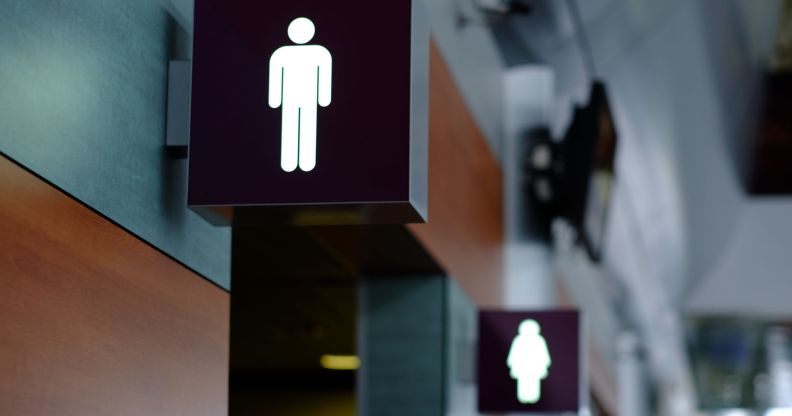
The EHRC guidance has been heavily criticised. (Getty)
Recent guidance on the rights of trans people to access single-sex spaces in the UK has been heavily criticised, leaving many people deeply concerned about what it means, and wondering whether it negates the protections offered by the Equality Act 2010.
Amid all of the online chatter and expressions of concern, it can sometimes be hard to get clarity, so we’ve taken a close look at the guidance and produced this guide to help you better understand it.
The non-statutory guidance, issued by the Equality and Human Rights Commission (EHRC) on Saturday (25 April), attempts to provide information about how single-sex spaces should be accessed in public.
The EHRC guidance comes in response to an 88-page UK Supreme Court decision issued on 16 April, in which it ruled that the legal definition of a woman in the 2010 Equality Act refers to “biological” women only, therefore excluding transgender women.

The EHRC, which has previously come under fire for its guidance on the rights of trans people since the appointment of Baroness Kishwer Falkner as chairperson in 2020, wrote that it aimed to “provide further clarity” with the updated guidance.
But its recommendations, which are used to justify statutory and non-statutory policies, have been heavily condemned by experts who argue they have been “rushed” and “ill-thought through.”
Here is an overview of the main points in the EHRC’s updated guidance on single-sex spaces.
EHRC says trans people should be banned from all gendered bathrooms
The biggest takeaway from the EHRC’s updated guidance is that it recommends public businesses and buildings forbid trans women from using the women’s facilities and trans men from using the men’s facilities.
However, the guidance also adds that, in “some circumstances,” trans women should also be banned from the men’s facilities and trans men from women’s facilities.
This means that, under EHRC’s guidance, trans people are not allowed to go into any gendered toilets whatsoever: only unisex facilities.
Several experts have branded these recommendations as “segregation” and blatant discrimination since, if gender-neutral toilets are unavailable or out of order, trans people will simply not be able to go to the bathroom.
Businesses could face ‘indirect sex discrimination’ charges for only having gender-neutral toilets
In its section on providing gender-neutral toilets, the EHRC argues that services are not explicitly required to provide single-sex spaces and can instead use what it calls “mixed-sex” facilities.
However, it goes on to argue that it could be considered “indirect sex discrimination against women” to only provide gender-neutral facilities.
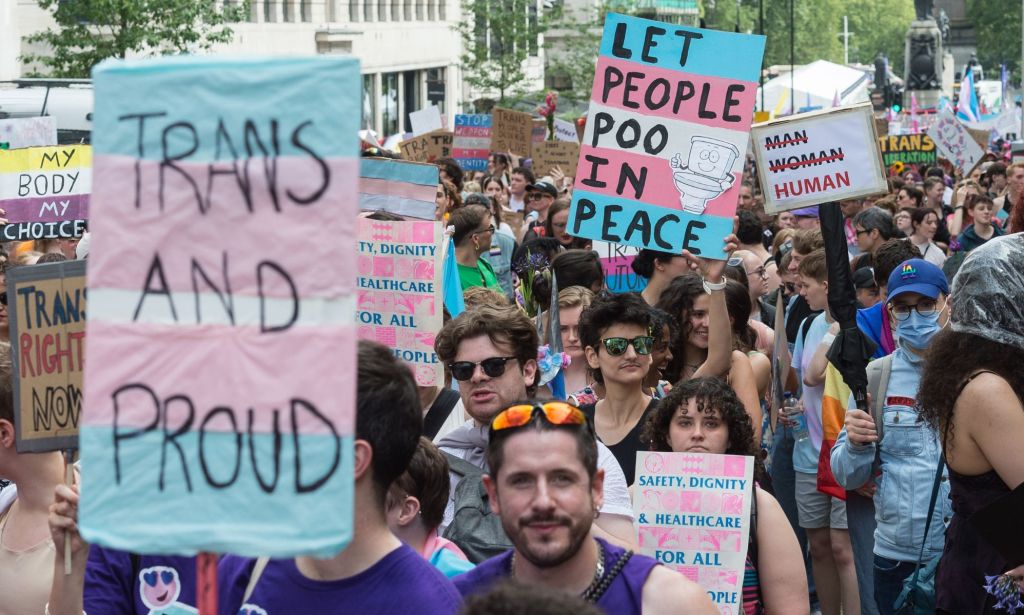
This means that certain spaces, such as gyms, swimming pools, or venues, could be forced to make their changing rooms or toilets single-sex. This could also disproportionately affect LGBTQ+ clubs and venues, many of which have gender-neutral facilities as standard.
The guidance also states that it is not vital to provide gender-neutral facilities at all, which, as unisex toilets are the only ones that trans people appear to be “permitted” to access under the guidance, essentially means that the EHRC don’t consider that it is essential to provide trans people with bathroom access.
EHRC to address single-sex sporting competitions ‘in due course’
While commenting on the provision of single-sex spaces in sporting venues such as changing rooms or bathrooms, the EHRC did not comment on trans people entering gendered sporting competitions.
It said in the guidance that there are “rules” for competitive sports that are single-sex, but that it intends to address those rules “in due course.”
Given Falkner’s and the EHRC’s previous comments on trans participation in sports, its like the advisory body will recommend the exclusion of trans women from female competitive sports.
EHRC guidance is not law
It’s important to remember that, while the EHRC’s guidance is concerning and should be criticised, it is not law and is not legally enforceable. The Equality Act 2010 still applies: and protects trans people from discrimination.
TransActual have an excellent guide to the wide-ranging protections afforded by the Equality Act 2010 here.
In its guidance, the EHRC begins by saying that employers should “follow the law,” however there is no currently legal obligation to exclude trans people from single-sex spaces.
However, the EHRC recommendations could be used as a justification for any future legislation that makes its way through the Commons, which prime minister Keir Starmer and health secretary Wes Streeting have both voiced their respective support for.