
Barrister explains why trans Supreme Court ruling violates European Convention on Human Rights
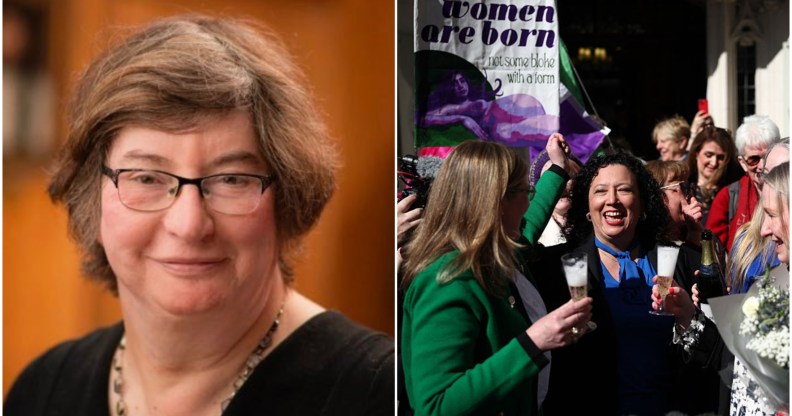
(L) Robin Moira White (R) Susan Smith (L) and Marion Calder (3R), Directors of For Women Scotland, celebrate with Maya Forstater of ‘Sex Matters’ outside Britain’s Supreme Court in London on April 16, 2025, following the court’s ruling on how to define a ‘woman’. (X/Getty)
Robin Moira White, a leading discrimination and employment law barrister, has appeared on the BBC Woman’s Hour radio show to discuss the implications of the recent Supreme Court ruling on the definition of a woman.
Last month, following a two-day hearing in London, an 88-page judgement by the UK Supreme Court’s justices was delivered.
“The unanimous decision of this court is that the terms woman and sex in the Equality Act 2010 refer to a biological woman and biological sex,” Supreme Court judge Lord Hodge said in the landmark case.
The case was brought forward on appeal by gender-critical group For Women Scotland (FWS) – which has reportedly been supported by author JK Rowling – against the Scottish government.
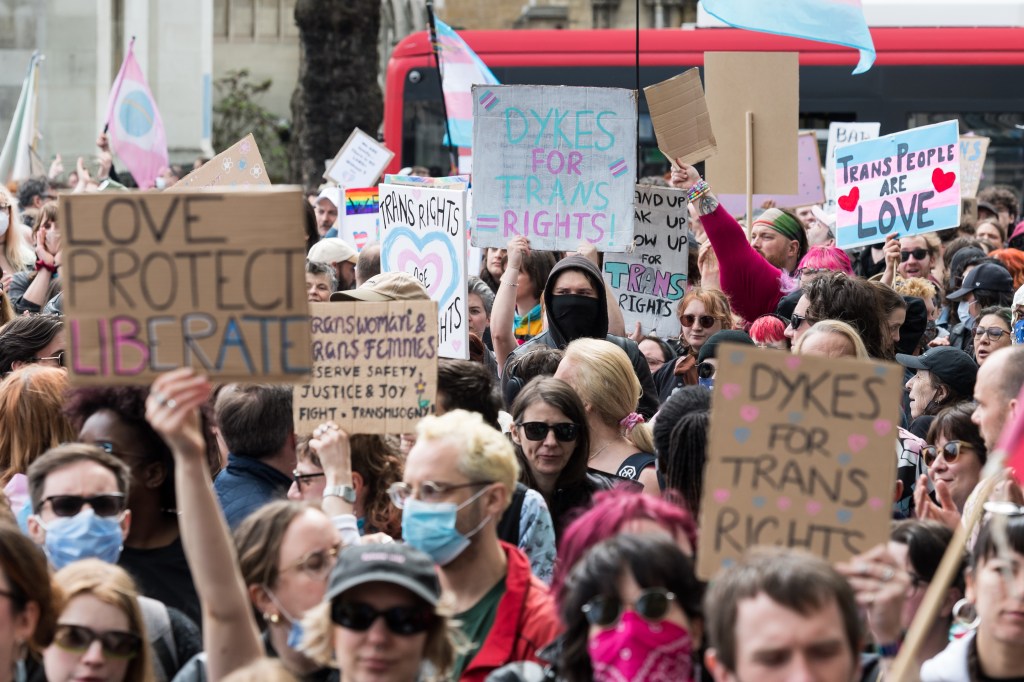
In essence, the ruling found that trans women are excluded from the legal definition of a “woman” for the purposes of the Equality Act 2010, a decision that has dismayed trans activists and allies.
Appearing on the BBC’s flagship Woman’s Hour radio programme on Monday (12 April), barrister Robin Moira White, who is a trans woman, gave her expert opinion on the verdict, and why she doesn’t think it will stand up to planned challenges in the European Court of Human Rights.
Speaking to presenter Nuala McGovern, White explained: “I don’t think the ruling will survive a trip to the European Court of Human Rights in Strasbourg… we didn’t have the Gender Recognition Act out of the goodwill of some government, we had it because the European Court, under the convention that we wrote and signed up to in 1951, told the UK it had to have an effective method of acknowledging people’s change of gender.”
Despite Brexit, the UK is still subject to the European Convention on Human Rights (ECHR). All 47 member states of the Council of Europe, including the UK, have signed it. Its full title is the “Convention for the Protection of Human Rights and Fundamental Freedoms” and it protects a vast array of individuals’ rights.
When pressed by McGovern about on what grounds the ECHR could overrule the judgement, White replied: “If you are trans, that acknowledgement of your changed gender has to let you live appropriately and with dignity, and if you go to the cinema or supermarket and you are forced to use facilities that are not appropriate to your gender then… your rights to privacy are compromised and your rights to live in dignity are compromised.”
“Unholy rush”

Giving an example of how a person’s right to privacy could be compromised by both the Supreme Court ruling and the subsequent, quickly released and widely-criticised guidance on single-sex spaces by the UK Equality and Human Rights commission, White said: “I this week was talking about a trans woman who for 20 years has worked in a financial institution, and is not known to be trans other than to her employers and her employers are trying to decide whether they have to tell her to go and use the male facilities.”
She added: “There’s been a somewhat unholy rush to exclude trans people from facilities, to take the Supreme Court’s judgement to mean rather more than it does, and the EHRC’s interim statement has been widely criticised by discrimination lawyers for being part of that unholy rush.”
“Their rights are not being respected”

When pressed about why being made to use non-affirming facilities was detrimental to trans people’s dignity, White explained: “If you specifically rejected your birth gender and you’re forced into facilities that reflect that, that is devastating for someone who has made those choices… and their rights are not being respected.”
One solution that Robin Moira White put forward was offering up spaces with additional privacy for people who are “disaffected” by the idea that “there might be a trans person” using a single-sex space.
She said: “One of the areas that I practice in is religious discrimination and some people from certain religions are very keen on the sex differences and maintaining (the) and the way you accommodate those needs are by providing additional privacy for those people who need it, not forcing particular groups into that additional privacy… then (people who don’t want to encounter a trans person) can use the additional private facilities.”
At the end of the interview, White confirmed that multiple trans people are already preparing to apply to the European Court of Human Rights, including transgender judge Victoria McCloud.
You can listen to the full episode of Woman’s Hour here.