
Labour’s leaked Women’s Conference plans condemned as an ‘attempt to isolate trans people’

(Leon Neal/Getty Images)
Leaked Labour documents which show the party is planning to postpone its women’s conference and limit positive action provisions to ‘biological women’, following the Supreme Court’s gender ruling, have been condemned as a “blatant attack” and “attempt to isolate” trans people by LGBT+ groups within the party.
Confidential advice sent to members of the National Executive Committee (NEC) – the party’s governing body which includes leader Keir Starmer and chair Ellie Reeves – ahead of a vote on Tuesday (20 May) was leaked online and has been widely shared on social media.
The papers lay out two options for how the NEC should vote, with the committee urged to postpone the women’s conference and vote in favour of interpreting Labour party rules and procedures as “on the basis of biological sex at birth”.
In April, the UK’s Supreme Court ruled in the case of For Women Scotland Ltd v The Scottish Ministers about how the protected characteristic of ‘sex’ is defined and applied in the 2010 Equality Act. The court’s justices decided the definition is a ‘biological’ one – despite the word biology not appearing in the Equality Act – and stated it explicitly excludes trans people.
The decision is expected to have wide-ranging implications for the trans community, as well as organisations, public bodies and services who may be forced to update their policies on single-sex spaces, inclusion and discrimination. Some, including the Football Association, England and Wales Cricket Board and Scottish Parliament have already taken steps to bar trans women from female spaces.
In the wake of the ruling, the Equality and Human Rights Commission (EHRC) – the UK’s equalities watchdog – issued interim guidance stating trans people should be banned from using single-sex facilities which match their gender and, in some cases, should also be barred from using those which match their ‘biological sex’.

In the documents, the NEC is urged to vote in favour of postponing the National Women’s Conference because it would be at “significant risk of a legal challenge” following the judgement if it were to go ahead – as it had in the past – on the basis of self-ID, adding given the “proximity” to the ruling it may result in “protests, direct action and heightened security risks”.
“This would also represent a political risk which would be likely to feature prominently throughout conference week,” the document also reads.
The leaked papers went on to warn that Labour would face “significant risk of direct and indirect discrimination claims succeeding” if it continues to use positive action measures such as the National Labour Women’s Committee and women officer roles based on self-identification.
The NEC is urged in the documents to vote in favour of using a biological definition of ‘sex’ to “mitigate the risk of legal challenge” going forward.
“Pending a wider review, all positive action measures relating to women in the Party’s rules and procedures shall be interpreted on the basis of biological sex at birth. Guidance shall be issued to all Party units and relevant stakeholders to this effect,” the document reads. “The Party will work with individuals and local parties affected by the judgment to resolve specific cases with sensitivity and compassion, acknowledging the significant effect the judgment will have had on many people.”
Further to this, it is recommended to the NEC that the women’s conference is postponed in “light of the legal and political risks” because “the only legally defensible alternative would be to restrict attendance to delegates who were biologically women at birth (including trans men)”.
“Equality and positive action is all about increasing diversity”
In response, in a joint statement issued by LGBT+ Labour’s trans officer Georgia Meadows, Labour for Trans Rights and Pride in Labour the content of the leaked proposals was condemned “unreservedly”.
They said the proposals are “not effective ways to ‘clarify’ anything” and will “restrict trans members’ engagement in internal democratic procedures”.
“We would also question whether the exclusion of trans women from Women’s Conference is a proportionate means to achieve a legitimate aim, as trans issues have come up time and time again during the conference, this seems to completely remove trans people from that debate,” the statement reads.
“It is a blatant attack on trans rights and is seemingly an attempt to isolate trans people even further within the Labour Party and the labour movement more widely.”
Calling on NEC members to vote the paper down, the group continued: “Trans people are already greatly underrepresented in British politics, and if passed, this decision by the NEC will further harm trans people’s ability to engage with the democratic process and make them feel unwelcome at a time when the trans community is increasingly under attack.
“Equality and positive action is all about increasing diversity, access and fairness in public spaces. There are no trans or gender non-conforming MPs, and our community is underrepresented both in the Labour Party and across devolved and local governments.”
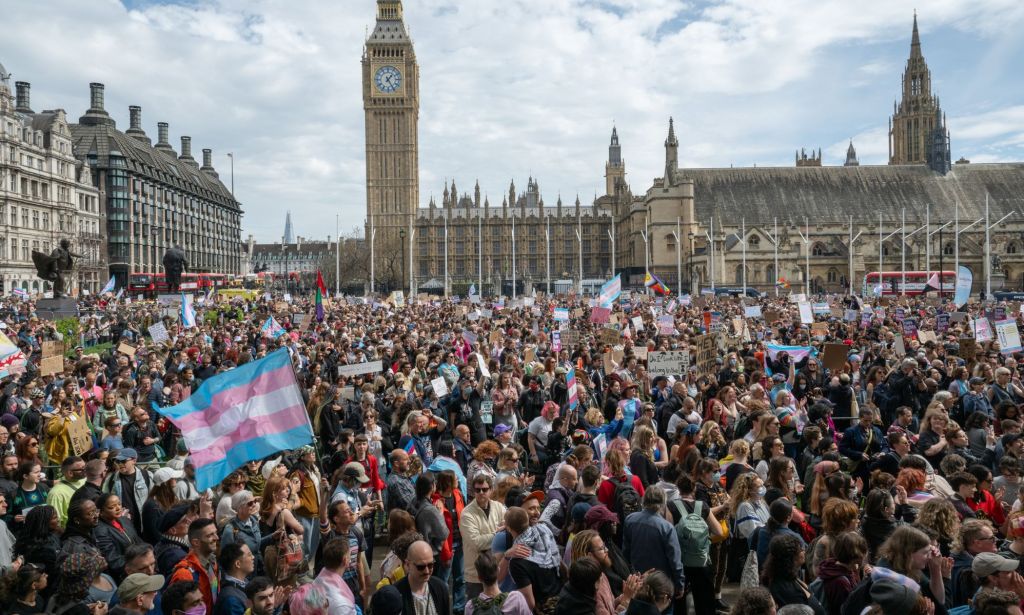
In their own statement, gender critical Labour organisation Labour Women’s Declaration labelled the decision to potentially postpone the women’s conference a “knee jerk reaction” and warned against “incendiary action as cancelling the single major policy-making conference of the party which focuses on issues affecting women”.
A spokesperson for the the group said: “We are shocked that hundreds of women in the Labour Party might be prevented from meeting at conference because the NEC would prefer to disadvantage all women rather than to exclude the very small number of trans-identified men who may wish to attend the women’s conference.
“The party should not act in fear of threats and demonstrations. We have held fringe meetings for years, often in the teeth of violent threats from trans activists, which we have managed carefully and kept everyone safe.
“It would be exceptionally disappointing if our Party, which strives to be a grown-up and serious political force, and a strong government, could not find the courage to run this conference as planned and run it in accordance with law which was introduced under a Labour government. Women deserve better.”
PinkNews contacted Labour for comment.
It is understood the Labour Party respects the Supreme Court’s judgment and will comply with statutory guidance once published. Ministers will also consider the EHRC Code of Practice when a draft is submitted following its consultation on changes.
What is the EHRC consultation?
Following the Supreme Court ruling and as part of its interim guidance, the EHRC said it aimed to provide an updated version of its Code of Practice – which will “support service providers, public bodies and associations to understand their duties under the Equality Act and put them into practice” – to the UK Government by the end of June.
The equalities watchdog said it would be reviewing sections of the Code to incorporate the Supreme Court’s judgment and ensure it is in-line with its guidance.
“We are currently reviewing sections of the draft Code of Practice which need updating. We will shortly undertake a public consultation to understand how the practical implications of this judgment may be best reflected in the updated guidance,” the EHRC said.
“The Supreme Court made the legal position clear, so we will not be seeking views on those legal aspects.”
Originally, the consultation was scheduled for just two weeks but following criticism from from the Women and Equalities Committee and trans groups it was extended to six weeks.
The EHRC said the changes were made “in light of the level of public interest, as well as representations from stakeholders in Parliament and civil society” and the consultation will now launch 19 May and conclude on 30 June.