
UK parliament announces trans toilet ban at Westminster

Westminster has changed its toilet policy (Canva)
A ban on trans people using the toilets at the Palace of Westminster that align with their gender has come into effect.
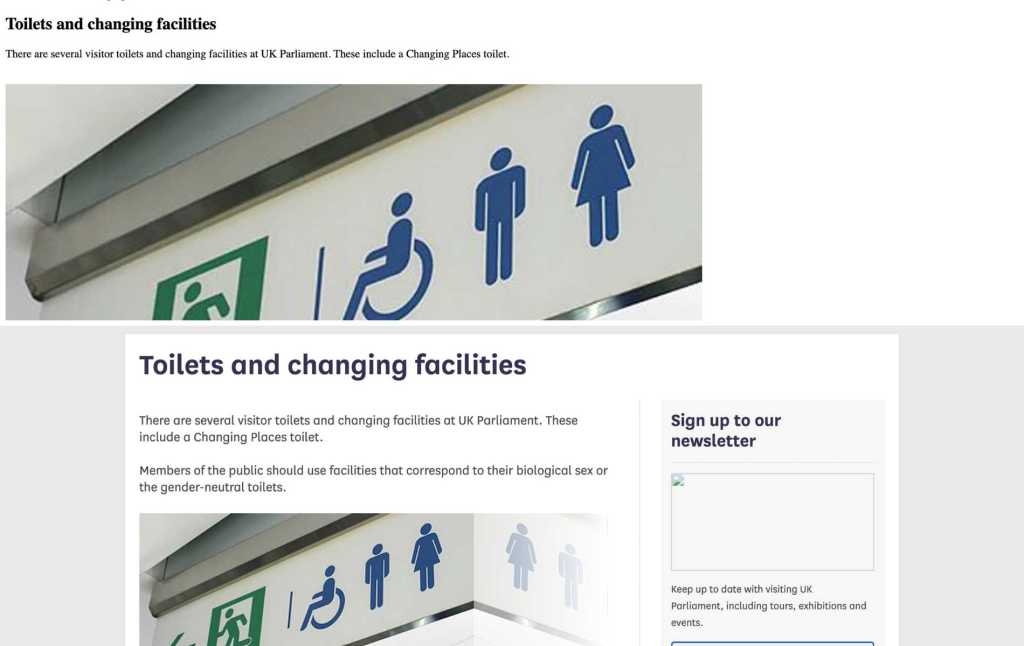
The UK parliament’s official website states: “Members of the public should use facilities that correspond to their biological sex or the gender-neutral toilets.” The rule covers both the House of Commons and the House of Lords, as well as Portcullis House which provides Westminster offices for MPs and their staff.
As recently as Saturday (21 June), the same page of did not include reference to who should use what facility based on “biological sex”, an archived web page shows.
A House of Commons spokesperson told PinkNews: “The House of Commons remains in compliance with the law as set out in the Supreme Court judgement. The current guidance is to ensure there is proper clarity for visitors to the Estate.
“Parliament is subject to the provision of services elements of the Equality Act 2010.
“The Supreme Court judgment deals directly with interpretation of that Act and one consequence of that judgment is that visitors are expected to use facilities which correspond to their biological sex, or use one of the gender-neutral facilities that are available.
“In complying with the law we are also keen to ensure that all visitors are treated inclusively and with respect.”
The Westminster update follows a similar move at Holyrood in Scotland, and comes in the wake of the Supreme Court ruling about how the protected characteristic of “sex” is defined and applied in the 2010 Equality Act.
The court handed down an 88-page judgement, decreeing that the words “sex” and “woman” referred to “biological sex” and “biological women”, thus excluding transgender people.
The Equality and Human Rights Commission (EHRC) responded by issuing interim guidance which called for access to single-sex spaces to be based on biology, meaning a trans woman is not allowed to use a female toilet, and a trans man cannot enter a male one.
The guidance added that in “some circumstances” trans women should also be banned from the men’s facilities, and trans men from women’s. This was later clarified to mean when a trans woman or man presents as their gender too well, such as a transgender woman appearing too feminine, they can be barred from facilities because “reasonable objection might be taken” to their presence.
Several organisations, bodies and service providers have already taken steps to ban trans people from single-sex spaces.
The change at Holyrood was branded “rushed” and “unworkable” by advocacy group Scottish Trans who claimed it would “exclude trans people from participating in Scottish democracy, whether as staff or as visitors to the parliament”.
Following the criticism, Christine Grahame, the MSP for Midlothian South, Tweeddale and Lauderdale, promised, on behalf of the cross-party Scottish Parliamentary Corporate Body, that Holyrood facilities would not be gender-policed and no one would be expected to show ID or a birth certificate to use toilets there.
The change in Westminster comes just a week after a trans barrister was questioned over her toilet use at Portcullis House.
After using the female toilets, Robin Moira White was questioned by gender-critical campaigners Kate Harris and Heather Binning.
Harris is the co-founder of LGB Alliance, and Binning is a director at Women’s Rights Network.
All three were attending a Women and Equalities Committee hearing, during which EHRC chairwoman Baroness Kishwer Falkner was giving evidence about the work of the UK equality watchdog.
Advocacy organisation TransLucent, of which White is a member, claimed she had been “effectively ambushed” by Harris and Binning and “and an ugly altercation took place”.
A spokesperson went on to say: “A manager was called by security staff, who informed the members of the [gender-critical movement] that within parliament, transgender and transsexual people were able to use toilets according to their gender. The members of the [gender-critical movement] were then escorted from the area.”
Harris was quoted by The Times as saying: “We were in the mother of all parliaments and it was not adhering to the law. It was not the fault of staff, who clearly have not been trained in how to deal with these issues.”
The House of Commons later issued an apology to Harris and Binning.
Share your thoughts! Let us know in the comments below, and remember to keep the conversation respectful.