
Scottish government reviewing trans toilet policy after fresh legal threat
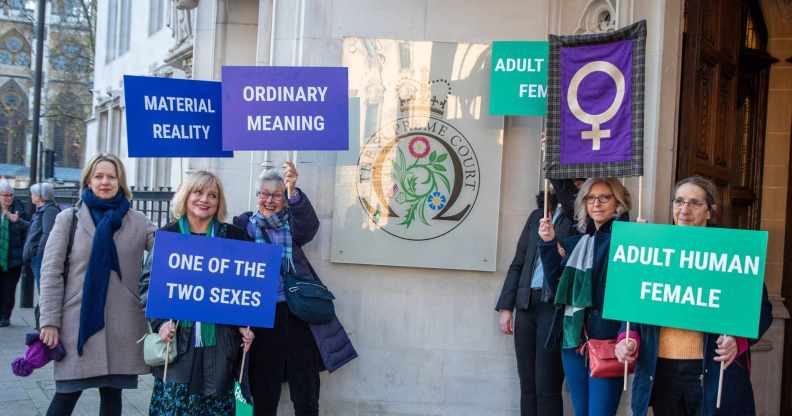
Members of Sex Matters outside the Supreme Court (Krisztian Elek/SOPA Images/LightRocket via Getty Images)
The Scottish government is reviewing its trans and non-binary inclusion policy following a new threat of legal action by gender-critical group Sex Matters.
In April, the UK’s most-senior judges ruled that the legal definition of the protected characteristic of “sex” in the 2010 Equality Act was based on “biology” and thus did not include transgender people.
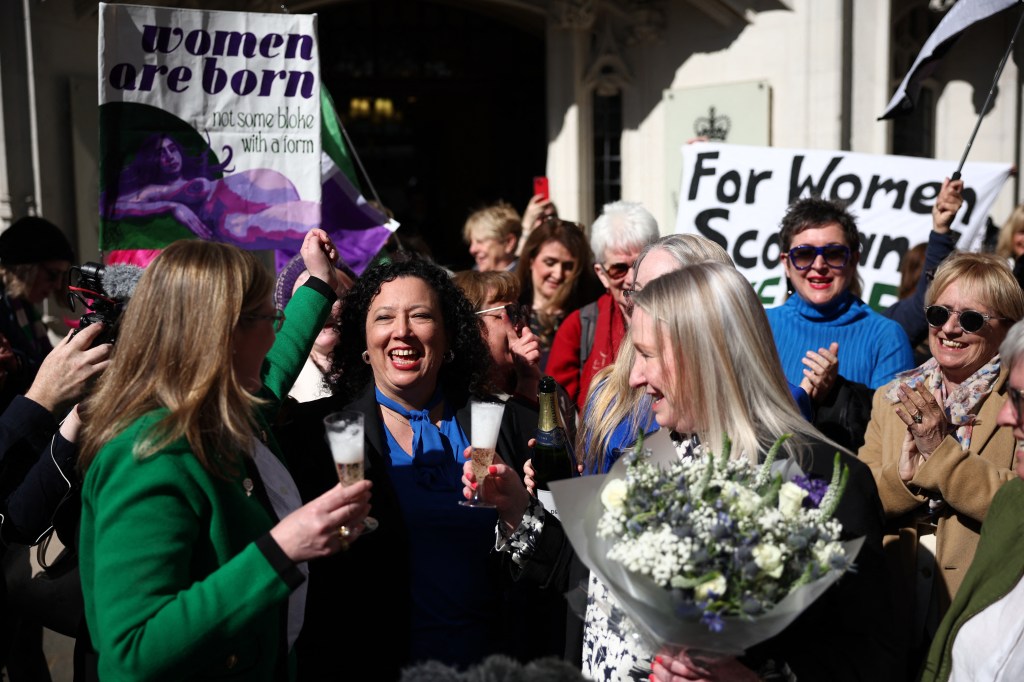
For Women Scotland Ltd vs Scottish Ministers was the conclusion of years of legal jousting. It is expected to have wide-ranging implications for the trans community, as well as organisations, public bodies and services who are likely to be forced to update policies on single-sex spaces, inclusion and discrimination.
Several organisations have already taken steps to exclude trans people from single-sex spaces and services, including the Football Association, the England and Wales Cricket Board and the Scottish parliament building.
In May, the Scottish Parliamentary Corporate Body, which oversees accommodation at Holyrood, decided that use of “all facilities designated as male or female” would be based on biological sex “in line with the Supreme Court judgement”.
The move was branded “rushed” and “unworkable” by members of Scottish Trans who also claimed it would “exclude trans people from participating in Scottish democracy, whether as staff or as visitors to the parliament”.
In a letter sent to Sex Matters on 27 June, the director of equality, inclusion and human rights at the Scottish government, John Sommers, said: ”We are now taking action to implement the ruling. This includes the establishment of a working group to review existing policies, guidance and legislation which may be impacted by the judgement.
“The work of this group is underway and covers all relevant portfolios across government. This work is enabling us towards a state of readiness to take all necessary steps to implement the ruling.”
The Scottish government had made it clear that all public bodies should satisfy themselves that they were compliant with the law, he added.
“We have encouraged them to undertake their own review relevant to their organisation and services in order to help inform any necessary practical steps required.”
The Scottish government’s Trans and Non-Binary Equality and Inclusion Policy declares that transgender staff should “choose to use the facilities they feel most comfortable with, including using accessible toilets if they prefer”.
The government was also committed to providing “access to gender-neutral facilities in all [its] buildings”, to best support trans and non-binary members.
Sommers’ letter was in response to Sex Matters saying on 17 June that members had attended a stakeholder meeting on 5 June with Catherine McMeekan, the Scottishg government’s deputy director for equalities.
During the meeting, McMeekan allegedly said the chief executive of the Equality and Human Rights Commission (EHRC), John Kirkpatrick, told her the Scottish government did not need to take action on the Supreme Court ruling until the equality watchdog’s statutory guidance had been updated.
Following the Supreme Court ruling, the EHRC issued interim guidance which called for access to single-sex spaces to be based on biology, meaning a transgender woman would not be allowed to use a female toilet and a trans man could not enter a male one.
In “some circumstances”, trans women should also be banned from the men’s facilities, and transgender men from women’s.
This was later clarified to mean that when a trans woman or trans man presented in an obviously feminine or masculine way, “reasonable objection might be taken” to their presence in a single-sex facility.
The EHRC promised to provide an updated version of its Code of Practice to the UK government by the end of June, to incorporate the Supreme Court judgement and “support service providers, public bodies and associations to understand their duties under the Equality Act and put them into practice”.
Initially a public consultation period was set to last for just two weeks, but it was extended to six after pressure from the parliamentary Women and Equalities Committee and trans groups, who criticised the limitations of the original timeframe.
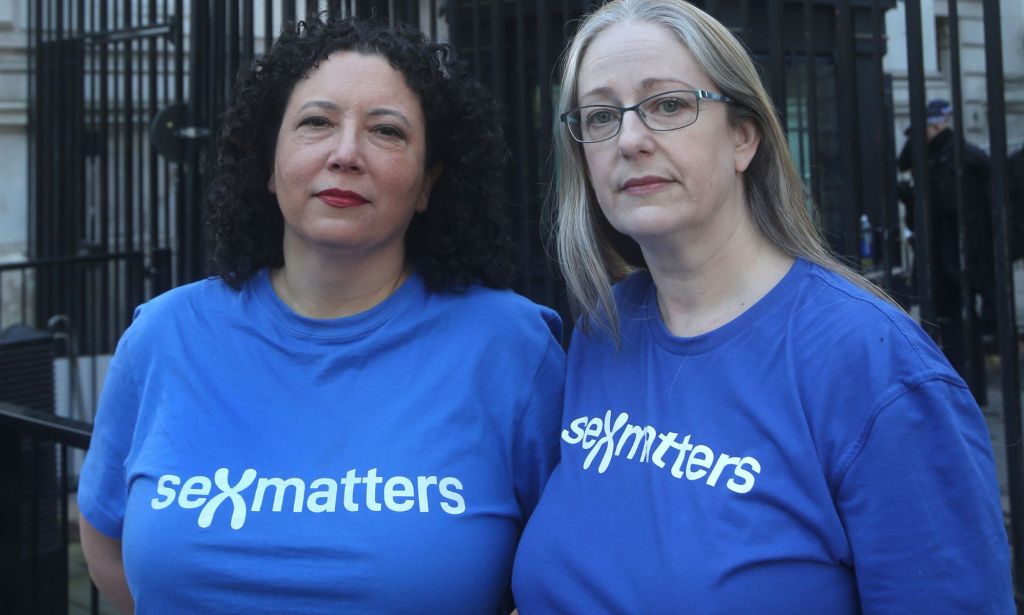
Referring to McMeekan’s belief that the Scottish government could wait for this update before taking action, Sex Matters founder Maya Forstater wrote to Sommers, claiming: “That advice is incorrect… [and] unlawful.
“We write to ask you to confirm that you will implement the decision of the Supreme Court, in full, and without delay. In the absence of such confirmation, we reserve the right to commence legal proceedings,” Forstater added.
According to a Freedom of Information request cited by Sex Matters in a second letter, sent on 2 July, there are 1,016 toilet facilities in 66 sites owned or leased by Scottish government.
“As far as we can see there is nothing to stop the Scottish government immediately bringing the policy on toilets into line with the law, by making a statement that all facilities designated as male or female within the Scottish government estate are to be interpreted as meaning biological sex, and that gender-neutral options are widely available,” Forstater wrote.
“This would be in line with the Supreme Court judgement and the action taken by the Scottish parliament. It is clearly a reasonably practical step in order to address the risk of individuals using opposite-sex toilets and other facilities.”
If the Scottish government “does not immediately stop the unlawful practices set out in this letter” Sex Matters “may decide to commence proceedings without further warning.”

In May, a group of trans women staged a topless protest outside Holyrood to condemn the court ruling and the Scottish government’s response to it.
One protester, Sugar, said the ruling was “not just a setback of humanitarian rights, it’s an act of erasure”, adding: “It sends a saddening message that trans people’s fears, dignity and lives do not matter in the eyes of the Supreme Court. Trans voices were ignored in that decision.
“This kind of judicial disregard sets a dangerous precedent for the erosion of democracy, and a descent into fascism.
“We ask Scottish ministers: why have you rolled over? Why are you no longer standing up for one of the most socially marginalised communities in the developed world? This is still a Scottish issue. We urge you to use every available avenue to stand up and fight for trans people.”
Share your thoughts! Let us know in the comments below, and remember to keep the conversation respectful.