
UK’s first out trans judge to seek rehearing of Supreme Court case
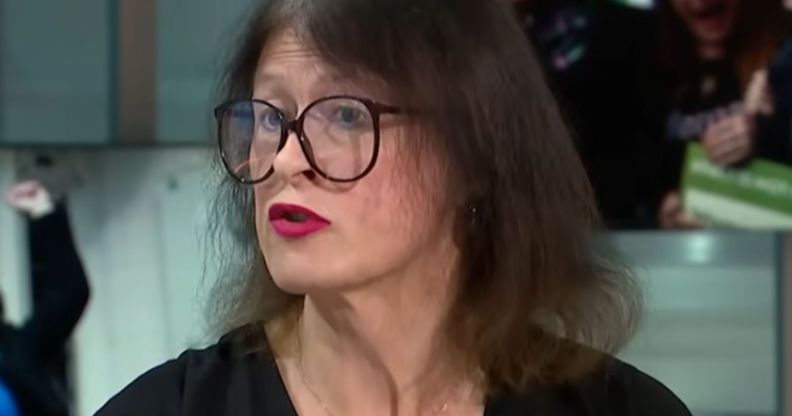
British lawyer and former judge Victoria McCloud topped The Independent Pride List 2025. (Screenshot/YouTube)
The UK’s first out trans judge has started the process of taking the British government to the European Court of Human Rights over the controversial Supreme Court ruled legal definition of ‘sex’ only applies to “biological women”.
Victoria McCloud, who retired in 2024 and is now a litigation strategist at W-Legal, is seeking a rehearing of the Supreme Court case, saying her Article 6 rights to a fair trial under the European Convention on Human Rights (ECHR) were undermined when the court refused to hear representation from her or speak to any single trans person.
The judgement, that was handed down in April, was the conclusion of a years long battle between gender-critical group For Women Scotland and the Scottish government in which court’s justices decided the “terms woman and sex in the Equality Act 2010 refer to a biological woman and biological sex”, therefore specifically excluding trans women.
Whilst gender-critical and anti-trans groups and activists claimed the ruling was a victory for women, human rights and LGBTQ+ organisations and campaigners warned the ruling would see trans people pushed out of public life and society.

In the months since the ruling, the Equality and Human Rights Commission issued draft guidance to bar trans people from single-sex spaces, facilities and services which match their gender. Leaked documents suggest the final version of the guidelines will be not too dissimilar and several organisations have already taken steps to exclude trans people including the Football Association, the England and Wales Cricket Board and the Scottish parliament building.
‘No more conversations about us, without us’
McCloud, who is supported by Trans Legal Clinic and W-Legal, said the application was brought under Articles 8 and 14 of the ECHR, alongside Article 6.
She said these are “the rights to respect for who I am, my family, my human existence, my right to a fair trial in matters determining my own freedoms and obligations without discrimination”.
“No representation or evidence had been included from us in the 8,500 group [the estimated UK population of people with GRCs who are diagnosed as transsexual]. I was refused. The court gave no reasoning,” McCloud said, as quoted by The Guardian.

“The court reversed my and 8,500 other people’s sex for the whole of equality law … We are now two sexes at once. We are told we must use dangerous spaces such as male changing rooms and loos when we have female anatomy. If we are raped we must go to male rape crisis. We are searched by male police, to ‘protect’ female police from, I assume, our female anatomy.”
A spokesperson for the Trans Legal Clinic said the legal action “embodies a simple truth: there must be no more conversations about us, without us”.
“At its heart lies the principle in Article 6 of the European Convention on Human Rights; the right to a fair and impartial hearing by an independent tribunal. This cornerstone of democratic societies exists to guarantee that those whose rights are affected can take part in proceedings that determine their future,” the legal group said.
“The Trans Legal Clinic has established a community crowdfunding campaign at www.translegalclinic.com/mccloudto help meet the costs of the case.
“The initiative is intended to enable members of the public to contribute directly to the proceedings, reflecting the collective interest and engagement in the issues at stake.”
Back in June, McCloud asked international not-for-profit organisations Genocide Watch and The Lemkin Institute to review attacks on trans rights in the UK.
She said it was her “sad duty” to ask the groups to confront “the systematic oppression of the trans community of the UK” during her keynote speech at Pride In London’s Human Rights Forum.
“We in the UK face bathroom bans, violence, abuse, deliberate social exclusion, strip searches of trans women by male police, and calls to photograph us in toilets and other spaces,” she said.
McCloud’s case also comes as For Women Scotland announced they are once against taking legal action against the Scottish government, this time over trans inclusive policies which they claim are “in clear breach of the law”.