
Queer US couples fear for equal marriage: ‘We don’t know what the future holds’

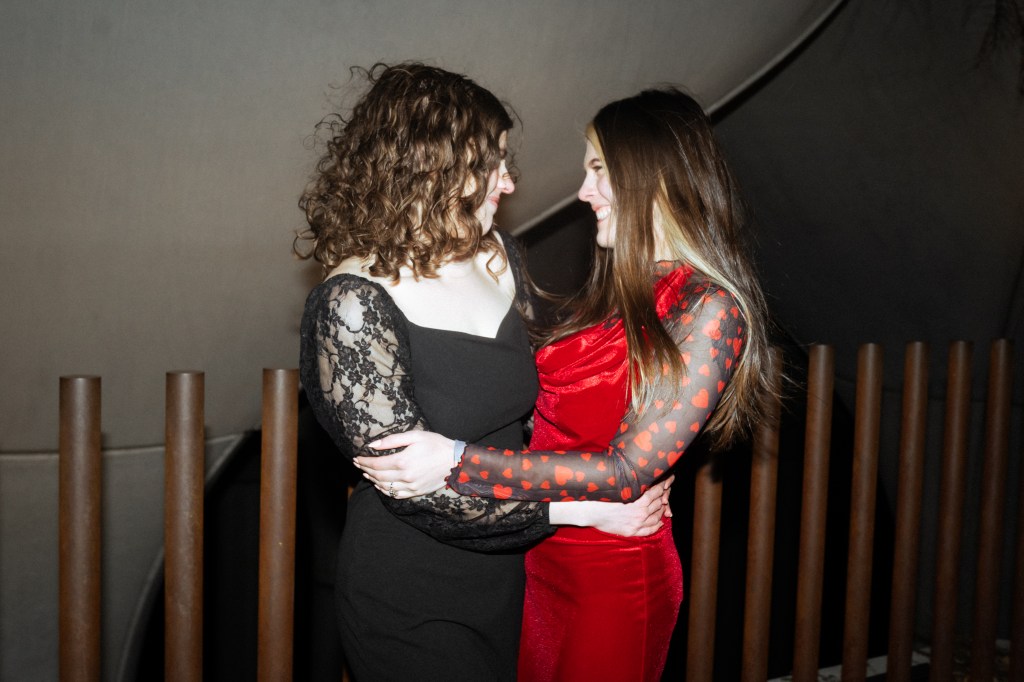
Kat Tenbarge and her partner Anna are getting married in 2026 (Kat Tenbarge)
Last Christmas, Kat Tenbarge and fiancée Anna Iovine were deciding where to get married. But, despite all the excitement that comes with picking a venue and planning the big day, worrying questions about the incoming Trump administration and what might happen regarding marriage equality were already looming large.
The couple, who live in New York, decided to hold the ceremony at an art museum in Cincinnati, Ohio next year because it was close to Tenbarge’s grandparents, who are elderly and unable to travel easily, and more affordable than in the Big Apple.
Tenbarge, an independent journalist who runs the newsletter Spitfire News, told PinkNews that she and Iovine had jokingly discussed that even if same-sex marriage legislation was reversed, they would “still be able to have a party” and then – hopefully – still obtain a marriage licence in New York even if they could not get one in Ohio. The Empire state being one of the few which had legalised same-sex marriage prior to the Supreme Court’s landmark decision in 2015.
Whether or not same-sex marriage will remain legal across the board is a fear that many couples are currently facing.
Research published last year showed that almost 80 per cent of married same-sex couples were either “very” (40.9 per cent) or “somewhat” (38.4 per cent) worried about the landmark ruling in Obergefell vs Hodges being overturned.
Speaking to KMTV, Ellie Nelson and her wife Alecks, who met at university, married in 2024 and described the potential of the law being reversed as frustrating.
“I don’t know if I have hope that [the Supreme Court] won’t take it on, and I know that if they do, what the decision’s gonna be,” Nelson said.
Gideon Levinson, who is planning a wedding to partner Jacob Rosenblum, told Scripps News that “no one feels like anything that has been decided will stay decided”.
He went on to say: “It feels like everything is up in the air. We don’t know what the future will hold even though something seemed set in stone so recently.”
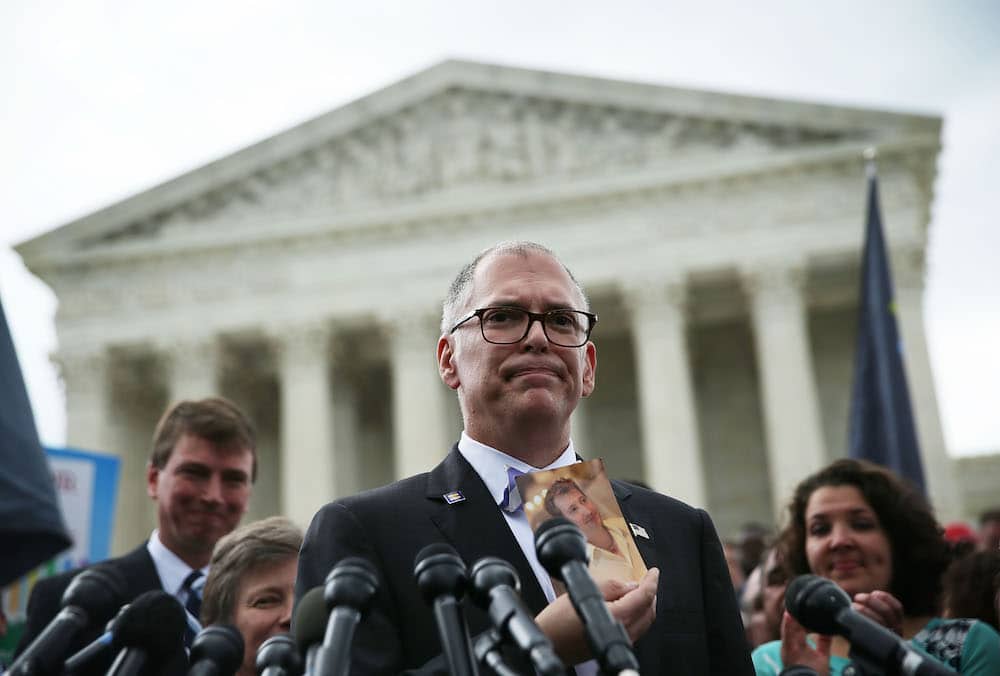
LGBTQ+ rights activist Jim Obergefell was the lead plaintiff in the landmark case and brought the action in 2013 after his home state of Ohio refused to recognise his union to terminally ill partner John Arthur. The couple had obtained a marriage license in Maryland, after the Free State began recognising same-sex marriage at the start of that year.
However, they were informed that despite having legal documentation of the marriage, Obergefell could not be listed on Arthur’s death certificate as his surviving because of Ohio’s ban on same-sex unions. The pair filed a lawsuit and a judge ruled in their favour. However, state officials lodged and won an appeal, forcing Obergefell to take the case up to the highest court in the US.
Prior to the Supreme Court ruling, same-sex marriage legislation had been decided on a state-by-state basis, some states had both legalised the recognition and performance of queer marriages before 2015 whilst others, like Ohio, had it banned outright.
The Supreme Court verdict, carried by five votes to four, ruled the bans were unconstitutional.
“They ask for equal dignity in the eyes of the law. The constitution grants them that right,” Anthony Kennedy, writing in the majority opinion at the time of the Supreme Court’s decision, said.
Little more than a decade on, married and unmarried queer couples are deeply worried about marriage equality after it was revealed that the justices could hear a case in which they were asked to overturn the law.
Former Kentucky county clerk Kim Davis, who refused to issue marriage licences to LGBTQ+ couples on religious grounds in 2015 and spent a short time in jail for doing so, is the driving force behind the latest moves. She is seeking $100,000 (£74,000) for emotional damages and $260,000 (now worth about £193,000) for lawyer’s fees after she was found guilty in 2022 of violating gay couples’ constitutional rights.
In a petition filed with the Supreme Court in July, her lawyer Mat Staver said: “Obergefell was egregiously wrong, deeply damaging, far outside the bound of any reasonable interpretation of the various constitutional provisions to which it vaguely pointed [and set out] on a collision course with the constitution from the day it was decided.
“This flawed opinion has produced disastrous results, leaving individuals like Davis find[ing] it increasingly difficult to participate in society without running [foul] of Obergefell and its effect on other anti-discrimination laws, and, until the court revisits its ‘creation of atextual constitutional rights,’ Obergefell will continue to have ruinous consequences for religious liberty.”
The legal petition highlights that the case “presents the ideal opportunity to revisit substantive due process that lacks any basis in the constitution”.
Research for the Williams Institute at the UCLA School of Law has shown that there are more than 800,000 same-sex married couples in the US today, double the number that existed 10 years ago.
Those most at risk of losing their marriage rights are couples who live in the 31 states that have dormant statutes and/or constitutional amendments in place that ban gay marriage but which were deemed unconstitutional by the Supreme Court verdict.
“It was one of those moments where I wasn’t surprised, really,” Tenbarge admitted about Davis’ potential case. “There’s not much that could surprise me at this point with the Trump administration and with fascism in this country but it definitely hit knowing that we are actively planning to get married.
“It’s sad on a number of levels but it also shows me that when you look at history from the perspective that you’re living through it right now, things can happen so quickly in both good directions and bad.
“I remember vividly in 2015 when gay marriage was made the law. It was right around my birthday, it was the year I graduated high school and it was right around when Cincinnati had its annual Pride celebration. It was such an incredible moment…. something amazing and historic to witness, and it felt really good as a queer teenager who envisioned getting married to another woman some day.
“Now, here we are a decade later. I would not have thought it possible at that time that we could see this shift happen so quickly.”
Tenbarge added that “everything started to change” when Donald Trump was elected president for the first time in 2016.
Since winning back the White House in January, Trump has signed a number of anti-LGBTQ+ executive order, while lawmakers in nine states had been trying to overturn the same-sex marriage ruling even before Davis lodged her appeal.
According to NBC News, Idaho, Michigan, Montana, North Dakota and South Dakota have all introduced measures explicitly seeking to reverse Obergefell vs Hodges. In addition, Missouri, Oklahoma, Tennessee and Texas have introduced legislation that, while no mention of the case is made, is aimed at creating “covenant marriage”, which would be only between one man and one woman.
It was for this reason that Levinson and Rosenblum decided to get married straight after the presidential election in November 2024, tying the knot in Colorado.
“Just knowing how much can change and how quickly, we were like… why take a legal gamble when we were already planning to get married,” Rosenblum said. “So, it was kind of a legal insurance policy to make sure that we exercise our right while we still had it.”
The changing tides are something Tenbarge is acutely aware of in her work as a journalist and she recalled being told by her grandmother to get a marriage licence in a pro-LGBTQ+ state as soon as possible.
“A lot of times, people don’t realise that progress really is three steps forward, four steps back, three steps forward, four steps back, or hopefully you make little incremental changes. But there’s always that push back.
“Now that we’ve lived through this push back so many times, and that I’ve covered it so much as a journalist, it no longer surprises me, it just saddens me. I think back to how optimistic I was as a teenager, living through [president Barack] Obama’s two terms, seeing all this progressivism, seeing all this hope and feeling we were making these massive, historic gains.
“But, now to see it go in the other direction, I really feel for teenagers who are beginning to explore their identity, coming to terms with their queerness, with their sexuality, with their gender identity, and not necessarily having that same sense of optimism.”

If the legislation was to be reversed, the power to decide whether or not to recognise unions would return to individual states, similar to what happened following the reversal of the landmark abortion case of Roe vs Wade in 2022.
Since that decision, a number of Republican-controlled states have enacted laws severely restricting access to abortion.
Despite the justifiable concerns regarding gay marriage, many legal experts believe the Davis case will go nowhere and even if it did, there are still many protections in place.
While a number of states could seek to halt same-sex weddings within their borders, the Respect for Marriage Act – signed into law by Joe Biden in 2022 – requires that “interracial and same-sex marriage must be recognised as legal in every state in the nation”. In essence, if one state was to outlaw performing weddings, it would still have to recognise those held where they were legal.
“Not a single judge on the US Court of Appeals showed any interest in Davis’ rehearing petition, and we are confident the Supreme Court will likewise agree that [her] arguments do not merit further attention,” William Powell, the lawyer for David Ermold and David Moore – the couple to whom Davis refused to issue a marriage licence – told ABC News.
Fellow lawyer Robbie Kaplan, who argued for LGBTQ+ rights in front of the Supreme Court in 2013, told Axios that overturning the legislation was “not just a recipe for administrative chaos [but] would result in an almost-indescribable amount of (needless) suffering and heartache”.
Regardless of whether the Supreme Court hears the case or not, even discussions about overturning the ruling has led Tenbarge to feel “called to be more visible in my identity”.
“When I think back to being a queer teenager, it was almost oversaturated, the amount of Pride [content], to the point where I was like if I were to get married, I wouldn’t want any rainbow iconography because it’s not necessary.
“Today, I feel differently, which is not [to say] that I want my wedding to be rainbow-themed but more that I want to talk about it and show it because I feel that visibility is critical for younger people.
“As I’ve been building out my platform as a journalist, I want to remind people that I can pass as a non-queer woman but I am a queer woman and I am gay, I am getting married.
“I also want to be publicly very proud of the fact that we’re getting married and when the time comes, I want to [say] we’re getting married in a red state because there are queer people all over red states and they deserve to see people living their most authentic lives and celebrating this stigmatised type of love.”
Share your thoughts! Let us know in the comments below, and remember to keep the conversation respectful.