Stark report highlights harassment of trans, cis and intersex people since Supreme Court ruling

Both trans and cis people are facing abuse and exclusion following the Supreme Court ruling. (Getty)
Trans, cis and intersex people alike are experiencing violence, harassment and exclusion in the wake of the UK Supreme Court’s gender ruling, a stark report by TransActual has revealed.
The report, entitled ‘Trans segregation in practice: Experiences of trans segregation following the Supreme Court ruling‘, was published on Tuesday (19 August) and includes the testimonials of not just members of the trans community, but intersex and cis people who do not meet the conventional standards of gender.
Following a two-day hearing in London in 2024, in April 2025 the UK’s Supreme Court published an 88-page judgement in which it ruled “terms woman and sex in the Equality Act 2010 refer to a biological woman and biological sex” – therefore specifically excluding trans people from the protected characteristic of ‘sex’ in the 2010 Equality Act.
The ruling was the culmination of a years long battle between gender-critical group For Women Scotland (FWS) and the Scottish government, with FWS supported in their legal action by gender critical author JK Rowling who toasted ‘TERF VE Day’ in the wake of the ruling.
Following the ruling, the Equality and Human Rights Commission (EHRC) issued draft guidance calling for service providers to bar trans men and women from single-sex services and facilities, adding in “some circumstances” trans people could also be banned from spaces based on ‘biological sex’.
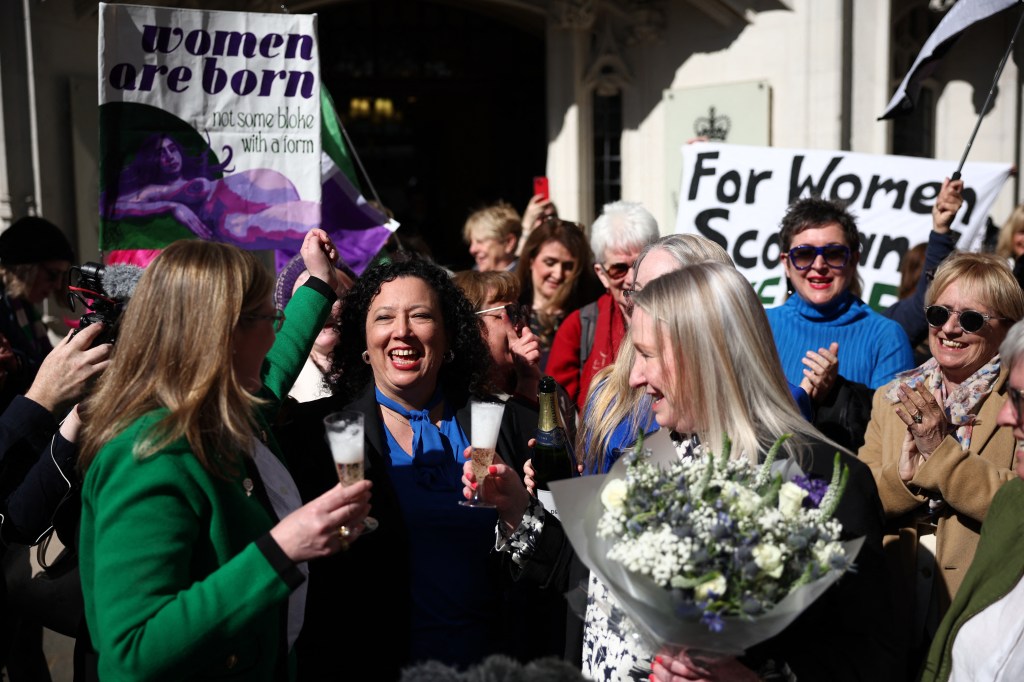
It was later clarified that the “circumstances” were where “reasonable objection” could be taken to a trans person’s presence, includes – such as in the case of female spaces – when “the gender reassignment process has given [a trans man] a masculine appearance or attributes”.
A leaked version of the EHRC’s finalised guidance, published by The Times last week, is said to be not too dissimilar to the draft guidelines and will ban trans people from changing rooms, wards and sporting competitions, as well as other spaces and services.
Whilst gender-critical and anti-trans groups and activists claimed the Supreme Court ruling was a victory for women, human rights and LGBTQ+ organisations and campaigners warned the judgement would see trans people pushed out of public life and society.
The report from TransActual has found huge swathes of people are being denied access to bathrooms and changing facilities because they ‘don’t look right’, being outed at work, facing violence for simply being out in public and being removed from groups they are part of.
The individual stories tell terrifying accounts of verbal and physical altercations, with people being called a variety of vile slurs and names, being filmed without their consent and being questioned about their life and body by strangers.
“I was denied access to female lounge because of being transgender I felt upset, alienated and othered,” one trans woman cited in the report said.
“I was invited by other women patients to take part in a spa evening, but I was unable to join them because the hospital directors would not allow me to be in a female space. The patients were upset and outraged on my behalf, they felt it was unjust.
“I felt like a hole had opened up, that I was a freak and not right for society.”
One trans man was told by his gym’s management that he is no longer allowed to use the male changing rooms, nor the female ones.
“I would only be allowed to use the family changing room, but as I don’t have kids, this would make me feel uncomfortable and I also feel it makes me look like a creep,” he said.
“It made me feel like I’m being segregated and pushed out of a space based on my gender and trans status. I don’t feel welcome at the gym. I feel like they are saying I am not a real man because I am trans. I felt like they are claiming that I’m some kind of threat to people, or that by me changing in my gender’s changing room I would somehow offend or upset other people.
“After that, I no longer wanted to use the space.”

In another case, a cisgender butch lesbian who said they “currently sport a short haircut that some would define as masculine”, alongside wearing masculine clothing, was told by in a female toilet that she was “not allowed” to use it.
“I felt invalid and embarrassed. I am painfully aware my experience was a glimpse of what the trans community are suffering every day. Going forward I will be more hesitant and anxious about using public toilets, but I will continue to do so. It’s sad that at 47 I’m back to my life and appearance being a political statement in the UK,” they said.
Commenting on the report’s release, Keyne Walker, Strategy Director for TransActual said the report “tells a story of bullying and exclusion”.
“The Supreme Court, the Equality and Human Rights Commission (EHRC)and the government have all claimed to care about the dignity and safety of women and trans people. This report proves that by taking the approach of segregation they are failing in that.
“If the government care about discrimination and violence against women they will refuse any EHRC guidance that ends with organisations or individuals policing who goes into which bathroom, and restore equality law to a sound footing.
“But don’t take my word for it. Take it from the many people who have told us their story in this report.”
Walker continued: “It never needed to be like this. As many legal experts have stated, the supreme court ruling was eccentric and at odds with broad understanding of Equality Law as it has operated over the past 15 years.
“Even were it correct, the EHRC could have sought a less extreme, harmful, disruptive and costly interpretation than they have, that does not impose automatic segregation based on the anti-scientific and undefined binary of ‘biological sex’.
“Their guidance, before it has even been finalised and considered by parliament and government, is already having a dire effect. Not just on trans people, but also anyone who might be ‘suspected’ of being trans. Organisations that would like to support trans people claim their hands are tied.
“Meanwhile, the guidance is acting as a bigot’s charter, creating confrontation on a daily basis that threatens to drive LGBTQ+ people out of work and public spaces.”