
Trans group delivers thousands of EHRC consultation pages directly to the equality minister’s door
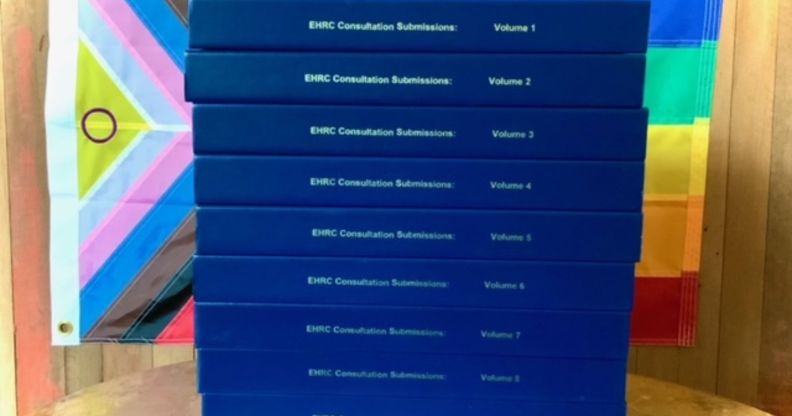
TransActual’s EHRC consultation volumes, delivered to Bridget Phillipson (Supplied)
A prominent trans organisation has hand-delivered thousands of pages worth of trans guidance responses to the door of equality minister Bridget Phillipson.
TransActual said representatives gave in 10 volumes worth of responses sent to the Equality and Human Rights Commission (EHRC), as part of its consultation on proposed updates to guidance for single-sex service providers, on Wednesday morning (27 August).
The nonprofit group said it delivered the 2,800 pages of evidence to both Phillipson and Labour MP Nia Griffiths, the parliamentary under-secretary of state for equalities, after claiming it does not trust the EHRC to “do its job”.
Proposed updates to the UK’s top human rights watchdog’s single-sex service guidance were published in April following the FWS v Scottish Ministers Supreme Court ruling, which argued the 2010 Equality Act’s definition of sex refers solely to ‘biological sex.’
If passed, the non-statutory code of practice would recommend excluding trans people from using toilets consistent with their gender identity and force them to bring ID into bathrooms.
The EHRC received over 50,000 responses to the updates after closing its public consultation in late July. Officials vowed to use the findings to amend the guidance “over the summer”.
However, TransActual officials argued the EHRC’s treatment of the consultation proved it couldn’t be trusted to handle the responses.
In a letter to both Phillipson and Griffiths, also hand-delivered, TransActual chair Helen Belcher asked the MPs to “forgive us for not trusting any outcome from the EHRC,” which she called “clearly biased”.
“[The responses] reflect the community’s outrage, hurt and horror that unelected judges can overturn, at a stroke and without listening to trans people, the legal understanding we’ve had for 15 years.
“That the EHRC should immediately rush so gleefully to implement trans-exclusionary policies while denying any ‘loss of rights’ for trans people; and that a Labour government should sit on its hands, ignoring multiple international human rights experts, and so betray a minority they now consider inconvenient.”

Belcher particularly deplored the alleged use of AI models to analyse the responses, highlighting the “known issues when dealing with ‘niche’ or ‘non-normative’ content” that are prevalent in AI, as well as the “lack of transparency” in how the data will be handled.
“Individuals who have been happily and peaceably transitioned for years – decades, even – now face a deeply frightening and uncertain future within the UK,” she added.
TransActual acquired the consultation responses by asking those who submitted them to also send the organisation a copy.
Overall, it received 375 responses, which it says is a “mere fraction” of the 50,000-plus responses received by the EHRC at around 0.73 per cent.
“However, we suggest they give a far more authentic insight into the feelings of the trans community and their allies right now than any AI-generated summary the EHRC will produce,” a spokesperson said.
PinkNews has reached out to Bridget Phillipson and Nia Griffiths to confirm they have received the volumes of EHRC consultation responses.
In a statement to PinkNews, an EHRC spokesperson said: “As Britain’s independent equality regulator, it is our job to provide expert advice on how to put the Equality Act into practice.
“We are currently analysing consultation responses and are amending the draft Code of Practice text where necessary to make it as clear and helpful as possible.
“The six-week consultation sought views on whether updates to the code clearly articulated the practical implications of the judgment and enabled those who will use the Code to understand and comply with the Equality Act 2010.”