
Trans Statue of Liberty painting to go on view in Baltimore after DC censorship allegations
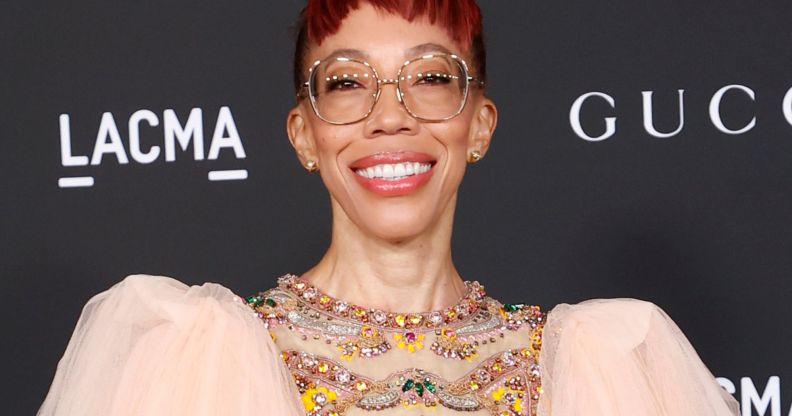
Amy Sherald cancelled the exhibit over concerns regarding her trans portrait. (Getty)
After cancelling her mid-career retrospective at the Smithsonian and accusing the institution of censoring her painting of a trans model dressed as the Statue of Liberty, painter Amy Sherald will now host the exhibition at the Baltimore Museum of Art (BMA).
Sherald, 51, who is known for her simplified realism portraits which depict African Americans in everyday settings, gained prominence in 2018 after painting former first lady Michelle Obama.
She was set to hold Amy Sherald: American Sublime at the National Protrait Gallery in Washington DC – part of the Smithsonian Institution – in mid September, but withdrew after alleging officials at the gallery expressed concerns over the content of one of her portraits.
Titled “Trans Forming Liberty,” the 2024 painting depicts a Black trans woman dressed as the Statue of Liberty and posing like the iconic New York monument.
In a letter sent to Lonnie G. Bunch III, the secretary of the Smithsonian, as seen by The New York Times, Sherald said she “entered into this collaboration in good faith, believing that the institution shared a commitment to presenting work that reflects the full, complex truth of American life” but it became clear “the conditions no longer support the integrity of the work as conceived”.
“This painting exists to hold space for someone whose humanity has been politicised and disregarded”
Sherald said in a statement she had been “informed that internal concerns had been raised” and such concerns “led to discussions about removing the work from the exhibition”.
“While no single person is to blame, it’s clear that institutional fear shaped by a broader climate of political hostility toward trans lives played a role,” the artist continued. “This painting exists to hold space for someone whose humanity has been politicised and disregarded.”
Sherald’s decision to withdraw her exhibition comes amid wider conversations about censorship at the Smithsonian due to pressures from the Trump administration.
Sherad claimed went on to claim Bunch suggested the painting be replaced with a video, however a spokesperson for the Smithsonian said the video was to “accompany the painting as a way to contextualise the piece” and was not meant to replace it.
“While we understand Amy’s decision to withdraw her show from the National Portrait Gallery, we are disappointed that Smithsonian audiences will not have an opportunity to experience ‘American Sublime’,” the institution said said in a further statement.
“The Smithsonian strives to foster a greater and shared understanding,” the statement continued. “By presenting and contextualizing art, the Smithsonian aims to inspire, challenge and impact audiences in meaningful and thoughtful ways. Unfortunately, we could not come to an agreement with the artist. We remain appreciative and inspired by Ms. Sherald, her artwork and commitment to portraiture.”
Following the censorship allegations, Amy Sherald: American Sublime will now open at the Baltimore Museum of Art (BMA), with people able to come and see it from 2 November to 5 April.
Commenting on the exhibition’s opening, Asma Naeem – the BMA’s Dorothy Wagner Wallis Director – said: “I’ve had the great pleasure and joy of knowing Amy Sherald for a decade. In that time, she has become a cultural force, capturing the public imagination through works that are powerful and resonant in their profound humanity.
“Amy’s story is also deeply intertwined with Baltimore. Beyond her education and time lived in our beloved city, Baltimore is rooted in her subjects, on her canvases, and in her titles.
“Presenting American Sublime at the BMA is a celebration of our creative community and a joyful reunion with those shaped by Amy’s extraordinary power to connect. We’re thrilled to share her transformational work with our visitors.”
Sherald said Baltimore has “always been part of my DNA as an artist”.
“Every brushstroke carries a little of its history, its energy, its people, and my time there. To bring this exhibition here is to return that love,” she said.