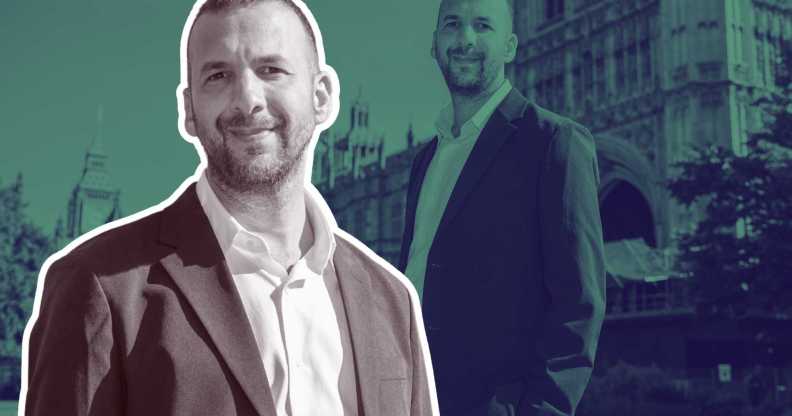
Zack Polanski: ‘It’s time for a party to stand in unconditional solidarity with our LGBT community’
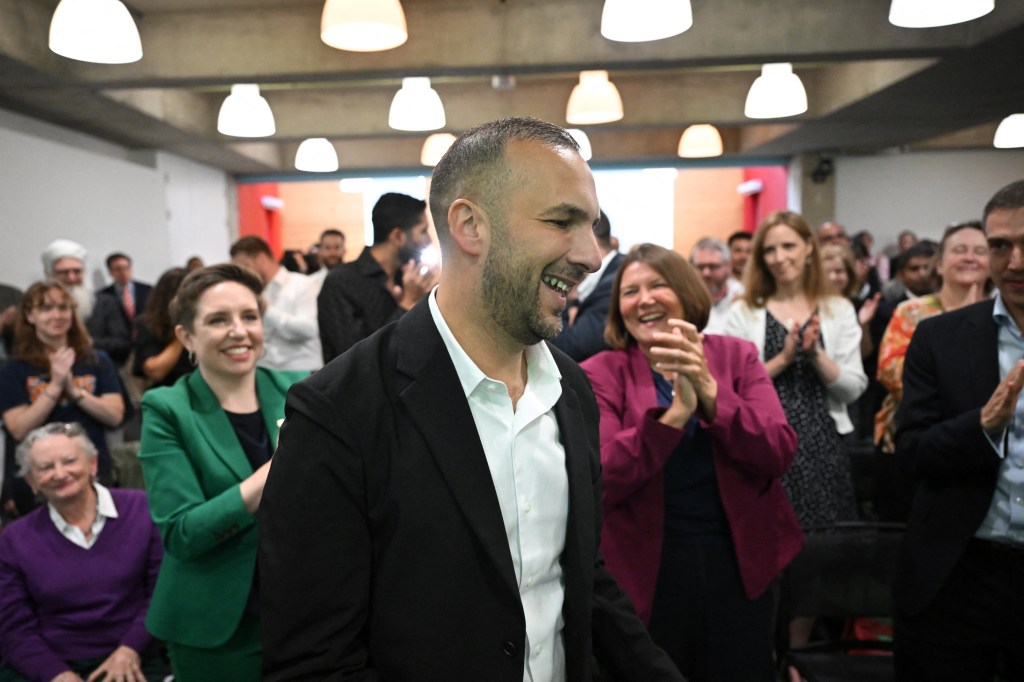
Zack Polanski outlined his own, and the Greens, LGBTQ+ policies ( Ben Montgomery/Getty Images)
In recent weeks the press has been awash with scathing descriptions of Zack Polanski as “deluded’, “silly”, a “dark moment for British democracy”, and, of course, “woke”.
He was also branded a “smooth-talking vegan” by one outlet, which as a gay, actually vegan, former actor living in Hackney, he is no doubt unperturbed by. In the face of such labels, Green Party leader Polanski remains unwavering in his commitment to radical leftist politics – if not rather emboldened – he made clear to PinkNews.
A London Assembly member and the Greens former deputy, 42-year-old Polanski was elected as leader of the Green Party of England and Wales in a landslide election at the start of September, in which he beat out Green MPs Adrian Ramsay and Ellie Chowns – who were running on a joint ticket – with a staggering 20,411 votes to 3,705.
Running the leadership contest on an eco-populism platform which put tackling inequality at the very heart of Green policy, Polanski pledged to make the Greens a “bold” party that are “absolutely clear about what we stand for, and against”.
Thirty seats, Polanski told members after his win, is the goal for the next general election.
He is confident the Green Party can grow to that in the face of legacy votes for Labour and increasing support for Nigel Farage’s Reform UK, which is succeeding in the polls with its divisive, anti-immigration, anti-LGBTQ+ and anti-environmental rhetoric.
In his victory speech, Polanski blasted Farage and Reform as a “charlatans” who only “pretend to serve working-class communities” and vowed to kick Keir Starmer out of Westminster: “My message to Labour is very clear: we are not here to be disappointed by you. We are not here to be concerned by you. We are here to replace you.”
It would not be exaggerated to say many LGBTQ+ people in Britain feel politically homeless.
In the run up to the general election in July 2024, many queer voters – as well as the wider population – were keen to get the Conservative Party out after 14 years in power, eager for change. The obvious choice, the tactical move – as it was widely agreed – was to vote for Labour. Opinion polls reflected that, with a Labour red domination predicted as election day crept near. Labour did, indeed, sweep the board and secured 412 seats in Westminster.
Despite support for Labour being clear, many LGBTQ+ people felt apprehensive given the continued flip-flopping of the party and its leader Keir Starmer on many key issues that matter to the community, namely trans rights. For instance, in 2020 Labour was committed to introducing self-ID for trans people but by 2023 the party – under Starmer – had shifted to a version of Gender Recognition Act reform that kept a “medical diagnosis of gender dysphoria”.
This disillusion has seemingly turned to disenfranchisement since Labour took power, with health secretary Wes Streeting making the Tories ban on puberty blockers for trans youth permanent, the party supporting the Supreme Court’s controversial ruling and Starmer going back on his own past comments and now saying he no longer believes trans women are women. In May 2025, just under a year on from the general election, Britain once again plummeted down ILGA-Europe’s Rainbow Map – which it topped just over a decade ago.
Perhaps unsurprisingly, as of this month, data suggests Labour has lost 45 per cent of its lesbian, gay and bisexual voters from 2024. The Greens, the same data suggests are leading amongst lesbian, gay and bisexual voters, but it is unclear if that is a direct switch.
Polanski, who himself is gay, has never shied away from passionately – and publicly – supporting LGBTQ+ rights and in particular the trans community and made trans rights a key tenet of leadership campaign. But what are his overarching beliefs and what policies will the Greens undertake under his leadership?
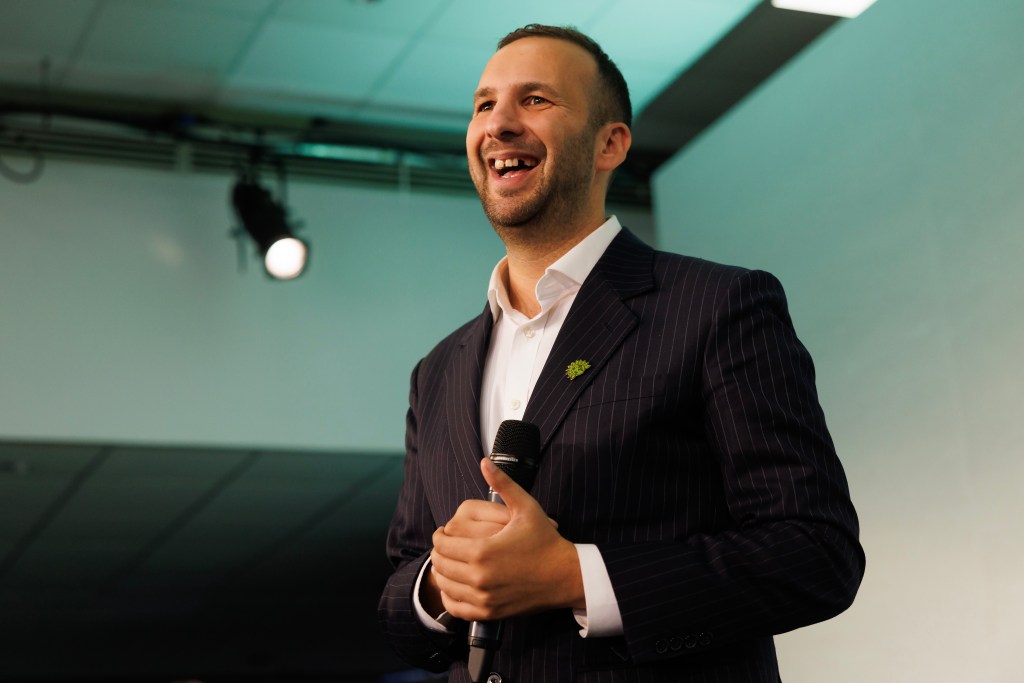
Just a day after Polanski’s election win, the first episode of Polanski’s new podcast, Bold Politics, went out.
In each weekly episode Polanski sits down with thinkers, activists, and cultural figures to discuss the topics such as migration, workers rights and sustainability which are shaping the UK’s future.
PinkNews spoke with Polanski in the grounds of St John the Baptist Church, Hoxton near the studio where his podcast is recorded to discuss his new show and the Greens LGBTQ+ policies under his leadership.
PinkNews: Why is this podcast vital in this political climate at the moment?
Zack Polanski: The podcast is vital because the mainstream media are very often owned by the same multi-millionaires and billionaires who have bought our politicians, who serve vested interests, and so when politicians don’t stand up for human rights to tackle inequality, to stand up to protect the National Health Service or, indeed, for us as an LGBT community, that’s because they’ve been bought and paid for.
So, I felt a podcast was vital to platform voices and ideas that often aren’t given space in the media. That doesn’t mean I’m avoiding scrutiny anytime that someone wants to ask me a question, I’m always happy to speak to a microphone. But, this is a space for the Green Party and the politics of the left more generally to say actually this is our agenda and these are the stories we want to tell.
PN: In the press release promoting the podcast, it mentions down the line you will speak with people you disagree with. Some people might disagree with platforming non-left views. What is your take on that?
ZP: When you platform people you disagree with, it’s got to be done carefully. So, there’s certain people that I just absolutely wouldn’t give a platform to because they have a platform all the time and what they’re saying is literally fascist. I think there’s other people [who we can platform] to give you an example, I met a guy in Clacton the other day who said that he didn’t like migrants, but then he pointed out that he was an Irish migrant. He said, ‘So, it’s not like I fundamentally have a problem with them, but look at my community’ – these are his words, not mine – ‘it’s a s**thole, it’s had no no investment, how can we accept more migrants?’ I just said to him, ‘let’s have a chat about this on the podcast’, so I’ve invited him on.
I think it’s conversations like that where someone has a point of view that I disagree with, but they’re not kind of pumping propaganda and they’re not pumping hate filled views. They’re just coming from a genuinely sincerely held point of view I happen to disagree with. I think those are really vital conversations to have.
PN: You have described this podcast as for the 99% and will engage people in a way the mainstream media is not doing – how do you think it will cut through the noise of all the podcasts that already exist?
ZP: I’m really excited that Bold Politics is already cutting through the noise, and I think a lot of that is just about the fact that it’s genuine authentic conversation. We’re not looking to have ‘gotcha’ moments. I’m not looking to pin anyone down. And, in fact, it was interesting one newspaper, one right-wing newspaper, gave it a low rating. They gave it two stars. I was disappointed to not get it one star. The reason why they said is because I’m sat there as a leader but I’m just listening and actually, for me, leadership is largely about listening.
The way it’s going to cut through I think is giving myself and the people who are watching or listening space to hear from people without them being interrupted every few seconds, but actually space to breathe, particularly when those people are from marginalised communities or representing the views of people who are not often heard or seen.

PN: What is a Greens vision for LGBTQ+ rights in the UK under Zack Polanski?
ZP: LGBT rights are human rights and those are not up for negotiation. I think it’s beyond time that we have a political party who say they stand in unconditional solidarity with our LGBT community.
I’m aware that in the last five years hate crimes have risen 125 per cent across the UK. It’s about making sure that we’re educating young people, that conversations are happening early so people are making informed views. But also this conversation cannot happen without talking about the particular scrutiny and vile propaganda that has been launched against trans people. And of course, the experience of LGB people is different to the experience of T people but there are commonalities, the commonalities of being othered, of often not feeling welcome or often the media talking about you without you.
The Green Party stand unconditionally to say trans rights are human rights, trans women and women, trans men and men and non-binary identities exist and are perfectly valid. It shouldn’t be refreshing for a political party to say that, but I’m hearing time and time again that people say ‘thank God someone is saying that’ – and we will keep saying it.
PN: A decade ago, the UK was a global leader in LGBTQ+ rights but the most recent ILGA-Europe Rainbow Map shows we are now being outpaced on LGBTQ+ rights by half of Europe. How would the Greens get Britain back to 1st place?
ZP: Well, first of all, I think our safety ranking has spiraled because of foolish moves by Wes Streeting, the health secretary. This [is] someone who [is] from the LGBT community who said he was absolutely in solidarity with the LGBT community, but the moment he had a sniff of power he completely reneged on so many policies. These are things around health care for trans people and just generally appeasing some of the hate-filled narratives we’ve had from the gender-critical movement. It is important to say that the gender-critical movement, particularly in the US, has literally been funded by fossil fuel companies. These are ways of distracting from a transition of oil and gas to renewables by creating narratives that they knew would divide the left, divide the environmental movement, and people like Wes Streeting, Keir Starmer, to be frank, and a lot of the Labour Party, obviously reform and the Conservative Party too, absolutely bought into these narratives.
So I think the first thing we need to do is to notice that, to call it out. That’s not to say that someone who is gender critical or someone who is worried about women’s rights should be dismissed or not included in a conversation. We need to separate the people who are fueling these narratives, the politicians who should and do know better, who are allowing themselves to be fueled by these narratives, to the largely women, but some men, who have been caught up in these conversations. I do think where we can, we do have to keep talking to people, it’s important that we don’t say we absolutely won’t listen.
“It’s also important that trans people are at the table”
It’s also important that trans people are at the table. Now trans people can’t do all the work and particularly if they feel like they don’t have the energy for it. That’s a particularly valid position and then it’s important to show our allyship but it’s really important – and I’m aware I’m saying this is someone who’s not trans – that ultimately trans people’s opinions are centered in this conversation. I’m always aware of what Graham Norton said a few years ago: where as a gay man he’s always asked about [trans rights] but [he said] ‘where are the trans people having these conversations?’
In terms of people who are concerned or scared, I think it’s important that we point out that violence against women and girls is a very real thing. Women not being able to get a gynecology appointment is a very real thing. The gender pay gap is a very real thing. But these are not the problems or caused by trans women. These are largely caused by cis men.
PN: The Greens 2024 Election Manifesto stated the party would campaign for self-ID for trans people – will this policy continue?
ZP: Absolutely.
Green Party policy is decided by our membership and not by our leaders. Policy after policy at Green Party Conferences has gone through with [an] overwhelming majority that is clearly trans-inclusive.
I stood on a very clearly socialist, progressive, and trans-inclusive platform and I won with 85 per cent of the vote. That doesn’t mean 15 per cent of the vote are not trans-inclusive in the party, but it demonstrates the strength of feeling towards trans-inclusive policies.
It’s also important to say that even the people who ran against me were also running on a largely trans-inclusive platform. So, that issue within the Green Party has largely been settled and I don’t think we need to keep relitigating it.
It’s important to say that people will say to me then, ‘does that mean you can have no debate? Does that mean people can’t have any questions?’ No, of course you can have questions. Of course you can debate. But as a leader of a political movement and as a political movement, we are perfectly entitled to choose the views, the platform, the ideas that we put to the public that are under the Green Party. So, if you’re not trans-inclusive, that’s totally fine. We don’t have to agree on everything. But the Green Party are a trans-inclusive party. Our policies are a trans-inclusive platform, and I’m a trans-inclusive politician. You know all of that. So, it’s up to you which party you want to join, but you know what you’re joining when you join the Green Party.
PN: If there was a Green government, would the Greens reverse the Tories, and subsequently Wes Streeting’s, ban on puberty blockers for trans youth?
ZP: Absolutely.
It’s really important that policy for trans people is informed by the National Health Service and is done in consultation with trans people. It seems like an abominable gap, particularly in the Cass review, that trans people were not included in the conversations. It’s a basic principle: nothing about us without us.
I am also cautious in this that it’s not for me as a politician on the other side to opine what is good or isn’t good for trans people, but it is important as a politician to ultimately say these policies should be decided by medical professionals in consult in consultation with the people with the lived experience and that gap is absolutely glaring in the decisions that been made.
PN: The EHRC has submitted its guidance based on the Supreme Court ruling on the definition of sex. How do you think the guidance should be interpreted and how can the rights of trans communities be protected?
ZP: The guidance is an absolute mess. The Supreme Court ruling in the first place was an absolute mess. Now it’s a Supreme Court ruling, so that then is the ruling, but we have Keir Starmer saying ‘that’s the ruling, so that’s my view’. That’s completely not how politics works. It’s not how campaigning works. It’s not how legislation works. The point of being the Prime Minister and the government is that you have a view on something. You pass it into legislation and then the Supreme Court rules based on the legislation you’ve made. So if the Supreme Court rules on something and we disagree with it, it is completely our right – and indeed – what we intend to do to argue that the law should be changed. The law is messy, the law is not clear and the law does not defend trans people and their basic human rights. By the way, I don’t think it defends people who are gender critical either but that’s a whole another conversation. I just think it’s a very, very messy ruling.
PN: The Greens have both an LGBTQ+ group and a gender critical group, how are you working to unite both groups within the party?
ZP: I won the election with 85% of the vote and that’s a really important thing to say here.
As Zohran Mamdani has been saying and I’ve been repeating. If you agree nine out of the 12 things that I say, great, join the party, vote for me and get involved. If you agree with 12 out of 12 things then go see a psychiatrist because something’s not right.
Now, all parties are broad churches and that’s right, but even churches have walls. So, if you agree on most things, that’s absolutely part of being in the Green Party. But there is no space in the Green Party for racism, homophobia, misogyny, and transphobia and ultimately, if those are the things that you want to espouse then that is not a space [for you].
Of course people can disagree, but this is about disagreeing respectfully. If someone wants to misgender someone, I don’t think that’s a respectful disagreement. Of course, anyone can misgender someone accidentally. I’ve certainly done it before. You correct yourself and as long as the person’s okay with it, you move on. But if you’re repeatedly misgendering someone, that’s not a disagreement, that’s harassment and has no space in the Green Party.
PN: As a gay leader, do you feel that comes with a pressure to speak for the community or that you are held to higher standards than other leaders because you are a member of the community?
ZP: I am the first gay man to lead a political party in England and Wales. We’ve had Adam Price in Wales and we’ve had Patrick Carve from the Scottish Greens in Scotland, but the first in England and Wales. It’s a responsibility I take really seriously.
So many people have told me what a moment it was for them personally to see me thank and kiss my boyfriend when I first won. That’s come from young gay people who have said what the difference it makes to see that representation in politics, but equally its moving its come from older people who said that they just didn’t think that they would see that day.
I see the importance of representation. I’m also really aware that at the center of my political platform and the Green Party’s platform is about tackling inequality. So not getting distracted by social justice, but actually saying inequality, lowering people’s bills, raising people’s living standards is everything that I’m focused on. Now at the same time as not being distracted, that means having absolute solidarity with the LGBT community, with migrants, with disabled people, with unemployed people and it also means not getting distracted by that. The way you do that is by saying solidarity with those people. That’s not up for negotiation. And – by the way – if you’re in one of those communities, inequality hits you even hard[er] because there is study after study that shows that intersectionality, so people who might be black and gay or might be queer and Asian, when you put those intersectionalities together, you are facing more inequality and you are likely to be more discriminated against by a system that very often rewards the powerful, the wealthy and people who are already in politics or the people who are already earning inordinate amounts of wealth. It is important to recognise that representation matters, social justice matters, and inequality overrides all of those
You can do all of those things. To use an Americanism, you can walk and chew gum at the same time.
PN: Earlier in the summer Zarah Sultana and Jeremy Corbyn’s Your Party gained huge swathes of support from left leaning voters but then have had a very public split. How can left voters in this country feel enfranchised in this political climate?
ZP: The Green Party got nearly 2 million votes for the last election, we have 39 second place finishes and by the end of the day we’re filming this interview, I’m expecting we might hit 80,000 members. The Green Party are not a new party. We are up and we are ready to go and crucially, we are a democratic party. We are one member, one vote. So sometimes people say to me ‘there’s this one policy that I disagree with’ – don’t let that stop you joining the party.
That’s the exact reason to join the party and get involved to help change our party policy. Now, if a policy you want to change is because you want to do something racist, misogynistic, homophobic, or transphobic, that’s clearly not acceptable and you’re not welcome to join the party. But if you have a disagreement on something, that’s exactly what our policy functions for.
We don’t have time to waste. We literally have fascism at our door. We have Donald Trump giving speeches where he’s climate denying, where he’s frankly racist and misogynistic. Tthen we have Nigel Farage amplifying a lot of what he’s saying. The reason that matters is often where Nigel Farage leads Keir Starmer gets to as quickly as possible. I want to be in a position – or I’m moving towards a position – where the Labour government are more scared of losing votes and seats to the Green Party than they are to Reform. That can only happen if we continue to grow our membership and if we continue to win seats.
I don’t think we need new parties. I think we need people to join the Green Party, the party where the momentum and the energy is right now where we can take the fight to Reform and challenge this unpopular Labour government.
PN: Why do you think people should vote for the Greens instead of Your Party?
ZP: The Green Party are the party of environmental, social, racial, and economic justice. We want to lower bills, we want to protect the National Health Service, and we want to call out the genocide in Gaza to do everything we can to stop it. At the same time, we stand in absolute solidarity with LGBT people, with migrants, and with trans people. We are a pro-peace party, we’re a socialist party, and we’re a progressive party. We’re a democratic party that are already up and running, and there’s no time to waste.
So, if all of that resonates with you, now is your day to join the Green Party at join.greenparty.org.uk.