
The Running Man’s Simon Haines on bi representation: ‘I’m trying to be the change I want to see’
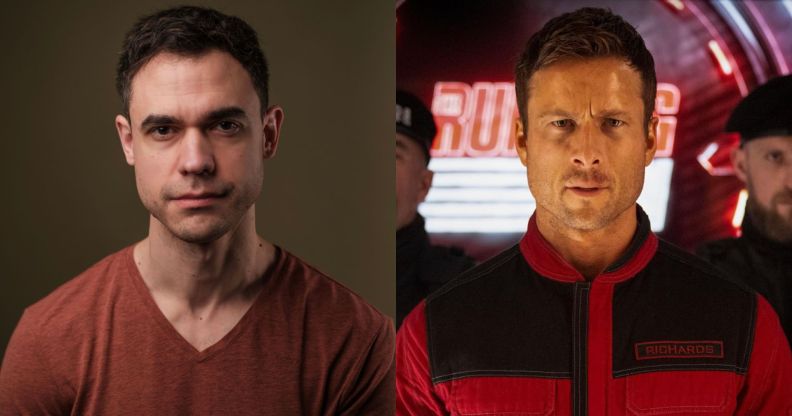
Simon Haines is in The Running Man. (Provided and Paramount Pictures)
The only Edgar Wright film actor Simon Haines had seen before featuring in The Running Man, was Hot Fuzz – and that was when he was a child.
“I grew up in Somerset and thought it was really funny but way too gory for me,” Haines says. He should fare better watching The Running Man back which seems less concerned with blood and gore and more interested in high-octane, blood-pumping action.
The dystopian action thriller is based on as Stephen King story and is a remake of the 1987 film that starred Arnold Schwarzenegger and was directed by Starsky & Hutch star Paul Michael Glaser. The reboot has Glen Powell as Ben Richards who enters the TV show, The Running Man, in the hope of winning the $1 billion prize money to help his sick child.

“It was a real thrill,” says Haines of shooting. The actor, whose character helps Richards get on the show, has nothing but positive things to say of his leading man. “He was a real team player. You can tell that he’s a real leading man in terms of the way he conducts himself with the cast and crew,” Haines enthuses.
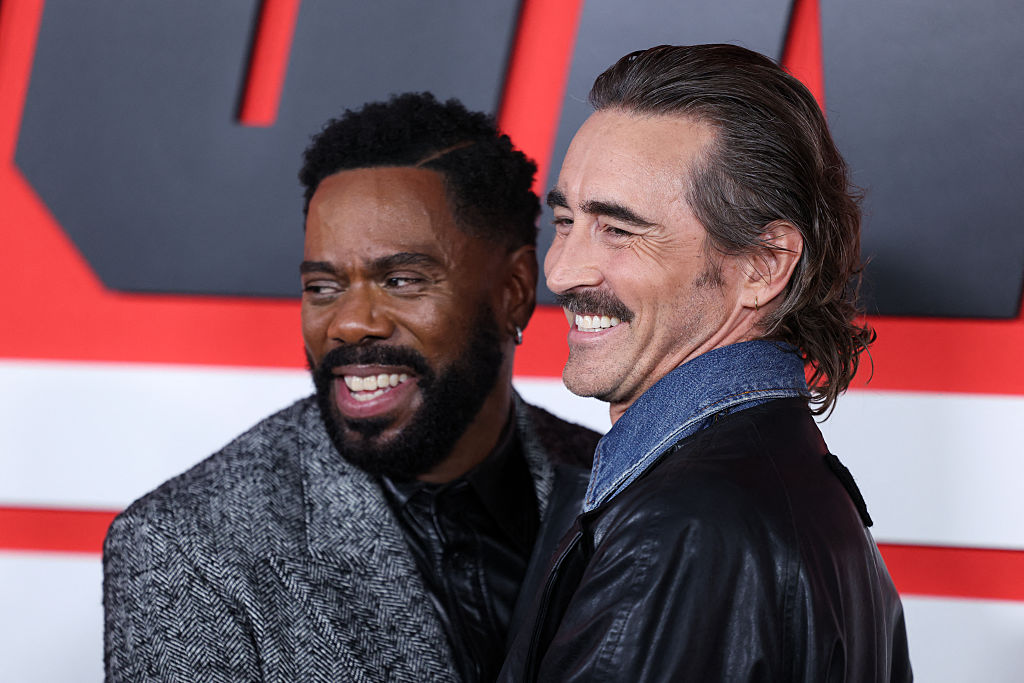
Haines, who is bisexual, also takes pride in being part of a cast that includes other queer actors such as Lee Pace, Katy O’Brian and “icon” Colman Domingo. “That was a total joy to be part of that team, even if we didn’t get to work together,” he adds.
As well screen credits that include The Lord of the Rings: The Rings of Power and Emmerdale, Haines is an accomplished stage performer, having starred in The Mousetrap in the West End and Straight White Men.
Currently, he’s in the early stages of a play “loosely inspired” by Tennessee Williams’ Cat on A Hot Tin Roof. It’s about a closeted bisexual footballer in present-day Britain, and gave Haines the chance to focus on a character he’s always been drawn to: Brick.
Popular literary theory is that Brick is a closeted gay man but Haines disagrees. “When he talks about his relationship with Maggie, he’s very positive about it up until the point where she cheats on him with his best friend. So, it’s bi-erasure of people to be like, ‘he must be gay’. She did have an affair with his best friend, that’s a pretty big betrayal.”
The hopes are the play will be staged some time next year. With it, Haines is looking to address the public consciousness around bisexuality and help them break away from assuming someone must be straight or gay depending on what relationship they are in.
It’s also motivated, somewhat, by Haines’ experience growing up with a lack of visible bi representation. Today, he can point to Nick Nelson in Heartstopper as well as Kit Connor, who plays him, and Alan Cumming as examples of that. Other examples include Maksim from The Wheel of Time, Patrick Zweig in Challengers, and We Live in Time‘s Almut.
“I am trying to be the change I want to see in the world,” says Haines, who believes there’s power in characters explicitly identifying as bisexual, an opinion shared by fans of 9-1-1‘s Buck (Oliver Stark). During a recent screening of Blue Moon at the London Film Festival, Haines was “gobsmacked” when Ethan Hawke, as lyricist Lorenz Hart, said he “likes both” men and women.
“I was like: ‘No, it can’t be… a bisexual character talking about the fact that they’re bi’. It was amazing. There is a power in such a heteronormative world for somebody to explicitly say, ‘I am this and this is different’, because people still don’t have those role models.”
Where Blue Moon failed, in Haines’ eyes, was having Hart fall into a bisexual stereotype, namely, “his love life is a mess”. Similarly, he disparages Ben Whishaw’s Passages, which showed a character exploring their bisexuality through an affair. “It’s so boring and it’s harmful if that’s all people are seeing.”
We touch briefly on the few times in the past year when queer women such as JoJo Siwa and Billie Eilish have clarified their identities after being accused of retreating back into the closet having been romantically linked with a man. It’s exposed even the queer community’s intolerance. Haines understands people’s feelings but says: “It’s just respecting that it’s not your life.”
Ultimately, he hopes we can reach a point where someone’s sexuality is not the main point of tension in a story. We’ve begun to see more of that in recent years, Riot Women and We Live in Time stand out as examples. The void has meant taking queer roles has become more meaningful for him.
“I’m actively seeking them out, trying to fill the gap,” he says.
The Running Man is due in cinemas on Wednesday (12 November).
Share your thoughts! Let us know in the comments below, and remember to keep the conversation respectful.