
New court ruling could have major impact for married LGBTQ+ couples in Europe
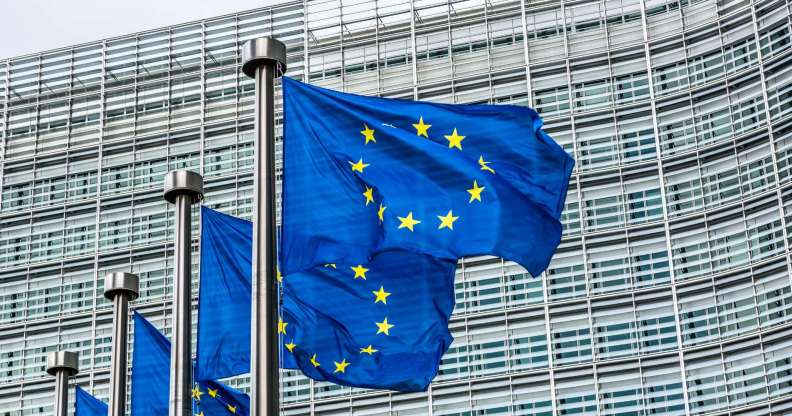
The court judgement could have a huge impact across the EU (Canva)
A new ruling by the Europe Union’s top court on the recognition of same-sex marriage could have a major impact for queer couples across the EU.
In a ruling in regards to two Polish citizens who married in Germany, the European Court of Justice (ECJ) has said that EU member states are obliged to recognise a union between two EU citizens which has “lawfully concluded in another member state” and where the couple in question have “exercised their freedom to move and reside”.
Refusal to recognise same-sex unions conducted in the EU is, the court has said, contrary to EU law and infringes on EU citizen’s freedom to move and reside as well as their rights to respect for private and family life.
However, the obligation to recognise does not require that a member state legalise same-sex marriage within its own laws.
The two Polish citizens, one of which also has German nationality, tied the knot in Berlin in 2018 but subsequently sought to move to Poland and requested their German marriage certificate be translated to the Polish civil register so their marriage would be recognised in Poland.
Their request was refused on the grounds that Poland has not legalised same-sex marriage.
The couple challenged the decision at the Polish Supreme Administrative Court, which referred the case to the ECJ.
“The Member States enjoy a margin of discretion to choose the procedures for recognising such a marriage, and the transcription of a foreign marriage certificate is just one of the possible procedures,” a summary of the judgement reads.
“Nevertheless, the Court emphasises that those procedures must not render such recognition impossible or excessively difficult or discriminate against same-sex couples on account of their sexual orientation, which is the case where national law does not provide, for same-sex couples, a procedure for recognition equivalent to that granted to couples of the opposite sex.
“Accordingly, given that transcription is the only means provided for by Polish law for a marriage concluded in another Member State to be effectively recognised by the administrative authorities, Poland is required to apply that procedure without distinction to marriages between persons of the same sex and to those concluded between persons of the opposite sex.”