
One of the biggest injustices in British LGBTQ+ history only took place in 1998
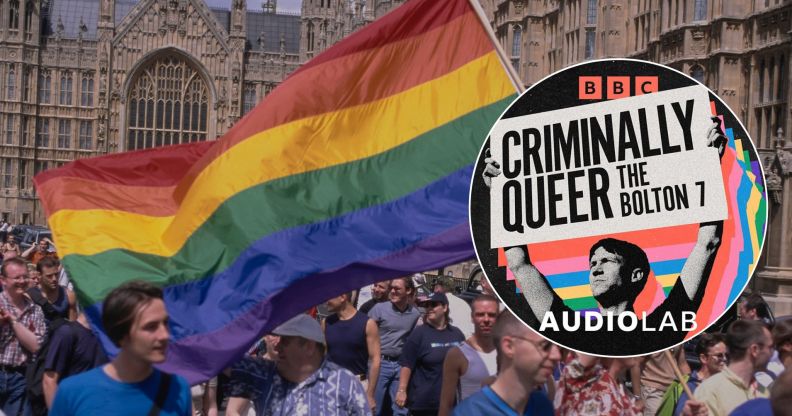
Criminally Queer: The Bolton 7 explores the shocking case of the Bolton 7 in the UK. (Getty/BBC)
Criminally Queer: The Bolton 7 explores the shocking case of the Bolton 7 in the UK. (Getty/BBC)
When writer and composer Hugh Sheehan came across the case of the Bolton 7, which saw seven gay and bisexual men convicted of gross indecency offences for engaging in consensual sex with each other in a private residence in the Greater Manchester town, he thought he’d read the date wrong.
“1998. It’s so recent. It’s such archaic laws being used,” Sheehan says today. While gay sex was partially decriminalised by the Sexual Offences Act 1967, little-known stipulations remained. It was illegal for more than two men to take part or be present during sex, while the age of consent remained 18 for homosexual men, compared to 16 for heterosexuals.
After private footage of the seven – Gary Abdie, David Godfrey, Mark Love, Norman Williams, Jonathan Moore, Craig Turner and Terry Connell, all aged between 17 and 55, all lovers or acquaintances – was obtained by police, the men were arrested, charged, and ultimately convicted.
Owing to vigorous campaigning from the likes of activists Peter Tatchell and Allan Horsfall and groups including Amnesty International, Stonewall, and OutRage!, the men didn’t receive custodial sentences. Then, in 2001, the Home Office offered six of the men up to £16,000 as part of an out-of-court settlement, after they took an appeal to the European Court of Human Rights.
The uproar surrounding the charges, and the men’s tenacity in fighting them, also led to changes in the law. “Peter Tatchell calls the trial the last show trial of gay men in Britain. It became the nucleus of equalising the age of consent and causing a paradigm shift so as to abolish Section 28,” says Sheehan, referencing Margaret Thatcher’s law against the “promotion” of homosexuality which was wiped from the statute book in 2003. The Sexual Offences Act 2003 also enshrined in law that sex between more than two men is no longer a crime.

The case was a watershed moment, and one Sheehan wants to remain imprinted in the annals of British LGBTQ+ history. He’s the host of BBC podcast Criminally Queer: The Bolton 7, released earlier this year, distilling the arrest, trial and legacy of the case into five shocking episodes. It’s one of the most lauded podcasts of 2025, winning big at the British Podcast Awards and being commended at the British Journalism Awards. “I just wanted to get to the bottom of the unjustness of it,” says Sheehan, who spent over seven months on the project, sifting through countless archives and interviewing experts and activists. “Which I don’t really think I did, because there is no justification for it really.”
The podcast makes it clear that despite partial decriminalisation having been in place for three decades by then, Britain in the late ‘90s was steeped in homophobia. The police made the men paw over the footage and explain in detail what was happening between them. The Crown Prosecution Service (CPS) humiliated them with grossly intrusive questioning, pulling apart their personal and sexual lives on a stage.
Most of the men were in their early twenties, still figuring out their identities. “My first sexual encounters with men were not happy; they were clandestine and shrouded in shame and secrecy. I just think, f**k me, what if what if there was also the possibility of being criminalised?” wonders Sheehan. “Just for messing about on one or two afternoons in somebody’s house, you’ve got the police coming after you as well, and doing so in a way that is not sympathetic or empathetic to your humanity and your self-hood.”

The number of men charged with gross indecency offences for homosexual acts peaked at 2,022 in 1989 – a 380 per cent rise on the number charged the year before the 1967 Act decriminalising gay sex was introduced. The Act’s privacy stipulation, which stated that homosexual acts could only take place with no one else present, meant that gay men in shared accommodation – often lower classes – could be arrested for two-person sex in their own home. Raids were still taking place in gay venues and sex shops, and police forces were known for their hostility towards the community.
“If you [were] a gay man, you were automatically taken less seriously by the police because you’re assumed to be involving yourself in illegal acts,” says Sheehan. “When you do commit a crime, quote unquote, via having sex with more than one person or having sex with somebody who’s 16 or 17, then you’re instantly on the back foot.” By 1998, the relationship between queer folk and the police was unequivocally shattered. “You’re almost just set up to fail really in any sense of interfacing with the police or the criminal justice system.”

Yet state institutions were far from the only aggressors of gay men at the time; the media and the general public remained virulently homophobic. While there were hundreds of letters of support sent to court in support of the seven men, they also faced physical and verbal attacks and even lost jobs.
“There was outrage at the time as to men having group sex and it being dirty and it being smutty, and all these conversations around sex and all these dynamics were very much happening with heterosexual people, [but] as soon as they happened between men, the idea of predation came up,” says Sheehan. The fact that one of the men was 17, which was below the legal age of consent for gay men but not for heterosexual men, fed into a “moral panic and the language of predation” in the media. “Everything was coloured by a prejudice and a homophobia that was fueled by Section 28 and Thatcher and a post-AIDS Britain.”
In statements to Sheehan, Greater Manchester Police and the CPS said that such prosecutions would not happen today. Sadly, the same can’t be said for the moral outrage. In the final episode of Criminally Queer, Sheehan explores how far society has moved on.

“One of the main theses of the series is that the language and the moral panic created around gay men in the ‘80s and the ‘90s is now being weaponised, verbatim, against trans people in ways that are maybe even more pernicious,” says Sheehan. It was “bizarre”, he says, comparing press clippings from the Bolton 7 era and those of today, which continually paint trans people as inherently dangerous societal threats.
“It’s such a slippery slope,” he continues. “The next step down is drag queens or people who are gender non-conforming. The next step down from that is feminine gays who are into different kinds of sex or whatever.” When one subsection of the community is treated with such contempt, it seems inevitable that other parts of it will eventually face the pushback too, he believes. “I really think that gay and lesbian rights will be under threat again soon.”
The final episode also examines whether justice has truly been achieved for the thousands of queer men convicted under archaic, homophobic laws. For Sheehan, the answer is a resounding no.

“Having met so many of these men who have these convictions, I just feel so strongly as to how f****** unfair it is,” he says. While men convicted of buggery and gross indecency have been able to apply for their convictions to be disregarded since 2012, those convicted of soliciting and importuning gay sex – which could have included as little as flirting with another man – have only been able to do so since 2022. Men who were convicted of having sex in a public toilet – the only place they may have been able to, given the era – are unable to apply for a disregard, as doing so remains a crime.
Only once someone has successfully applied for a disregard may they be pardoned, and only those who have been pardoned have received a state apology.
“They shouldn’t have to apply and jump through hoops and dig up their past,” Sheehan says. “They should just be afforded an apology. Like it feels like the bare f****** minimum of what we teach children: if you wrong somebody, apologise.”
For some of the convicted men, a pardon is satisfactory. Others may feel that they don’t wish to be pardoned, only apologised to, while some don’t wish to engage with the state at all. According to Home Office data, between 2012 and 2022, only 522 people have applied for a disregard out of the thousands who were criminalised.
“I just think, Jesus, can you imagine having to go through that experience and then, once you’ve been convicted, to be at the hands of abuse and threats, and then to have this on your record? It blows my mind,” Sheehan sighs. “That’s why I was just like, this is such an important story to tell. We cannot brush this under the rug.”
Criminally Queer: The Bolton 7 is streaming on all podcast platforms now.
Share your thoughts! Let us know in the comments below, and remember to keep the conversation respectful.