
Trans National Security Agency employee sues Trump administration for ‘denying her existence’

A trans employee is suing the Trump administration (Artur Widak/NurPhoto via Getty Images)
A trans employee of the National Security Agency (NSA) is suing the Trump administration over its anti-trans executive orders and policies, which the employee says violate federal civil rights law.
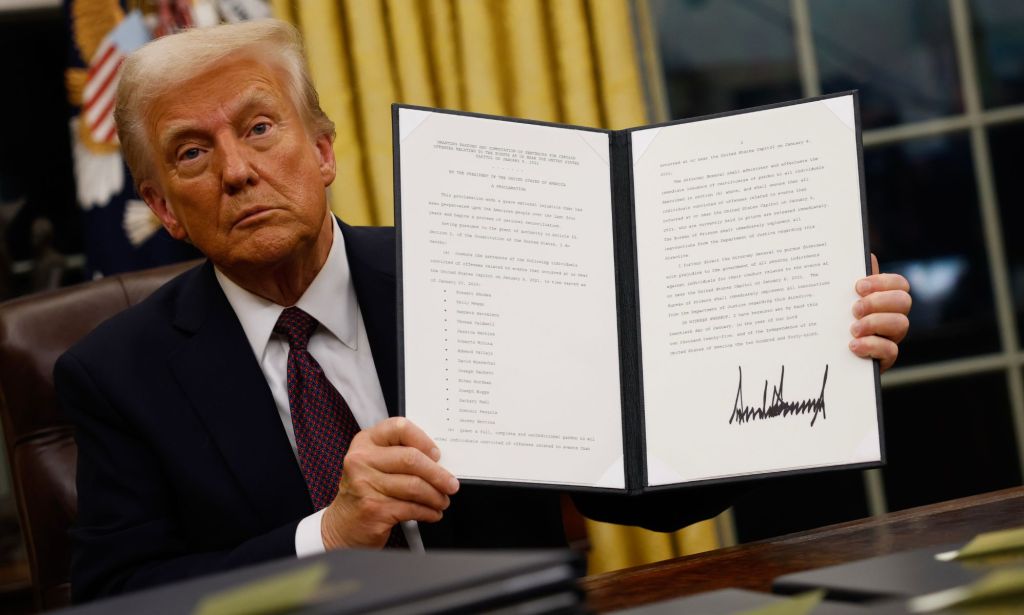
Sarah O’Neill, a data scientist at the intelligence agency, has disputed the legality of Executive Order 14168, which was signed by Donald Trump in January following his return to the White House for his second term and stated that the US would henceforth only recognise “two sexes, male and female” and these are “immutable”.
The executive order, titled ‘Defending Women From Gender Ideology Extremism and Restoring Biological Truth to the Federal Government’, claimed so-called “ideologues who deny the biological reality of sex” have “used” the law to “eradicate the biological reality of sex”.
Trump went on to state his administration will “defend women’s rights and protect freedom of conscience by using clear and accurate language and policies that recognize women are biologically female, and men are biologically male”.
O’Neill’s lawsuit, which was filed at the U.S. District Court in Maryland, says Trump’s executive order “declares that it is the policy of the United States government to deny Ms. O’Neill’s very existence”.
She said since the executive order was signed her workplace has revoked its policy recognising her as a trans person and her “right to a workplace free of unlawful harassment,” whilst also “prohibiting her from identifying her pronouns as female in written communications” and “barring her from using the women’s restroom at work”.
O’Neill believes the order contravenes Section VII of the Civil Rights Act 1964, which prohibits employment discrimination based on characteristics such as race and sex, and its later amendments which included gender identity and sexual orientation.
In 2020, the US Supreme Court ruled on three cases where it concluded existing provisions under the 1964 Civil Rights Act also apply where “an employer fires an individual merely for being gay or transgender” – simply put, the court ruled LGBTQ+ people are protected against employment discrimination at the federal level.
Justice Neil Gorsuch wrote in his legal opinion at the time: “It is impossible to discriminate against a person for being homosexual or transgender without discriminating against that individual based on sex.
“Consider, for example, an employer with two employees, both of whom are attracted to men. The two individuals are, to the employer’s mind, materially identical in all respects, except that one is a man and the other a woman.
“If the employer fires the male employee for no reason other than the fact he is attracted to men, the employer discriminates against him for traits or actions it tolerates in his female colleague.
“Or take an employer who fires a transgender person who was identified as a male at birth but who now identifies as a female. If the employer retains an otherwise identical employee who was identified as female at birth, the employer intentionally penalises a person identified as male at birth for traits or actions that it tolerates in an employee identified as female at birth.
“Again, the individual employee’s sex plays an unmistakable and impermissible role in the discharge decision.”
The ruling went against Trump’s then-first term administration which intervened in the case to argue Title VII provisions should only apply based on the “ordinary meaning of sex” as either male or female and not cover sexual orientation or gender identity.
O’Neill’s lawsuit argues, as quoted by the Associated Press: “The Executive Order rejects the existence of gender identity altogether, let alone the possibility that someone’s gender identity can differ from their sex, which it characterizes as ‘gender ideology.'”
She is seeking for her workplace protections and rights prior to the executive order to be restored alongside financial damages.