
University professor banned from teaching about Plato over ‘sexuality’ rules
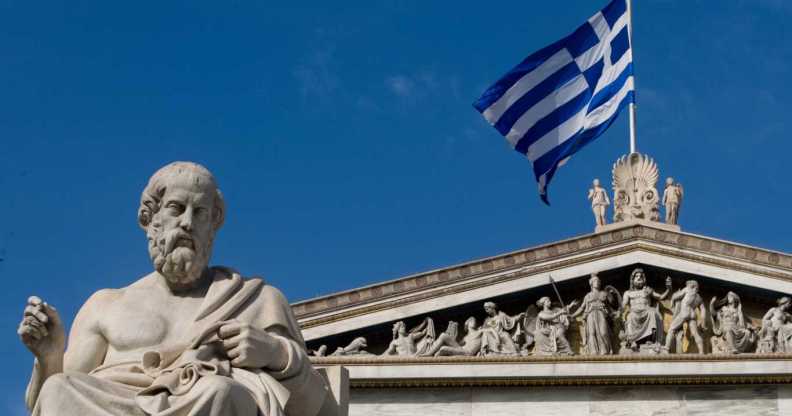
A statue of the ancient Greek philosopher Plato stands outside the Athens Academy. (Milos Bicanski/Getty Images)
A professor at Texas A&M University has been told he can’t teach Plato because it’s too gay, it appears.
On Tuesday (7 January), professor Martin Peterson was allegedly instructed by administrators to cut some teachings by the ancient Greek philosopher.
His head of department, Philosophy department chair Kristi Sweet, reportedly wrote in an email that by cutting certain teachings his philosophy class would be able to comply with new policies on discussion of race and gender.
Emails seen by Daily Nous allegedly order the university to “remove the modules based on race ideology and gender ideology and the Plato readings that may include these”.
The readings impacted by the instruction are from Plato’s Symposium, specifically from Aristophanes’ account of the origin of love and Diotima’s ladder of love, both of which address love between people of the same sex.
The Board of Regents updated its rules in November, to state that courses may not “advocate race or gender ideology, or topics related to sexual orientation or gender identity”, following a controversy involving a professor Melissa McCoul at the university who continued to teach a children’s literature course that former president of Texas A&M University Mark Welsh stated “contained content that did not align with any reasonable expectation of standard curriculum for the course”.
Welsh departed from his role in September last year after dealing with backlash over McCoul, who was fired after a viral video showed the student confronting her over her use of LGBTQ+ themes in analysing children’s books.
The updated rules have been criticised by Peterson for censoring professors and limiting academic freedom, with Peterson stating that the readings were connected to a lecture on sexual morality, and that “these topics are commonly covered in this type of course nationwide”.
“Texas A&M is a public institution bound by the First Amendment. The Supreme Court has noted that academic freedom is ‘a special concern of the First Amendment, which does not tolerate laws that cast a pall of orthodoxy over the classroom’,” Peterson wrote back to the head of his department, Sweet.
Share your thoughts! Let us know in the comments below, and remember to keep the conversation respectful.