
Six myths about trans athletes, debunked
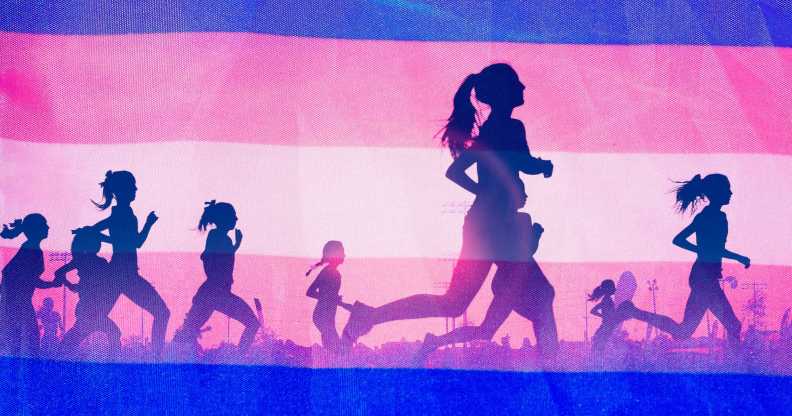
Trans athletes deserve to compete in sporting events. (Getty)
Trans athletes are back in the news again and, as such, so are the myths some use to try to justify their exclusion from sports.
The US Supreme Court heard oral arguments regarding two cases that could determine the legality of laws banning trans students from sporting events on Tuesday (13 January).
Several claims based on myths around physical ability in sport were used to justify bans in Idaho and West Virginia.
Here are some of the most common arguments used to ban trans women in sports, and why they’re nonsense.
‘Teams are sex-segregated because boys are better at sports than girls’

This is untrue for multiple reasons, and is rooted in underlying misogynistic perceptions of women that date back to the 1830s.
While recorded depictions of sex-segregated sports date as far back as Ancient Greece, women were seldom allowed to play sports in the 19th century because of misogynistic perceptions of them as inherently weak and helpless, according to Goal Five.
Eventually, upper-class women were allowed to play tennis and golf at local country clubs and, by the turn of the century, women gradually fought for their right to compete. By the time of the early 1900s, many regulators introduced women’s-only categories over complaints that they were “intruding” on male spaces.
Thus, sex-segregation became the norm in the sporting world and has since persisted partly due to tradition, but also to allow opportunities for both female and male athletes. Not because of “biological” advantages, but because of issues such as the gender pay gap.
Sex-segregated categories are also not innate. Many argue the practice is increasingly untenable, according to The Society Pages, and leads to further misogyny over who can and can’t compete in the women’s category, such as the controversy over Caster Semenya, who is a cisgender woman.
‘Transgender women are taking away opportunities for cisgender women’
There are two fundamental problems with this argument. The first is that there are virtually no trans women competitors who are at the top of their respective sports. The second is that trans women are women and, as such, deserve to compete as much as their cisgender competitors.
According to WorldAtlas, the five biggest sports by number of fans are football (soccer), cricket, hockey, tennis, and volleyball. Of those sports’ respective annual rankings, none have ever featured a trans woman.
The only people taking opportunities away from women are the national and international sports bodies that have implemented bans on trans competitors, many of which still insist they believe that trans women are women.
Football legend Gary Lineker himself deplored the rising number of bans in May 2025, describing trans people as “some of the most persecuted on the planet”.
‘Excluding trans women from women’s sports isn’t transphobic, it’s just a game after all’
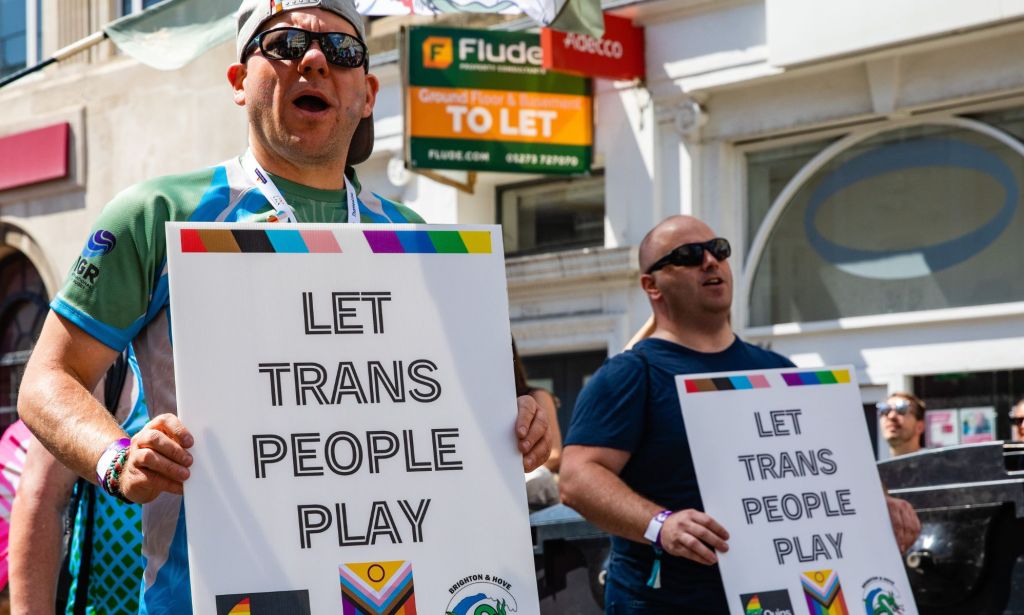
Puzzlingly, excluding trans women from women’s sports is one of the most commonplace anti-trans beliefs among the general public.
A YouGov poll from February 2025 found that 74 per cent of the UK public think trans women should be excluded from women’s sports, while 60 per cent feel the same way about trans men in men’s sports.
This viewpoint is likely so common because of a perception that sports are nothing more than unserious games detached from real life. That, in turn, makes the transphobia easier to digest because it isn’t viewed as ‘real’ transphobia.
The issue here is that sports are not detached from reality. Sporting is a $417 billion industry that has real sway over people’s perceptions of reality. Its influence is why riots are so common following major sporting events.
Sports are so influential, in fact, existing tension between El Salvador and Honduras turned into a brief war, known as The Football War, in 1969 after riots over the results of a 1970 FIFA World Cup qualifier. While the roots of the conflict ran much deeper, it contributed to the build-up of the war, which took place between 14-18 July 1969, hence its other name, the 100 Hour War.
Whether you’re a fan or not, it’s undeniable that sports have a huge influence over the world, from its culture to its politics. When trans people are denied the right to play, they are denied the right to participate in a major part of global society.
‘Trans women are injuring cis women during sporting events and are dangerous’
This claim is common among more anti-trans pundits and groups, many of whom are trying to demonise trans people across all walks of life.
The most notorious example used is volleyball player-turned anti-trans pundit, Payton McNabb, who was injured playing high school volleyball against a trans competitor in 2022. McNabb has since become an ambassador for the Independent Women’s Forum (IWF). The IWF have been accused of aggressively lobbying for trans-exclusionary policies.
According to a 2023 study, 214,000 female volleyball players aged 14 to 23 have been injured since 2012. Nowhere in the study does it say trans people are vastly responsible for these injuries.
There is no evidence whatsoever that suggests trans women are inherently more dangerous or prone to injuring someone than cis competitors. None at all.
‘Sports bans are okay because there aren’t that many trans athletes’
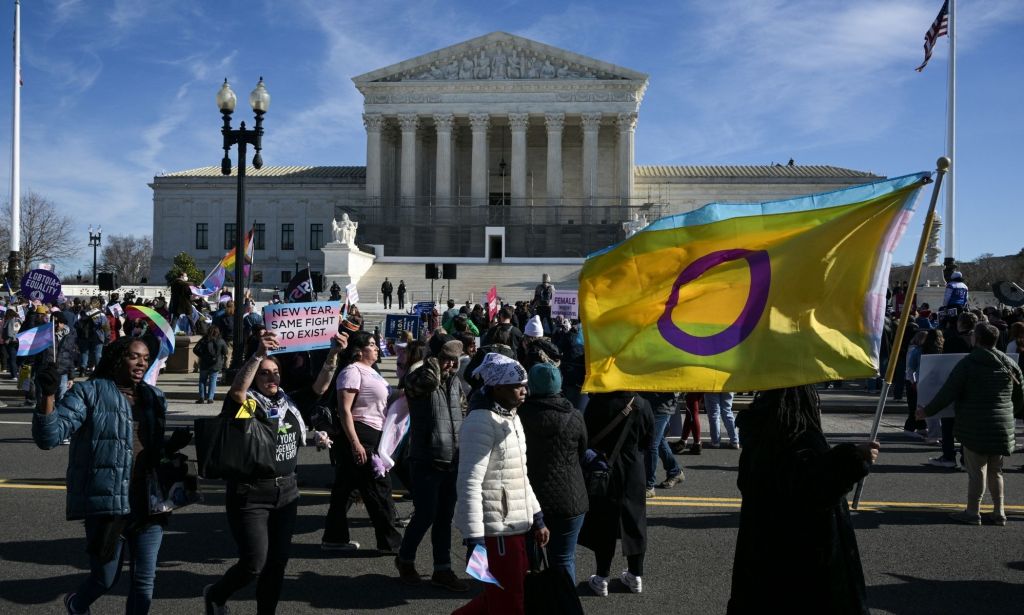
This argument was used by solicitor Hashim Mooppan while speaking to the US Supreme Court on behalf of the Trump administration.
Mooppan argued that laws banning trans women from competing in women’s sports should be permissible because trans athletes represent a tiny fraction of student athletes.
A report from the National Collegiate Athletic Association found that, in 2024, there were fewer than 10 of the 550,000 student athletes nationwide are out as trans.
The issue with this argument is that it could be, and is, just as easily used to justify why trans people should be allowed to compete.
The American Civil Liberties Union (ACLU) has used that argument to justify overturning trans sports bans, arguing that the sheer public scrutiny against trans athletes far outweighs any possible damage they could cause, if any at all.
‘Trans women have an inherent, unchangeable advantage over cisgender women in sports’
This is the big one – virtually every single justification for banning trans women from women’s sports purports that, because they are assigned male at birth (AMAB), they have an inherent advantage.
One major logical problem with this is the state of women’s sports right now. If trans athletes, who have the same level of training as their cis counterparts, have an underlying advantage, surely every top-rated woman in sport would be trans?
A 2024 study backed by the International Olympic Committee found that, conversely, trans women could be in many ways disadvantaged in sporting competitions due to changes induced by feminising hormone replacement therapy (HRT).
Endocrinologist Dr Joshua D Safer told the ACLU in 2020 that a person’s genetic make-up, such as their sex chromosomes, are not good indicators of athletic performance.
“There is no inherent reason why [a trans woman’s] physiological characteristics related to athletic performance should be treated differently from the physiological characteristics of a non-transgender woman.”
This argument’s misogynistic foundations are best displayed when trans women are banned from non-physical sports such as chess or snooker. In 2022, British Open snooker champion Maria Catalano claimed trans women should be banned from competitions because cisgender women’s brains are “wired differently”.