
Men under 24 returning to homophobic views of past generations, study suggests

Young men are more likely to hold homophobic views, study suggests.
Men born in the 2000s are far more likely to hold conservative views on LGBTQ+ rights compared to previous generations and women of the same age, a study has suggested.
Polling from the Pew Research Center found that men aged 24 and under are far more likely to oppose same-sex marriage and even homosexuality generally than those born between the 1980s and 1990s.
Men are also far less likely to support LGBTQ+ rights than women of the same age. In fact, women are consistently more likely to be LGBTQ+ allies than men across all age ranges.
The 2024 study, highlighted in a report from the American Institute for Boys and Men (AIBM) in December, found that 71 per cent of men born in the 2000s believe same-sex marriage should be legal. Comparatively, 77 per cent of men born in the 1990s and 73 per cent born in the 1980s support same-sex marriage.
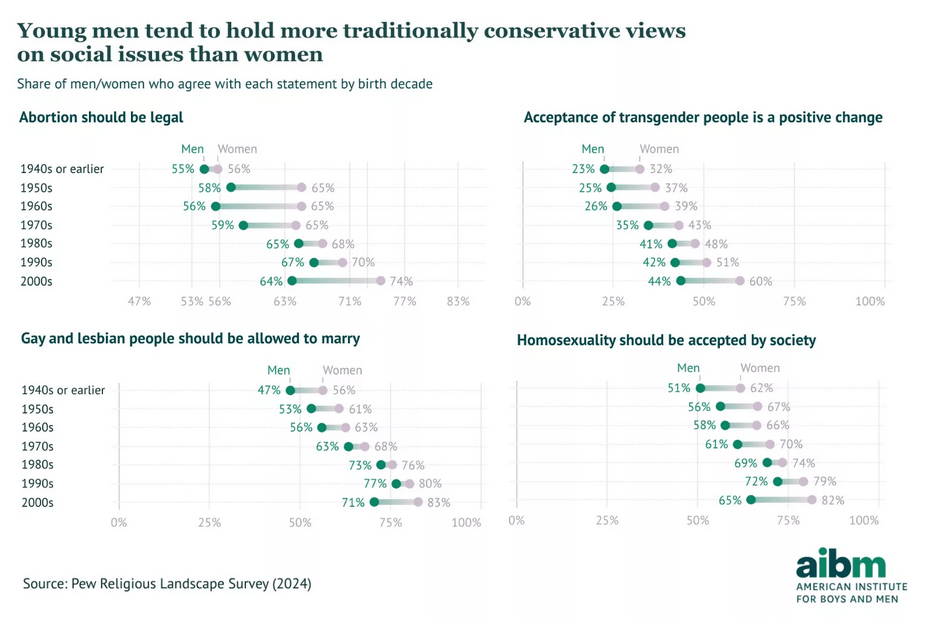
Sixty-five per cent of 2000s men believe homosexuality should be accepted in society, over seven per cent less than those born in the 1990s and three per cent less than 1980s men.
Women aged 24 and under, meanwhile, are far more likely to support LGBTQ+ rights, with 83 per cent supporting same-sex marriage and 82 per cent supporting homosexuality generally.
AIBM noted the gender gap for those born in the 2000s was the widest in nearly every subject compared to every other decade.
Trans rights were by far the most contentious subject among young people. 60 per cent of 2000s women said they believe trans people should be accepted by society, while just 44 per cent of 2000s men answered similarly – a gender gap of 16 per cent.
Support for same-sex marriage saw a 2000’s gender-gap of 12 per cent, support for homosexuality had a gap of 17 per cent, and abortion rights a gap of 10 per cent.
Washington University professor of practice, Ryan Burge, argued the survey results prove that young men are increasingly influenced by “social-issue messaging”, particularly from right-wing religious groups.
“As academics often say – we need more time and more data,” he wrote. “I suspect the next five years of survey results will significantly clarify the trajectories of young men and women when it comes to religion.
“As their lives stabilise, they settle into careers, and some begin to marry and start families, we will get a much clearer sense of whether religion is actually taking hold. If a shift is coming, these next few years will be decisive.”
Research published in 2024 suggested that Gen Z are more likely to identify as LGBTQ+ than Republican compared to other generations.
The Axios poll found that just 21 per cent of those aged between 12 and 27 describe themselves as Republican, while more than a quarter described themselves as LGBTQ+. It also found that young people are far more likely to be religious than other generations.
Share your story! Do you have an important, exciting or uplifting story to tell? Email us at [email protected]