
EHRC trans guidance to be changed under ‘constructive’ review, sources claim

Equalities minister Bridget Phillipson was handed the EHRC trans guidance in September. (Getty)
Equalities minister Bridget Phillipson was handed the EHRC trans guidance in September. (Getty)
Guidance which could determine transgender people’s right to access the correct single-sex facilities is reportedly being modified to lessen the impact against businesses, the UK’s equality watchdog has said.
Government sources have said lawyers are working with the Equality and Human Rights Commission (EHRC) to change elements of the code of practice on single-sex service provision that was handed to the Equalities Department last year.
A currently unpublished draft of the code was handed to equalities minister Bridget Phillipson in September following a controversial consultation responding to a Supreme Court ruling on the 2010 Equality Act’s definition of a woman.
The proposed updates, brought under former EHRC chair Kishwer Falkner, would have banned trans people from using facilities, such as toilets, consistent with their gender identity and, in some cases, their birth sex too.

Sources close to the situation claimed to The Guardian that lawyers for both the EHRC and the government are discussing potential changes to the finalised draft following the appointment of the new EHRC chair, Dr Mary-Ann Stephenson.
“We have to get this right, and this takes time,” one source said. “But it is fair to say that we are finding the EHRC more constructive under the new chair than the old one.”
Under UK law, changes to a code of practice handed to ministers can only be made if the draft is rejected and amendments are requested.
While no specific changes have been reported at this time, sources claim that Dr Stephenson is more open to taking a “pragmatic approach” that could limit the financial impact a trans toilet ban would have on businesses.
UK businesses at ‘constant risk’ of lawsuits under EHRC trans guidance
In September, over 650 UK private organisations, including Ben & Jerry’s and Lush Cosmetics, warned that a law banning trans people from single-sex spaces would place them at “constant risk” of lawsuits.
Dozens of backbench Labour MPs echoed these concerns in a private letter to business secretary Peter Kyle, saying they had been contacted by an overwhelming number of small businesses that fear the financial implications could put them at risk of closure.
A government spokesperson confirmed that MPs were reviewing the code of practice “with the care it deserves”, ensuring that it “provides clarity for service providers”.
Trans+ Solidarity Alliance, a UK-based trans rights non-profit, warned the Labour government that a trans toilet ban in any form would become “Labour’s legacy on LGBTQ+ rights for a generation”.
Reacting to suggestions that the code could be changed, the organisation’s director, Alex Parmar-Yee, said: “Any new version of the EHRC’s code that does not provide clarity for service providers on how to include trans people will not fix this mess.
“Trans people are being thrown out of social groups, banned from bathrooms, and put at risk going about our daily lives,” she continued.
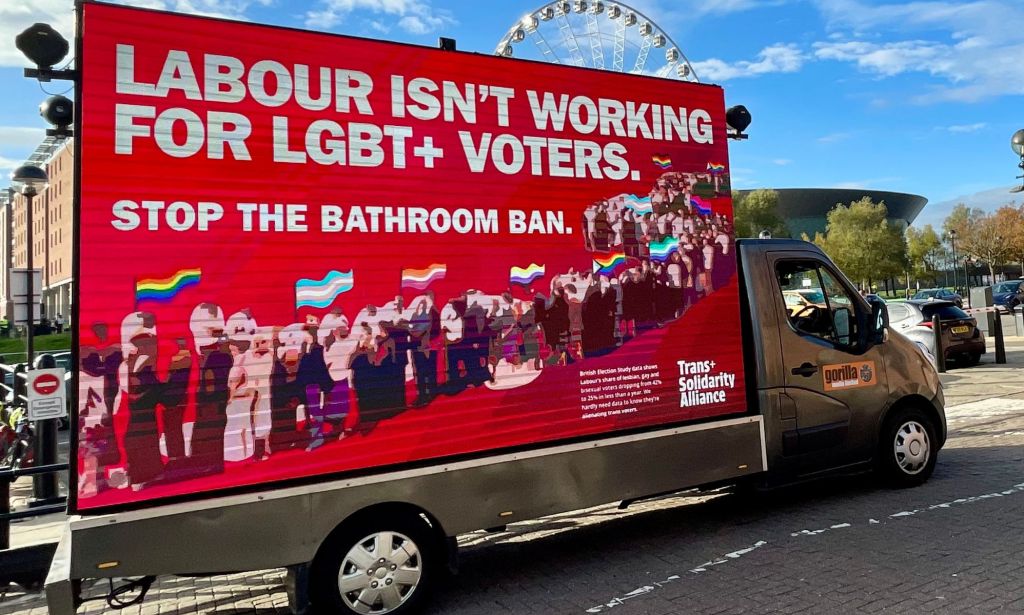
Parmar-Yee added that, while she was glad to hear that MPs were listening to the backlash against the “unworkable guidance”, they must remember that “exclusion must be the exception and not the rule”.
“Anything else means businesses, charities, and public services being forced to police everyone’s gender,” she added.
The Supreme Court ruling’s impact is already being felt, with numerous people – cisgender and transgender – have already reported being harassed inside toilets, while others have said they were denied access to facilities altogether.
One individual, a transgender man, recalled to TransActual that he was barred from both male and female changing rooms at his local gym. He was forced instead to use the family changing room, which he said “makes me look like a creep”.
A spokesperson for the EHRC said it was “convinced that our updated services code of practice is both legally accurate and as clear as it is possible to be”.