
‘Trans women are no threat to cis women, so why is the public ready to believe they are?’

Statistics prove that trans women have never been a threat to cis women. (Getty/Canva)
Statistics prove that trans women have never been a threat to cis women. (Getty/Canva)
Let’s be crystal clear – according to the bulk of reliable evidence, data, and research on the subject, transgender women as a demographic are not, and have never been, a threat to cisgender women and girls.
Mountains of evidence proves that trans women, whether in bathrooms, changing rooms, sports, or other women-only spaces, do not constitute an inherent danger to their cisgender peers.
Earlier this month, a report found just four official complaints made against trans women in single-sex spaces across 382 public bodies since 2022.
READ MORE: EHRC trans guidance to be changed under ‘constructive’ review, sources claim
A month prior, academic Rosa Campbell, writing for the History Workshop Journal, used the case study of an Australian woman’s-only refuge as evidence that trans women are more likely to share experiences of violence with cis peers than cause them.
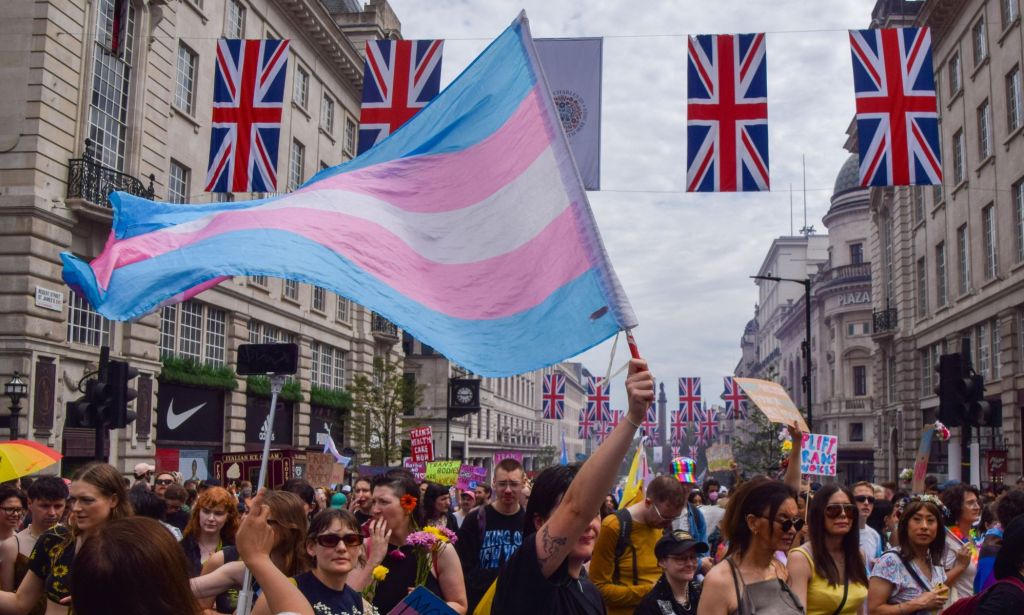
Numerous studies have shown that trans women, particularly trans women of colour, are disproportionately the victims of violence. One report from the UCLA Williams Institute found that trans people are four times as likely to face abuse, while a separate report from the Crown Prosecution Service found that nearly three-quarters of trans people have experienced abuse.
Bizarrely, despite this evidence, a growing number of people in the UK seem to think that trans women are dangerous to cis women and girls.
A YouGov poll from February last year suggests that over half of UK adults believe trans women shouldn’t be allowed to use women’s changing rooms, toilets, or refuges. Shockingly, a quarter of people who have a friend or family member who is trans shared this sentiment.
So why is there a disconnect between rhetoric and reality? What is driving this belief that trans women are a threat to their cis peers, despite evidence?
Cisgender women collective says trans issues are ‘manufactured’
The disconnect is predominantly caused by ignorance, argues Not In Our Name (NION), a collective of cisgender women united in their solidarity with trans people.
Speaking to PinkNews, the group argues that the uninformed public are being swept up in a “manufactured drama” built on “what-ifs” rather than facts.
“It’s the spectre of fear that makes people take action – whether it is real or imagined,” a spokesperson for the group says. “People don’t tend to get too bogged down in the details, unless it impacts them directly.
“Instead, they focus on the headline which is intended to grab people’s attention – irrespective of whether or not it fully reflects the actual facts of the story.”

NION launched last year with an open letter condemning politicians for appropriating women’s rights to justify anti-trans policies. The open letter, at the time of reporting, has over 78,800 signatures.
Its founders argue that the majority of cisgender women are not only aware that trans women aren’t a threat, but they “don’t even think it”.
Separating YouGov’s poll by gender shows that women were less likely to hold trans-exclusionary views. Female respondents were six per cent less likely to object to trans women using female toilets and five per cent less likely to take issue with them using rape crisis centres.
Pushing these damaging claims is part of a tactic NION calls “toilet hysteria”, which is historically used to paint a group or demographic – in this case trans women – as a constant threat, even during a person’s trip to the bathroom.
It has worked in part because of an uninformed, yet largely common view that trans people are a new phenomenon.
“Psychologically speaking, it is not particularly difficult to whip people up into fear and hate,” they say. “Humans are naturally primed to be wary of the unfamiliar, different, or unknown.
“Given that we have had years of scaremongering about trans people, it’s not surprising that people start to respond with prejudice and fear rather than acceptance and compassion.”
‘Transmisogyny’ and how sexism fuels transphobia
While this explains how public opinion is so easily swayed by anti-trans rhetoric, it doesn’t answer a fundamental question – why are right-wing politicians suddenly attacking trans people?
Aside from the fact that bigotry is ripe within right-wing spaces, NION argues it’s used by failing political figures or increasingly unpopular pundits to distract from actual issues.
“Trans people have become a political football, used as a distraction from other, more pressing matters that are perceived as too big or too difficult to navigate,” they argue. “The fact that the evidence is not there to back up claims made about the community is largely irrelevant to those seeking to ‘other’ trans people, and trans women in particular.
Numerous political figures, from Zooey Zephyr to Kamala Harris, have made similar observations that bigotry is a prime tactic for obscuring unpopular economic decisions.

This is done by making the prejudice more palatable through euphemisms. Republican senator Barry Goldwater famously used this tactic to mask his support of racial segregation during the 1964 presidential election.
Transphobic activists use a similar tactic, framing their prejudice as a feminist issue. Under this skewed worldview, banning trans women from women’s-only spaces is a pro-woman move because trans women are viewed as men.
In reality, transphobia is itself built on a patriarchal, misogynistic view of femininity as inferior to masculinity. In this framework, trans women, viewed as men, have purposefully degraded themselves by choosing to live as the ‘inferior sex’ and must have done so to exploit women.
This forms the basis for what’s known as ‘transmisogyny’, a term invented by Julia Serano to describe how trans women are only treated as women when it serves to oppress them.
An example of transmisogyny is the arrest of Ashley Del Valle, a trans woman and New Yorker charged with indecent exposure for showing her breasts, but was then housed in an all-male jail.
In her book Whipping Girl, Serano argues that, because the existence of trans people implies that gender is not rigid, conservatives try to paint trans women as men. This, in turn, allows transphobes to justify their claims that trans women are a threat by appropriating the overwhelming evidence that cisgender men are responsible for the majority of violence against women.
NION echoed this, saying that those who gain from patriarchal systems use their power to oppress transgender and cisgender women. This, they say, is the biggest threat to women.
“We see this in all of the available statistics,” they say. “Those who reject the concept of gender diversity go out of their way to actively conflate trans women with cis men in order to perpetuate the myth that trans women are something to be feared.
“It’s evident to anyone who cares to look that this is just another example of a minority group being targeted as a distraction from the real challenges we face, none of which have anything to do with trans people. Tens of thousands of women agree so we know we are not alone in our position.”
Share your story! Do you have an important, exciting or uplifting story to tell? Email us at [email protected]