
EHRC refuses to publish meetings on trans guidance
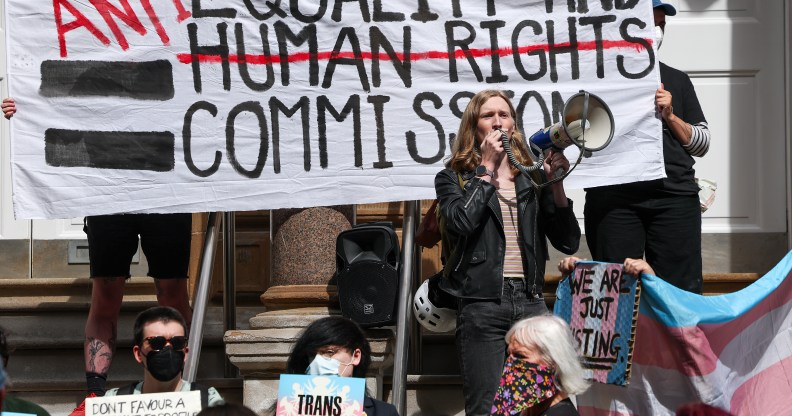
Trans rights demonstrators gather outside the Equalities and Human Rights Commission on May 02, 2025 in Glasgow, Scotland. (Getty)
The Equality and Human Rights Commission (EHRC) has refused to publish minutes of several Board meetings related to its guidance on single-sex spaces.
The UK’s top human rights regulator withheld meeting minutes across nine dates in 2025 in response to a freedom of information (FOI) request.
Activist Philippa East, who issued the request, said that she was told by a spokesperson that the Board meeting minutes would be published “at a future date”.
Its decision to withhold the meeting minutes has been met with backlash from campaigners, who argue it contradicts the regulator’s policies as a public organisation.
The Trans Advocacy and Complaints Collective (TACC) cited an excerpt from the organisation’s transparency and corporate reporting section, which reads: “On this page, you can find minutes of all Board meetings for the last five years. We aim to publish the minutes of meetings as soon as we can after they have been formally approved.”

TACC argued in a letter to the regulator that its refusal to publish meetings, some of which were held more than six months ago, fell “well outside what could reasonably be described as publication ‘as soon as we can’.”
It further argued the EHRC’s insistence that it intends to publish the minutes is “increasingly untenable”, adding: “FOIA does not permit indefinite withholding based on future publication where no clear or reasonable timeframe is provided.”
The Board meetings which East says the EHRC had refused to publicise ranged from June to November 2025.
The regulator partially shared Board meeting minutes from the Scottish branch of the EHRC between May and September 2025.
One of them appeared to confirm that the EHRC had used AI to process the 50,000 responses it received as part of its public consultation into the single-sex code of practice.
“Key themes emerged from responses to the consultation, including general disagreement with the FWS judgment and the concept of biological sex; the necessity of asking about sex at birth and the implications for human rights and privacy; and the lawfulness of providing ‘trans-inclusive’ services.”
Share your story! Do you have an important, exciting or uplifting story to tell? Email us at [email protected]