
Major medical orgs partially U-turn on trans surgeries – here’s what they said

The AMA and the ASPS have partially U-turned on policies regarding trans surgeries. (Getty)
Two major medical organisations have partially reversed their support for gender-affirming care for transgender youth – here’s what they did and didn’t say.
The American Medical Association (AMA) and the American Society of Plastic Surgeons (ASPS) made partial changes to their recommendations on gender-affirming care for trans and non-binary youngsters.
In a statement reported by the New York Times on Wednesday (4 February), the AMA – the largest and only national association which represents nearly 200 medical speciality societies across the country – recommended that any gender-affirming surgeries be delayed until adulthood.
A day prior, the ASPS took a similar position, claiming that there was insufficient research on the benefits of gender-affirming surgeries, according to a literature review published alongside its statement.
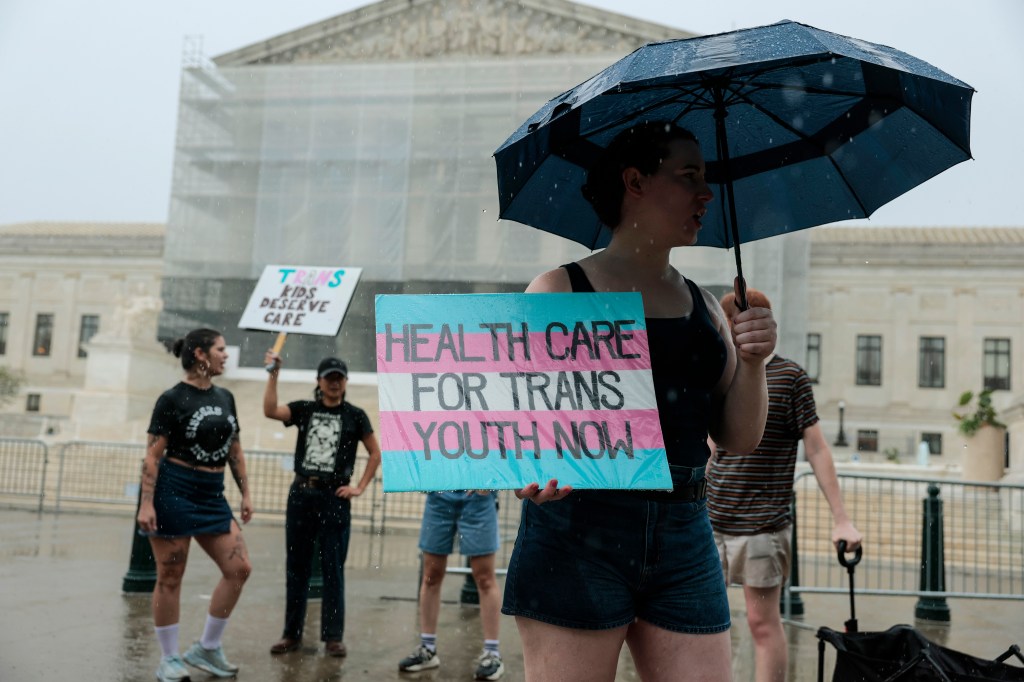
The announcements mark a step back for LGBTQ+ rights across the US and internationally. Activists and campaign groups regularly cite the AMA’s and several other medical institution’s recommendations as evidence that appropriate gender-affirming surgeries are safe and effective.
Gender confirmation surgeries such as phalloplastys, hysterectomys, and baginoplastys, are virtually never performed on trans under-18s. Some teenagers aged 16 and above can undergo procedures like facial feminisation surgery (FFS) or a mastectomy, though these are incredibly rare.
Research has shown that providing appropriate healthcare for trans youngsters not only hugely improves their quality of life, but can reduce suicidality.
Right-wing groups and politicians have, over the past decade, falsely claimed gender-affirming surgeries are incredibly common by conflating them with gender-affirming care, which largely involved physically reversible, safe, and potentially life-saving puberty suppressants, known as puberty blockers.
In reality, cisgender youngsters are far more likely to undergo gender-affirming surgeries than their trans peers, according to research from Harvard.
Last week, a Republican lawmaker in Tennessee went so far as to call for the parents of trans children to be put to death for supporting gender-affirming care.
AMA continues to support puberty blockers, spokesperson says
The AMA said it had not, and did not plan to, U-turn on its support for puberty suppressants, but had instead decided that “surgical interventions in minors should be generally deferred to adulthood”.
Other major medical organisations, including the American Academy of Paediatrics (AAP), told the New York Times that their recommendations remained consistent and did not include a “blanket recommendation for surgery for minors”.
Dr Andrew Racine, AAP’s president, said: “The AAP continues to hold to the principle that patients, their families, and their physicians – not politicians – should be the ones to make decisions together about what care is best for them.”
The Trump administration has bolstered attacks against gender-affirming care provisions across the US over the past year.
While many US states banned hospitals from providing often life-saving gender-affirming care years before Trump started his second term, the president has ramped up those attacks by targeting medical organisations in states where it is still legal.
Those attacks grew after the US Supreme Court ruled to uphold Tennessee’s gender-affirming care ban for trans youngsters, essentially setting a legal precedent that any active or future laws are lawful.
Nearly a quarter of all trans youth in the US live in a state that has banned gender-affirming care in some capacity, according to the Human Rights Campaign.
Share your story! Do you have an important, exciting or uplifting story to tell? Email us at [email protected]