
This LGBTQ+ art exhibition is begging you to listen to trans youth
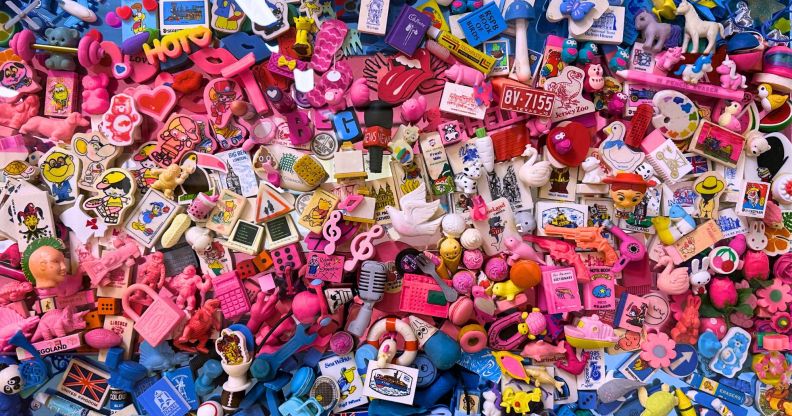
Under Our Skin is available to visit in Brixton Tate Library until 26 February 2025. (Supplied)
There’s a striking art installation currently available to view at the Brixton Tate Library in south west London right now called Protect the Children.
Created by Trans+ History Week founder Marty Davies, the piece uses hundreds of children’s pencil erasers, some over 56 years old, to form the transgender Pride flag. It was created as part of the “Under Our Skin” exhibition, which is free to visit until 26 February.
“I wish I’d used Locatite super glue gel from the start!” Davies joked in an interview with PinkNews. “I pray for the erasers to resist gravity and stay in place.
“It’s created an unintended layer in the work as the odd eraser pops off and lies at the bottom of the case. It’s fragile, just like our rights.”
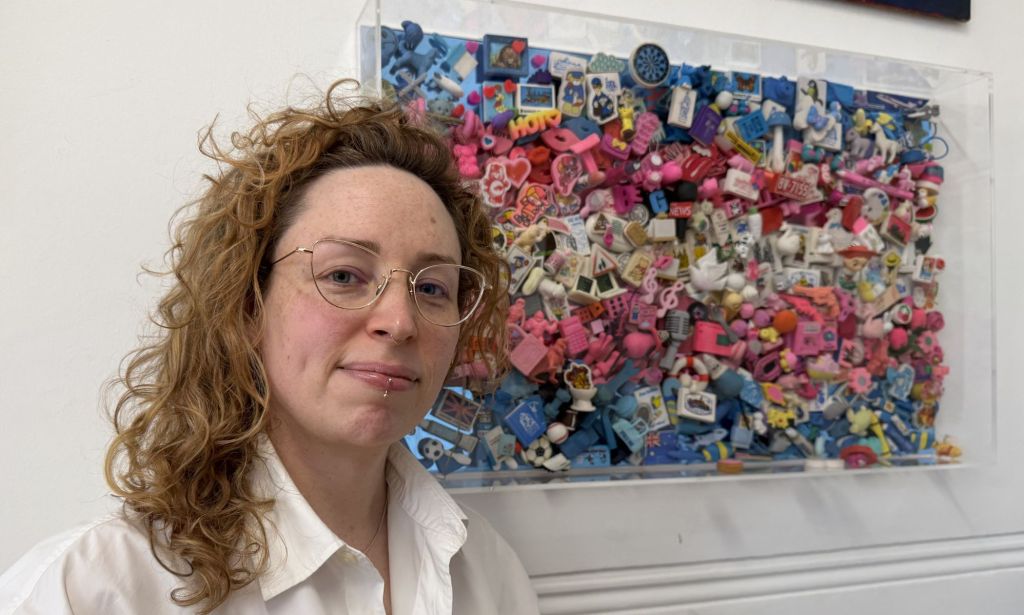
Davies created Protect the Children in opposition to the government’s latest updates to its relationships, sex, and health education (RSHE) guidance.
Published in July last year, the updates instruct staff not to endorse or teach any particular view on “transgender identities” as fact and instead highlight what it describes as a “significant debate” on the subject.
Growing up during the much-reviled Section 28, Davies said they immediately recognised the “looming” threats that the new provisions, which she dubbed a “gaslighting tactic”, could cause.
During the artistic process, Davies says the art piece became something much bigger, encompassing the rights of trans youth as a whole in one, defiant, literal statement: “You can’t rub us out of reality. We’ve always been here.”
‘They do not feel centred in the conversations about their own lives’
It has been a tumultuous time for trans youth in the UK and overseas. The impact of Labour’s widely-reviled puberty blockers ban, the closure of the Tavistock, and the recently issued gender questioning guidance has only been exacerbated by those in power routinely leaving trans youngsters out of the conversation.
Even when campaigners show support for trans youth, it is usually framed in a way where parents are choosing on behalf of their children, rather than acknowledging their legal and human right to make their own healthcare decisions.
“If you listen to trans, non-binary, and intersex youth, they will tell you that they do not feel centred in the conversation about their own lives,” Davies says. “I do think there can be a tendency in advocacy to reach for rhetoric and rights framing that feels most effective without thinking about what might be reinforced by doing so.
“An overemphasis on parental rights will, of course, distance the conversation away from a young person’s own right to self-determination. And that is a problem. I chose the title of the work as Protect the Children to call attention to the harm that can be done by an over-focus on, and abuse of, parental rights.”
Protect the Children is just one of the several art pieces viewable at Under Our Skin which provides a nuanced understanding of key issues that are seldom discussed with care and consideration in mainstream UK society.
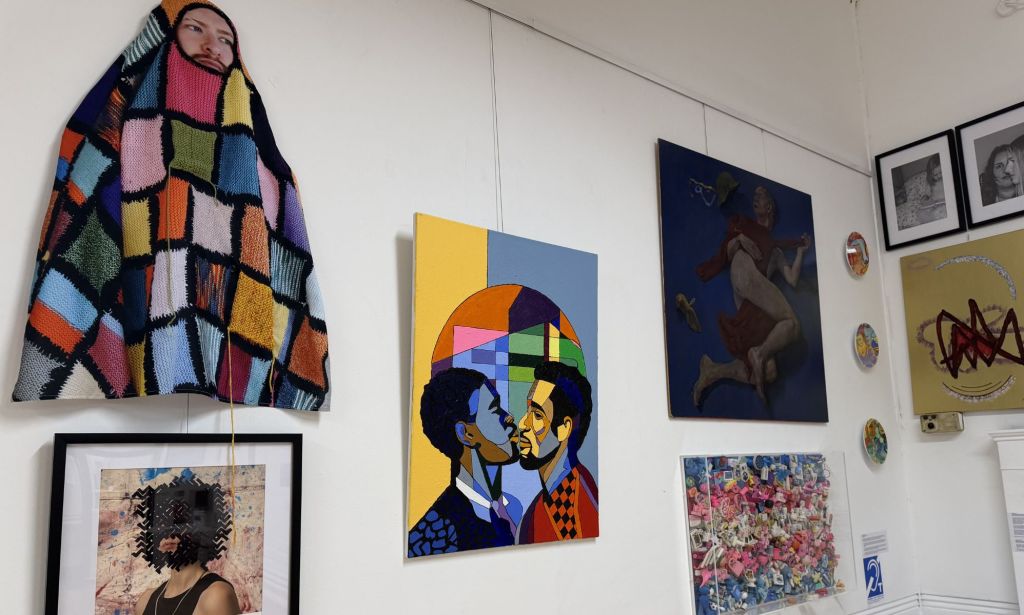
The exhibition’s curator, Xavier White, says his main goal was to create a bright and accessible artistic representation of “the things that make us and the moments that shape us”.
“For LGBTQ+ people these can be anything from bullying, to coming out, to finding belonging through community,” White said. “I wanted a bright and accessible exhibition, where people think, ‘this is fun – I want to see what it’s about.’
“I challenge anyone to walk around Under Our Skin and come away not having learnt something new about LGBTQ+ life, or developed a greater empathy for our community.”
‘It’s a really accessible work, and it creates intrigue’
For White, art allows anyone to understand and empathise the intersectional ways that certain topics connect us, regardless of who we are. This is particularly true, White says, when discussing traumatic topics like bullying or abuse.
“I cannot separate my gayness from my ADHD or dyslexia, and I cannot separate that from my experiences of acute chronic illness, and of disability,” White says. “What I can do, is create artwork about it to help others understand my work.”
One example, White notes, is the piece Injections of Hope and Other Side Effects – a 3D lenticular print that moves and changes as you walk around it. This allows the viewer, White says, to “interact with the subjects it covers in a way that lays me bare”.
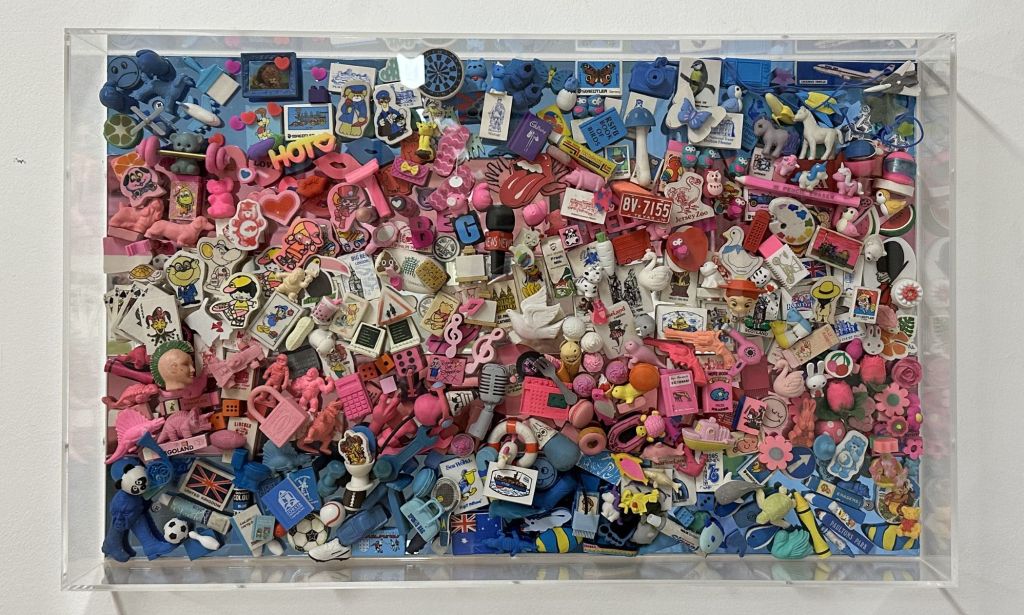
Protect Our Children is, itself, a firm example of this. The piece is, for all intents and purposes, about the impact of transphobia, but by representing it through an item used by virtually every school-age child, Davies has broadened its impact. Suddenly, it has transformed into a representation of how all adolescents are ignored by society, while still focusing on the specific way this impacts trans youngsters.
“There are many mini stories playing out in the interactions of the erasers. Some for me and some for us all,” Davies explains. “I have erasers that represent my sister and my mum. And ones that represent my child self. But there are also stories of the dismantling of our rights, of toilet bans, sports bans and the funding behind it all.”
White says he was drawn to the piece because of the “literal” way it conveys its message. Also, he says, it’s simply a cool piece of art to look at.
“I love seeing if I can spot an eraser I used to own, and watching audiences do the same,” he says. “It’s a really accessible art work, and it creates intrigue, which is exactly what I’m trying to do with Under Our Skin.
“It’s impossible to leave that artwork, and the description on the wall under it, without an understanding that the new RHSE guidance seeks to erase trans people from both history and the contemporary narrative. However, trans people cannot be erased.
“I hope people enjoy Under Our Skin and come away having learnt something. It hope it’s the authentic exhibition that the queer community needs, and that it reaches out beyond that and humanises us in the eyes of non-LGBTQ+ people who just so happen to stumble across it,” White says.
Under Our Skin is still available to visit for free at the Brixton Tate Library in London until 26 February 2025. Details are available in the link here.