
High Court’s ruling on EHRC trans guidance heads to Court of Appeal
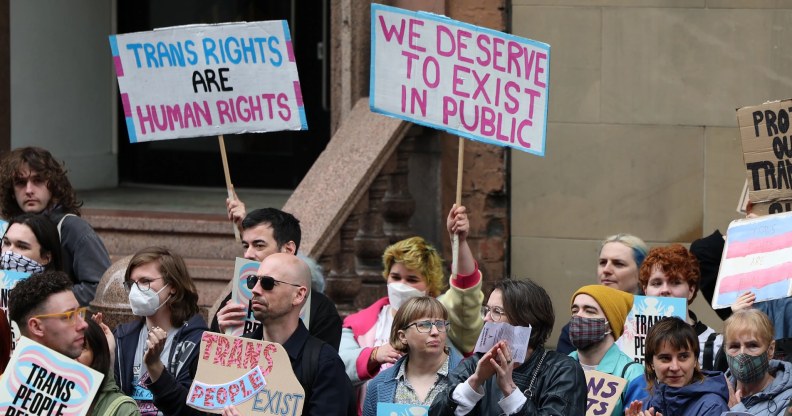
Trans rights demonstrators gather outside the Equalities and Human Rights Commission on May 02, 2025 in Glasgow, Scotland. (Getty)
UK non-profit The Good Law Project is helping three claimants appeal the High Court’s decision on the lawfulness of the EHRC’s interim trans guidance.
On 13 February, the High Court said that trans women are lawfully permitted to use women’s facilities, save for at work, in a decision on the Equality and Human Rights Commission’s interim code of practice.
The judgement ruled that service providers do not need to exclude trans people from using the correct facilities, including toilets and changing rooms, despite the EHRC’s claims. High Court Justice Swift ruled that the equality watchdog’s interpretation of the law is inaccurate but that single-sex spaces in workspaces must remain trans-exclusionary.
READ MORE: EHRC concludes regulatory action on single-sex spaces review
The High Court initially denied the claimants’ permission to apply for judicial appeal, which Good Law Project said they “expected”, with Justice Swift writing that none of the proposed grounds of appeal had “any real prospect of success”.
The Good Law Project is now assisting the claimants in applying to the Court of Appeal on the same five grounds, one of which argues that the High Court’s approach to human rights was “flawed”.
“We think it failed properly to recognise the nature and scope of the positive obligations imposed by Article 8 of the European Convention on Human Rights to protect the rights of trans and intersex people, and to avoid relegating them to ‘an intermediate zone as not quite one gender or the other’,” The Good Law Project wrote in a case update statement on 23 February.
The other grounds for appeal include: “The Court erred in finding that the Guidance was accurate and contained no material omissions, when this was unsupported by its own findings as to the law”, “the Court failed to construe the Guidance in accordance with its natural and ordinary meaning”, “the Court misconstrued the 1992 Regs”, and “the Court erred in failing to identify a breach of the Respondent’s specific mandatory duties under ss. 8 and 9 of the Equality Act 2006”.
Last October, the EHRC withdrew interim guidance which was published in April 2025, which said employers and service providers must exclude trans folk from gendered spaces or services, including toilets.
The EHRC’s draft code, submitted to the UK government in September 2025, has not yet been approved or published.
Share your thoughts! Let us know in the comments below, and remember to keep the conversation respectful.