Honey Mahogany on politics and drag in Hunky Jesus: ‘We want trans people to be thriving’
One of the stars of Hunky Jesus is Honey Mahogany. (BFI Flare)
For drag performer and political activist Honey Mahogany, being granted an Honorary Sainthood from the Sisters of Perpetual Indulgence marked a career highlight. “I consider it one of the biggest honours of my life,” Mahogany says of her Sainthood to PinkNews ahead of the 2026 BFI Flare London LGBTQIA+ Film Festival.
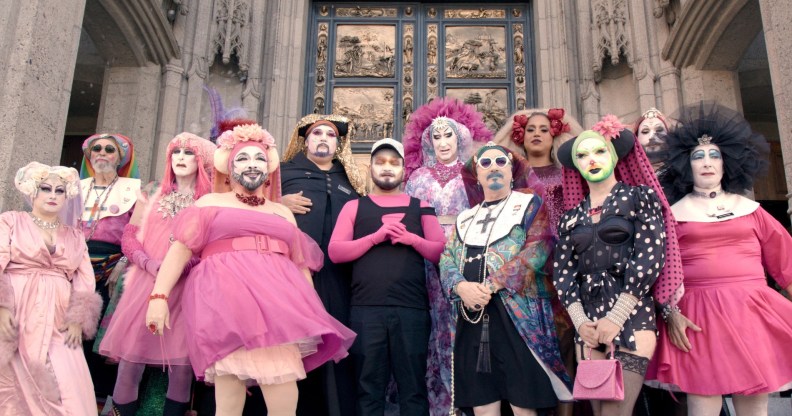
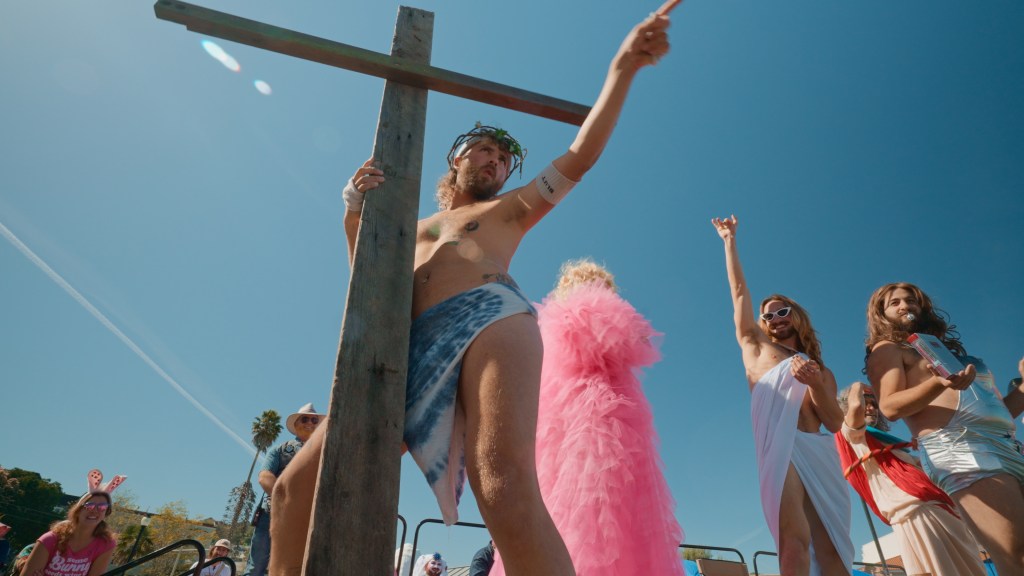
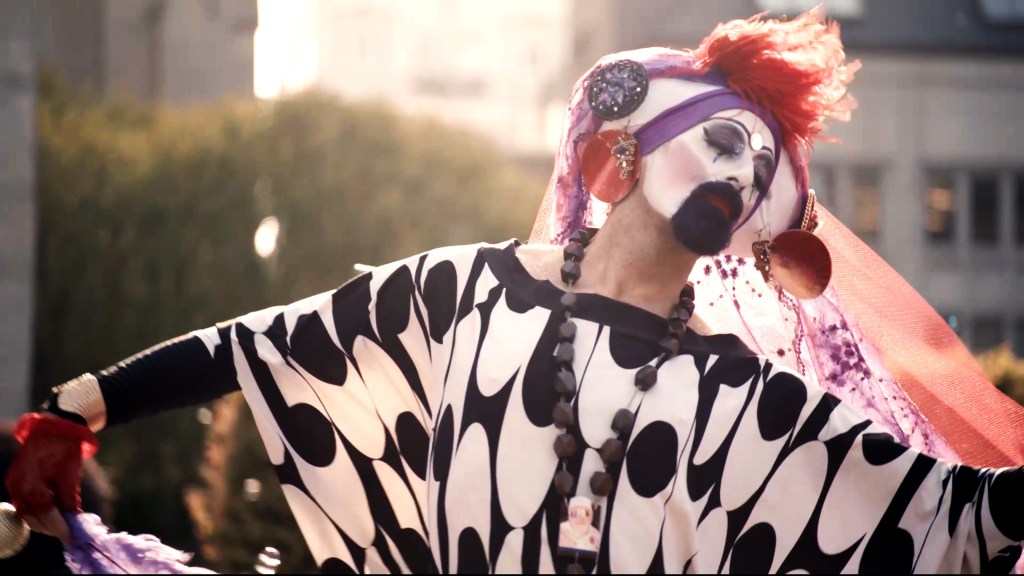
The Sisters of Perpetual Indulgence – a legendary collective of queer and trans nuns who have coupled activism with performance art over the past four decades – are the subject of Jennifer Kroot’s documentary, Hunky Jesus. The group seeks to banish religious guilt and spread universal joy. Part of this mission, and the focus of the documentary, is the annual Easter Sunday tradition of the Foxy Mary and Hunky Jesus competition. Participants dress up and perform as the biblical characters, rewriting the religious holiday as a defiant expression of community, performance, and radical jubilation.
As well as capturing the colourful competition, Hunky Jesus features sit-down interviews with Sisters and San Francisco community figureheads to discuss the legacy, history and continued importance of the Sisters. One of whom is Mahogany, who you may know from RuPaul’s Drag Race season five.
Since, she has turned her attention to activism and politics in her native San Francisco, California. There, Mahogany has been instrumental in setting up The Transgender District, the first legally recognised trans district in the world. Additionally, she became the first trans person to serve on the San Francisco Democratic County Central Committee and the first Black trans person to win an elected post in California. Furthermore, in 2024, Mahogany was appointed director of the San Francisco Office of Transgender Initiatives.
In an exclusive interview with PinkNews, Mahogany discusses her appearance in the documentary Hunky Jesus, the politics of performance and her work in San Francisco:
When did the Sisters of Perpetual Indulgence enter your life?
The Sisters are such a landmark, history-making organisation. They’re an incredible symbol for resilience and what it means to turn pain into power. They are also a very special organisation for me. I grew up relatively sheltered; my family were immigrants from Ethiopia, and I didn’t see a lot of gay people or diversity.
My first exposure to the Sisters of Perpetual Indulgence was seeing them on the news opposing the Pope, John Paul II’s visit. My family is Catholic, and it was quite shocking to see nuns portrayed in this way – my family saw it as sacrilegious. As I got older, I started to shed the internalised homophobia and learned about the history of the Sisters: fighting off anti LGBTQ protesters through drag, being the first organisation to pen a safer sex pamphlet and distributing materials during the HIV and AIDS crisis. I immediately became a fan, and my connection to the sisters grew out of my friendship with Sister Roma, whom I’ve known for over 20 years. We met at a bar while I was performing, and we just hit it off; the rest is history.
The documentary centres on the Hunky Jesus competition, which had me thinking about recent discussions about art being political. Do you think art is inherently political?
I think everyone just existing is political at this point. I struggle to see how anyone could say any sort of performance is not political. Even when you think about classical performances, they often make statements that reflect their times, society’s values, and our internal struggles with those values.
To me, it’s very obvious that something like drag, especially in this day and age, would be politicised. I have never thought that drag had a gender. I’d grown up sometimes most inspired by cis women who have performed in drag, drag kings and people who did not identify with the gender, even before they had the term non-binary.
With the Sisters of Perpetual Indulgence, the Hunky Jesus and Foxy Mary contest is their big annual anniversary. But they also do amazing theatrical events, like Project Nunway, where sisters dress up in elaborate themes. I’ve hosted and performed at it; it’s just so cool to see all of those nuns decked out in these extravagant looks.
I’m also interested in your shift from the likes ofRuPaul’s Drag Race to politics in San Francisco. Did you always have political ambitions?
No, not at all. My grandfather was a senator in Ethiopia and he was an ambassador in Mexico City. I never got to know him; he passed before I was born, and I never really thought about politics as a viable career.
I remember being involved in Amnesty International because, growing up in Catholic school, I disagreed with so much, so I [clung] to things I did agree with. A lot of it was being of service and wanting to do good in the world. I was politicised in that sense. I became more engaged after Bush was elected for the second time, I was convinced the election was stolen. That politicised me.
I went to school at the University of Southern California, and I was so surprised – coming from San Francisco, where it was so heavily blue – that I was on a campus that was very purple at that time. Seeing a lot of Republicans on campus made me realise that it is not a safe thing that the Democrats will win. That’s when I really started getting politically involved. But again, I never thought that I would run for office.
My first full-time job was working as a homeless outreach worker. I saw firsthand the impacts of people getting kicked out of their families because they’re LGBTQ+. I didn’t think about it as being involved in politics, but I felt that was such a profound injustice. That’s what motivated me to get my master’s in social work. I had to take these government classes where they taught you how to analyse, write and advocate for a bill. I remember thinking, I will never need this and here I am doing that all the time.
What is the reality of LGBTQ+ life today in San Francisco from your perspective?
San Francisco is a sanctuary city within a sanctuary state for multiple communities, the LGBTQ community, the trans community, and the immigrant community. Our California State Legislature, the LGBTQ caucus and Equality California have done incredible work to ensure our state is passing progressive legislation to protect our communities. A lot of the protections that we enjoy come from the state, despite us having a so-so Governor who flip-flops on the trans community.
I work as the Director of the Office of Transgender Initiatives, the only office of its kind in the country. Our main purpose is to serve as a bridge between the government and the trans community. We’ve been really, really busy over the last few years. Some of the programs that have come out of our office include ensuring that we have gender neutral bathrooms in the city and county of San Francisco… We have name policies so that people, regardless of what their birth certificates or IDs say, can use their chosen names.
Also, we have our ending trans homelessness program, an initiative under Mayor London Breed. We wanted to see whether, by focusing on its particular population, we could make a significant impact in reducing homelessness. And we did, we effectively got a lot of people into supportive housing.
Currently, the administration is making a lot of funding cuts that are going to impact many, but certainly the trans community. I think this year is going to be pretty brutal. That’s just to say, San Francisco is absolutely an incredibly safe place for trans people, but we’re also being impacted by what’s happening on the national level. I’ve fought my entire career to make San Francisco more welcoming, particularly communities of colour and trans communities. We want trans people to be thriving.
During this divisive time, what inspires you to keep driving forward?
I’m a Capricorn, so I’m like: ‘We have a trajectory. It’s just going to take us a while to get there.’ What inspires me is knowing history. Ultimately, we’re all here because our ancestors survived multiple generations of tragedy, political turmoil, genocide and war, and they were able to survive and pass their genes down to us so that we could live in the world a better place.
I have certain privileges that are opportunities, or maybe even duties, to act upon because I have a platform and the connections to help people in this moment. That’s what keeps me going and inspires me, the stories of the past and, you know, the hope for the future.
Hunky Jesus plays at BFI Flare: London LGBTQIA+ Film Festival on 18 and 19 March. Tickets available now.