
Kate Nash dismisses backlash to fiercely pro-trans song: ‘I can f***ing handle it’
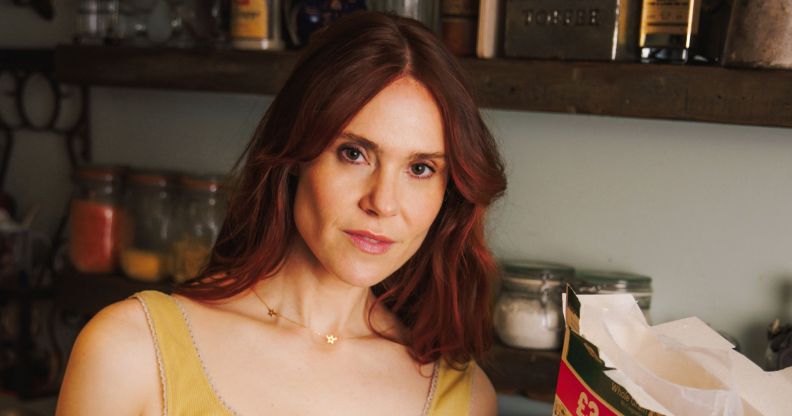
Kate Nash on anti-trans trolls: ‘If you just want to bully people on the internet, I’m sad for you.’ (Emily Marcovecchio)
“If you think you can troll Kate Nash out of having an opinion, then bring it the f*** on, motherf***er!” bellowed Kate Nash at her set at queer music festival Mighty Hoopla on Sunday.
The crowd, adorned with more glitter than clothing, thwacked fans, cheered, and waved huge, billowing trans flags in the sky.
Nash throwing down the gauntlet to her social media trolls rounded off a lengthy speech in which she lamented the state of feminism in Britain: some of the loudest feminist voices in the UK today, she said cryptically, are transphobic. “But dinosaurs will die,” she added, pursing her lips, before launching into her brand new single “GERM”.
Released last week, the punky spoken word song is a searing takedown of so-called trans-exclusionary radical feminism (TERF), with rage vibrating through every scratchy guitar thrum. TERF is re-written as “GERM” – “Girl, Exclusionary, Regressive, Misogynist”.
She outlines facts about the number of women who are sexually assaulted and murdered by cisgender men, and stats about how trans women are at an increasingly high risk of experiencing violence themselves. “Women are facing serious dangers,” she spits, but not “from trans people needing a p*ss, but from actual violence that is carried out against them every week”.
As if on cue, the trolls began trolling. Speaking over Zoom less than 24 hours after that electrifying Hoopla set, she breathlessly reels off the frequently misogynistic bile that has filled her social media comments since the song’s release. “You’re writing me poems and calling me an old hag and a has-been and a spineless worm and that I can’t do maths and that I’m a mess and that I shouldn’t do what I’m doing with my body and I’m pathetic and I’m old and a bint,” she says. “I can’t really take any of this seriously.” Her eyes roll so far back into her head I’m worried they may never return.
It sounds like more than most could cope with, yet she’s stoic. “There’s a part of me that has this like, fear,” she begins, before re-assessing. “Then I’m getting letters from trans people that are so moving and so powerful about how they felt hearing the song and how grateful they were, and that is a hundred times more powerful than any insult you could throw at me.”
Kate Nash, now 37, has been a public presence for almost 20 years, ever since her breakout hit “Foundations” spent five weeks at number two on the UK music chart in 2007. She came to fame at the height of the tabloid media’s onslaught against young, often vocal, often working class women, and frequently found herself a target of the vitriol. She fielded endless comparisons to Lily Allen, swallowed criticism of the “sheer mundanity” of her lyrics, and even recently, was deemed some sort of anti-feminist for joining OnlyFans to fund her tour.
Yet she’s never been one to be walked over (the first time I saw her live, as a 14-year-old attending the iTunes Festival, a man in the crowd heckled: “We’re only here ‘cos it’s free,” to her instantaneous retort: “Well go home then, you pr**k!”)

“I have received a lot of insults in my life. I’ve been trolled since I was 17,” she chuckles. “I don’t know what it would take to get me to go, ‘I can’t have an opinion because I’ve been trolled so much’.”
Her defiance has solidified in part since she started OnlyFans – “Once you do something that bold, you have to really not give a f**k anymore” – but also with age, and the confidence that her stance on trans equality will stand the test of time. “I know what I’m talking about. I know I’m right,” she exhales.
“Sure, leave this comment. How f***ing embarrassing for you. Someone’s gonna look that up one day and be like, ‘That was my great grandma. What a f**king c*nt.’ I’m leaving something behind that I can be proud of and that people will respect, and if you just want to bully people on the internet, I’m sad for you.”
“GERM” started as a splurge of words on a page last summer, an article or perhaps an essay. While touring festivals, she would have chats with her employees-cum-friends, many of whom are trans, about the simmering hostility directed at the community.
Then, in April, the UK’s Supreme Court ruled that the legal definition of “women” and “sex” in the Equality Act 2010 refers to biological women and biological sex, and therefore excluded trans women. Already, the impact is being felt: the Equality and Human Rights Commission’s interim guidance suggests trans people should be banned from all gendered toilets, and some organisations and companies are taking note.
Immediately, Nash texted her producer Kool Kojak and started turning her words into a song. It was both natural, as a musician, and calculated, as she wanted to see her stance cemented in history. “I literally was like, ‘I want this on record. I want it to exist in music history that a feminist, cis woman was pro-trans and a trans ally and calling out transphobia,’ and saying that this isn’t feminism.”

After the Supreme Court ruling, Nash says that for the first time in her life, she felt “embarrassed” to call herself a feminist. “I took it really personally,” she says. “It really upset me because I should never feel embarrassed to be a feminist. Feminism is the most important ideology in my life.” Nash worries that people may soon view being a “feminist” as synonymous with being anti-trans. “I hate that,” she says, bitingly.
“I just think we need to start calling a spade a spade because dismantling systems of oppression lies at the core of feminism and trampling on the rights of other people in order to put ourselves first is not feminism,” she adds.
She’s at pains to stress that white feminists have “done this before”, by historically excluding Black women from the push for gender equality. “We need to acknowledge mistakes we’ve made before, and cis women are not more important or better than trans people. We are not, as feminists, saying we’re going to take rights away from other people because white feminists deserve the most protection,” she decrees. “We’ve done it before. I feel like I can’t allow this to happen [again].”
There are so many things that she doesn’t understand about anti-trans arguments, she says, like the notion that trans women are pretending to be trans purely to attack women in single-sex spaces. “Men do not have to Mrs. Doubtfire it to rape and kill us. They can just do that and that is what they do. It’s completely absurd to take like three stories or something about trans people and then set a paradigm for an entire group of people.”
Or the suggestion that some, often right-wing men, who are anti-trans in the name of protecting “fairness” in women’s sports or spaces, ever cared about gender inequality to begin with. “Did you do anything about that before you sort of thought, ‘Oh my God, trans people are taking over the world!’ Did you give a sh*t about it before? Were you doing anything to try and help women before that? No, you f***ing weren’t,” she says, laughing but evidently furious. “You didn’t give a f*** until you wanted to make trans people the enemy. And now you’re like ‘Well, women’s bodies!’ I’m like, don’t you f***ing dare talk to me about women’s bodies because you have not done anything to help women and their bodies.”
Part of Nash’s empathy for the community is born from seeing numerous friends go through the “quite difficult, quite complex” experience of transitioning, but mostly, it’s in her blood. She comes a “long line of infuriatingly stubborn women”, as she told the Hoopla crowd, who “really instilled in us it is not okay to bully people”.
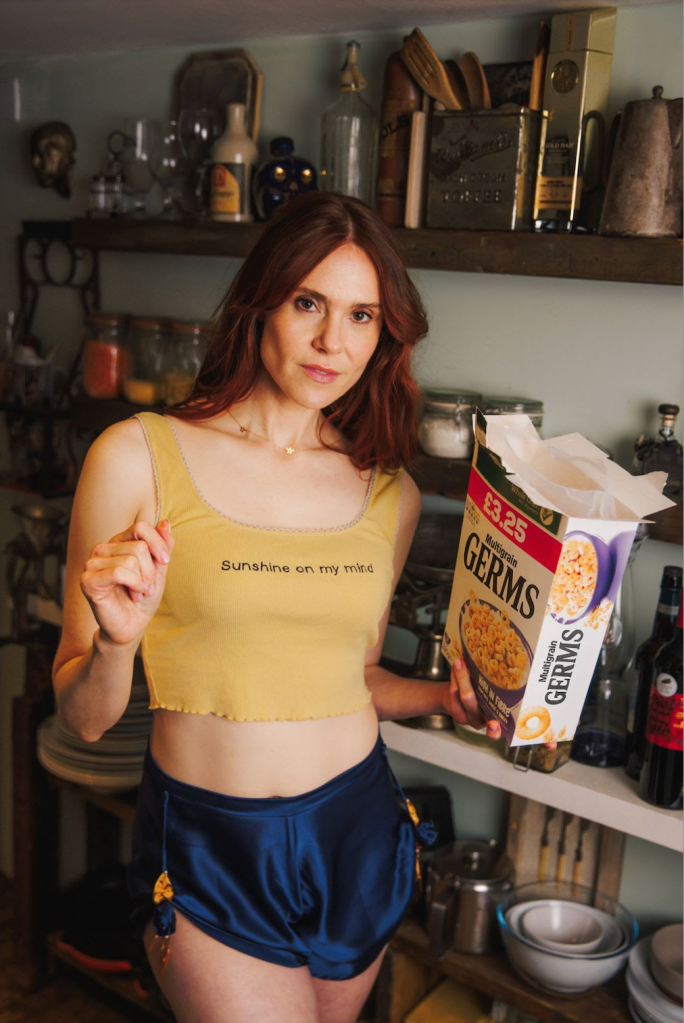
Her mother, a nurse, has “cared for people her entire life and she’s like, no bulls**t. She’s this strong, passionate person who did stand up for people.” Her mother is the sort of person who, if she sees mistreatment happening, has no qualms calling it out.
Nash’s grandparents moved to Newcastle from Ireland, “when there were still signs on the door that said ‘No Blacks, no Irish, no dogs’,” she recalls. Her granny, a cleaner, would routinely fight for Indian and Jamaican people in the community who were experiencing intense racism. “I think that it’s been instilled in me to have a moral compass and that fighting for what you believe in is really important. That’s where I come from. Those are my actual family bloodline roots. You grow up with a bit of a cause if you come from a family like mine,” she smiles.
Nash knows its scary – “they’ve scared everyone off of talking about this” – but she wants to see more cis women speaking out, before the prospect of trans people having their rights curtailed becomes a fully-fledged reality in the UK. “We need to get organised. We need to be as organised as Mumsnet, and that’s really hard,” she jokes.
Somehow, she’s managed to retain her humour despite the wave of abuse she’s received. She’s also retained her empathy, even for those she so vehemently disagrees with. “To anyone out there, to any of the famous transphobes, it’s not too late. You can come back from the rabbit hole,” she offers. “It’s never too late to just go, ‘I think I made a mistake there.’”
If they don’t though, she’s ready for that, too.
“I think there’s also a little sick part of me that enjoys it as well, because like I said, I come from a family of fighters. I’m like, hold my beer. Put me in coach. I’m ready. I’ve been taking the heat 20 years – I can f**king handle it.”
“GERM” is streaming now.
Share your thoughts! Let us know in the comments below, and remember to keep the conversation respectful.