
LGBTQ+ hate crimes ‘one step closer’ to becoming an ‘aggravated’ offence
LGBTQ+ hate crimes are one step closer to becoming aggravated offences. (Canva)
Hate crimes based on a person’s LGBTQ+ identity – including their sexuality and gender – are a step closer to being made aggravated offences in the same way racial and religious hate crimes already are.
LGBTQ+ charity Stonewall worked with Labour MP for North Warwickshire and Bedworth, Rachel Taylor, to introduce New Clause 122 to the Crime and Policing Bill.
The amendment, which has cross-party support, would “create statutory aggravated offences motivated by hostility towards an individual’s disability status, sexual orientation or transgender identity (or perception thereof)”.
Alongside this, the amendment would also “protect people who are victims of hate crime because of their association with individuals based on their disability status, sexual orientation or transgender identity (or perception thereof)”.
‘Aggravated offences’ refers to a crime which is made more serious by the presence of certain factors, known as aggravating circumstances.
The Crime and Disorder Act 1998 created specific racially or religiously aggravated offences when it was passed, which have higher maximum penalties than the non-aggravated versions of those offences.
If the Crime and Policing Bill passes all stages of parliamentary approval with Taylor’s amendment, LGBTQ+ and disabled people would have same protections as people who face racial and religious hate crime, with stronger sentences that act as a deterrent to people committing such offences.

Speaking in parliament on Wednesday during a debate on the bill, Taylor cited the 1999 London nail bombings which saw nail bombs detonated in Brick Lane, Brixton and and at the Admiral Duncan pub in Soho; each bomb specifically targeting members of the London’s Bengali, Black and LGBTQ+ communities respectively: “I raise that appalling incident to remind the House that hatred comes in many forms, but whoever in our society it is against, we must all stand equally strongly against it.
“We must have hate crime laws that show that whether the hatred is for someone’s race, religion, sexual orientation, gender identity or disability, Britain is a country that will not tolerate it; that all hatred is equal; and that all those who commit vile acts of hatred will face the same grave consequences.
“I regret to say that that is not currently the case.
“Today the law recognises five categories of hate crime— race, religion, sexual orientation, transgender identity and disability—but only two, race and religion, are treated as aggravated offences subject to stronger sentencing powers; the other three are not.
“That discrepancy cannot be right. We cannot say, as a society, that some forms of hatred are more evil than others.”
She continued: “We must fight back against this hatred. We must show that we are not content to stick with the status quo.
“The victims of these attacks deserve to live in a society that says that we take this hatred seriously and will not stand for it. Victims must be at the heart of our criminal justice system, and we must ensure that laws protect them.
“That is why my New Clause 122 is so important.”

Supporting Taylor’s amendment “wholeheartedly”, Lib Dem MP for Sutton and Cheam Luke Taylor said it would “strengthen the law on hate crimes directed at disabled, LGBT+ people, and rightly seeks to protect people who are victims of hate crime because of their association with individuals in those groups”.
Fellow Labour MP Jacob Collier, who represents Burton and Uttoxeter, said the amendment “delivers on a promise, a promise that we in the Labour party made in our manifesto to the British people: that we would act to close the gap in our hate crime laws and provide equal protection to LGBT+ people and disabled people in the criminal justice system”.
Collier continued: “It is about living up to our values. Labour is the party of equality, fairness before the law and standing with those whose voices have too often been ignored.
“That is why I joined the Labour party and this amendment is rooted in that tradition.”
He added it is also “fitting” the amendment is being tabled in Pride Month and “in the wake of the Supreme Court ruling which has caused so much anguish among the trans community”.
“This is also about dignity. It is about recognising that, whether you are a trans teenager being punched in a park, a gay couple being spat at on the tube, or a disabled man being harassed on his way to work, all people deserve the full protection of the law,” Collier said.
“They deserve to know that this country is on their side, and that if they are targeted for who they are, justice will not look the other way.
“New Clause 122 would provide vital protection for disabled people, who remain far too invisible in the public conversation around hate crime despite facing damaging harassment, violence and abuse every single day.”
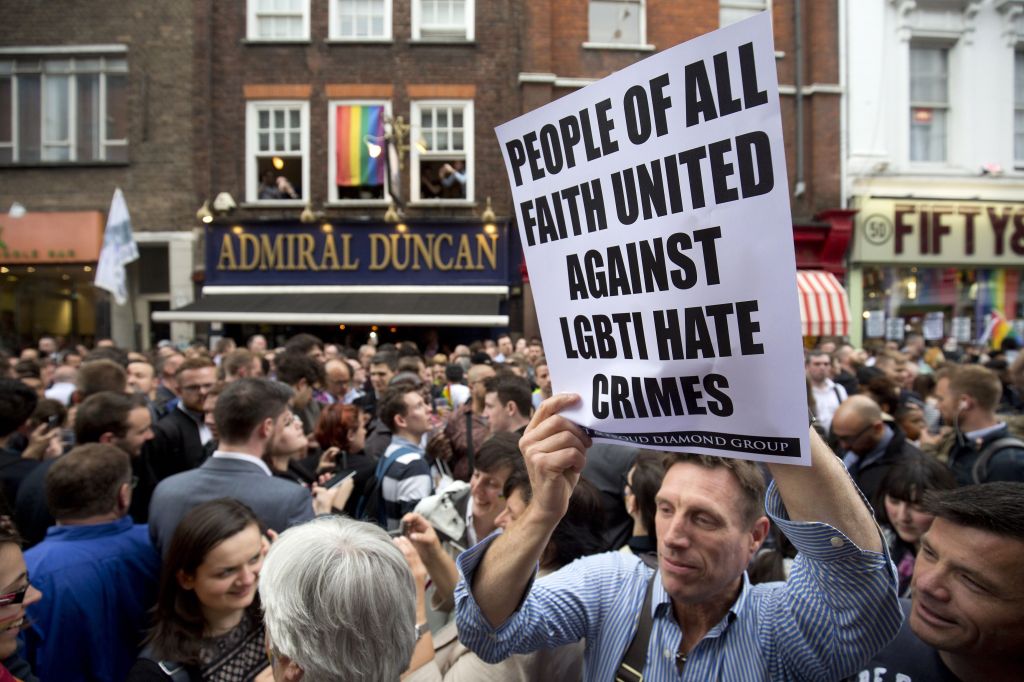
Commenting on the amendment being tabled, Simon Blake, CEO of Stonewall, said in a statement: “Making anti-LGBTQ+ hate crime an aggravated offence is an important milestone towards achieving equality for LGBTQ+ people under the law, putting sentencing on an equal footing with religious and racial hate.
“Yesterday we moved one step closer to giving LGBTQ+ people equal protections they rightly deserve. I am delighted the government have made a commitment to bring in this change when the Bill reaches the House of Lords, and we will work tirelessly to hold them to their word.
“We are very grateful to Rachel Taylor MP for driving this work in Parliament, particularly at a time when many LGBTQ people are feeling increasingly under threat.”
Taylor herself said she was “absolutely delighted that the government has listened to me and the cross-party MPs who supported this vital change in the law”, adding: “All hatred is equal. And all those who commit vile acts of hatred will face the same grave consequences”.
Recent data, ending March 2024, there were 140,561 hate crimes recorded by the police in England and Wales, a decrease of 5% from the year ending March 2023 (147,645 offences).
In the year ending March 2024, there were 22,839 hate crimes related to sexual orientation and 4,780 related to being transgender.