
Tuc Watkins on fatherhood, gay roles and Andrew Rannells romance: ‘I feel very fortunate’
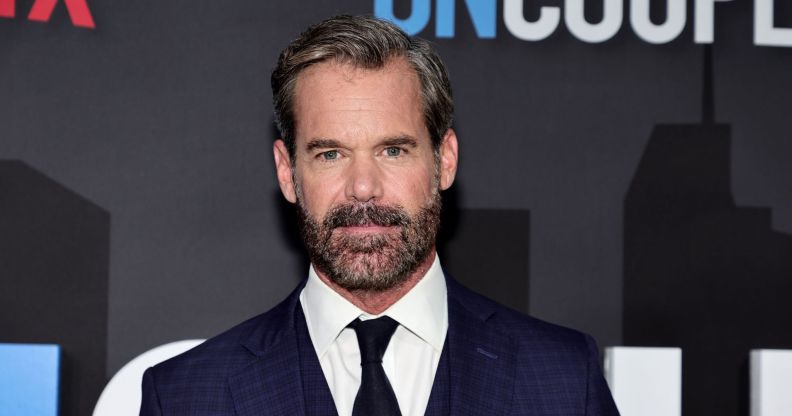
Actor Tuc Watkins talks playing gay in the ’90s, life with Andrew Rannells, and his new film Exit Interviews. (Getty)
Four years ago, actor Tuc Watkins sat his then eight-year-old twins down to show them what he did for work. Of all of his TV and film roles, Watkins popped on 1999’s The Mummy, and his children watched in horror as his character, the bespectacled tomb raider Bernard Burns, had his eyes ripped out of his skull by the titular undead beast. “They both, at the same time, just started bawling,” Watkins deadpans. “I was fumbling for the remote to turn it off. To this day, they still haven’t gone back to The Mummy.”
In fairness, few of Watkins’ roles have a child-friendly stamp. After brief appearances on Baywatch and Growing Pains in the early ‘90s, he got his proper TV breakthrough playing bumbling bad boy David Vickers on ABC daytime soap One Life To Life [OLTL], on and off from 1994 to 2013. It’s one of the defining roles of his career, but isn’t quite a kid’s idea of a good time.
His appearances in a slew of cop dramas – CSI, Cold Case – are too bloody. Perhaps his role as Pistol Pete in sitcom Parks and Recreation? If his pre-teens are on TikTok, they’ve probably already come across Desperate Housewives’ Bob Hunter. “There’s nothing worse than an actor who has kids who encourages their children to watch their work,” Watkins says. “So if they come to it naturally, so be it.”
The actor, 59, moustachioed and handsome, languid and open, is speaking to me from Los Angeles, a few days on from the world premiere of his new film Exit Interviews at FilmOut San Diego; it will play at Atlanta’s LGBTQ+ film festival Out On Film on 26 September. It’s another one that might be a better watch for someone with life and love experience. With warm vulnerability, he plays Robert, a lovelorn, gay middle-aged writer who, in a ballsy attempt to understand his loneliness, interviews all of his ex partners and turns the footage into a documentary.
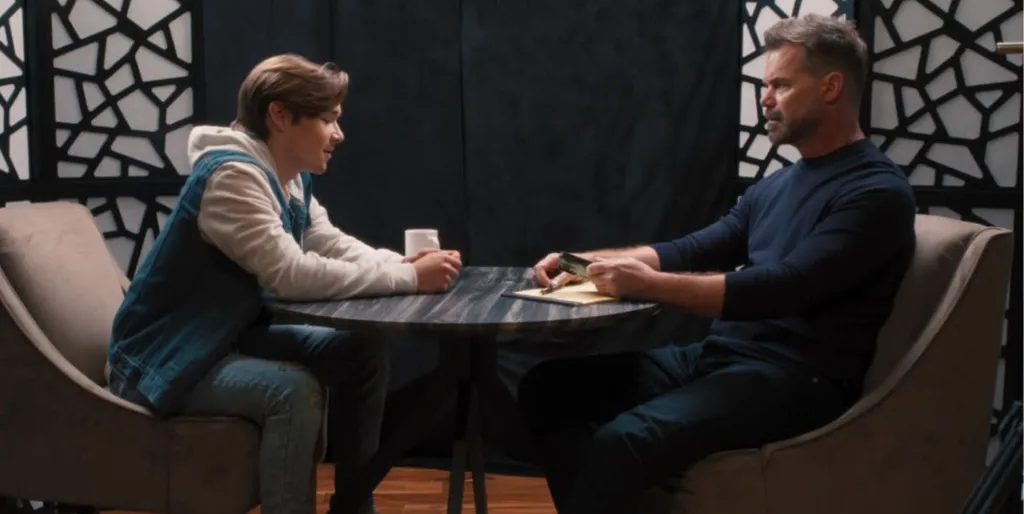
Each ex represents a different element of a romantic relationship. “One is sex, one is passion, one is laughter. It really developed from those emotions that I felt,” says Garrett Abdo, who makes his feature film debut with the movie. “In writing it, mentally, you have to sit across the table from a fictionalised version of yourself and rip yourself apart.”
It’s not something Watkins would relish in. “I wouldn’t have the courage to assemble all of my exes and ask them their opinion of me,” he chuckles. “I would want to be understood rather than trying to understand.” Plus, he says, there is no bad blood between him and the three men he has had “major intimate relationships” with in his life. “I still love all of them. I’m still with one, which is great,” he says of his current partner, the actor Andrew Rannells.
“I do adhere to the theory that if you ever loved someone, you never stop. I’ve never stopped. It changes lanes. That’s not to say that I’ve stayed in touch. I’m not really friends with my exes, but I still love them,” he shares, disarmingly candid. Exit Interviews paints a bleak picture of modern gay dating too, all soulless hook-ups and numbing disappearing acts, and Watkins is happy to share his own experiences on the apps. “I went on the same date with eight different guys,” he says, his date of choice being “a lap around Runyon Canyon in Los Angeles and a cup of coffee”. None of them were “the person I thought they were going to be,” he says. “I’m not blaming them, they probably thought the same thing about me.”
Instead, success came through a real-life meet-cute of sorts. Then a single dad, Watkins met Rannells in 2018, while the pair performed on Broadway in the 50th anniversary revival of gay play, The Boys in the Band. The soon-to-be couple played a couple on the rocks.
Watkins has previously detailed how the curtain would go up and he and Rannells would be out of character, but still holding hands. They dated briefly, before reuniting while filming the Ryan Murphy-produced Netflix film adaptation of the play in 2019, and six years later Watkins is “really happy in my relationship. I love my partner. My kids love my partner.” He smiles. “I feel very fortunate to be where I am right now.”

Stars of the original 1968 play The Boys In The Band were either straight and held in contempt for their roles, or deeply closeted. Watkins muses about how “empowering” it was to star alongside eight other out gay actors in the Tony Award-winning revival – including Rannells, Jim Parsons, Matt Bomer and Zachary Quinto – and how it felt like “the needle had been moved forward”.

Watkins has seen how that needle has moved in the space of his own career, too. Born in Kansas, he moved to LA in his twenties to pursue acting after a $300 appearance in an advert made him realise it was a viable career. Despite not coming out publicly until 2015, some of his earliest roles, like dramedy Beggars And Choosers and screwball comedy I Think I Do, were gay.
“I’ve been playing gay characters since the ‘90s when agents told you: ‘Don’t do that.’ Honestly, if I had been offered more straight roles that were exciting, I would have done them,” he shrugs. “A lot of the roles that I was offered were gay characters that straight people didn’t want to play. We all got to find our way to the surface and that’s the way that I found mine.”
Many LGBTQ+ roles back then were “issue-orientated”, focussing on the AIDS crisis or discrimination. Then, in the mid 2000s, Desperate Housewives creator Marc Cherry wanted to show that gays can be the only residents on a street without major issues.

During an interview with Cherry, Watkins and Kevin Rahm, who played his on-screen husband Lee, “Cherry said: ‘I wanted to show what it was like when a gay couple moved into a suburban neighbourhood, and when a gay couple moves into a suburban neighbourhood, not that much happens. Not that much changes.’ And I thought, ‘Oh, that’s so cool. I love that idea. It doesn’t make for exciting television.” Still, Bob and Lee were imbued with Cherry’s signature comedic wit (and plenty of sex jokes), and the couple were a hit. “It just goes to show you that things don’t fall apart or your world doesn’t get shifted just because gay people happen to live around you.”
The needle shifted further in the 2010s, and gay characters became infinitely “more layered,” Watkins says. His career ascended to new heights as a result. Over the past five years, he’s played a gay billionaire on stage in The Inheritance, a closeted gay Republican congressman in Black Monday (alongside Rannells, who played his partner), and a gay divorcée alongside Neil Partrick Harris in Uncoupled.
It was the latter role which left Abdo broken, in awe, and overjoyed that Watkins was down for Exit Interviews. “The first episode of that, that’s what happened to me. All of a sudden my husband was gone, with no notice, no nothing. Watching that show ripped me apart, and [Watkins] was just so good in it,” he says.
Today, as gay roles abound, gay rights are at risk. Watkins, who has previously described himself as a “left-leaning progressive”, has made a habit of talking about these “hot topics” with his twins, who turn 13 in December. “I had my kids through surrogacy,” he says. “I always talk to them about things like that before they can even sort of comprehend them so that as they get older they don’t remember not knowing it.”
He recalls telling his children he is “allergic” to alcohol after he quit booze seven years ago, and talking to his daughter about how she was conceived after she told her classmates her mother was dead: “She said, ‘Yeah dad, you can stop. I get it, it just takes too long to explain the story so I just tell people she’s dead.” The birds and the bees chat came about after he caught them watching Bella and Edward getting intimate in Twilight. Watkins’ best anecdotes always involve his kids. “When things come up naturally like that and you lean into them, I find that things always go better that way.”
In his early days of parenthood, Watkins struggled. He moved back to Kansas for support, and put acting largely aside. I wonder about now, as roles come in thick and fast and his kids reach a pivotal time of their lives. “I don’t find it difficult,” he says of striking a balance.
“I used to have fear of: ‘I won’t be able to do this project or that project. I’m duty bound. I need to do right by my kids.’ But I found that I can do that and still entertain things that come my way,” he shares. When work does come that requires him to be out of town, loved ones step in, plus “a lot of times, Andrew’s here, and if Andrew’s away – because Andrew works a lot and it’s different every time – it works out”. It sounds idyllic and sweet and wholesome, and I’m pleased none of those eight dates worked out.
Exit Interviews is playing at Out On Film on 26 September.
Share your thoughts! Let us know in the comments below, and remember to keep the conversation respectful.