
Green Party MP ‘heckled’ in parliament when discussing LGBTQ+ inclusive sex ed in primary schools
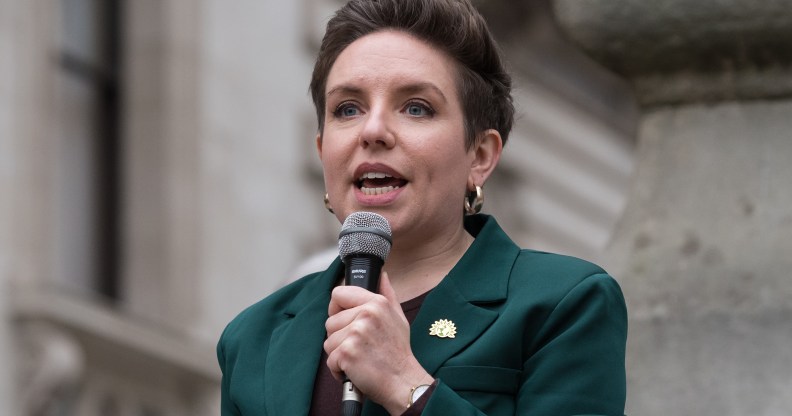
Carla Denyer was “heckled” in parliament (Wiktor Szymanowicz/Future Publishing via Getty Images)
Green MP and former Green Party co-leader Carla Denyer was “heckled” in parliament when asking a question about LGBTQ+ inclusive relationships and sex education in primary schools.
During oral questions on Monday (19 January) Denyer, who is bisexual and represents Bristol Central, told the House she had heard from constituents who are worried the updated guidance on relationships and sex education “does not actually require primary schools to teach about same-sex relationships”.
“Will the Minister set out how she will ensure that all children learn, in an age-appropriate way, about a diverse range of relationships if it is left to schools’ discretion?” Denyer asked Georgia Gould, Minister of State for School Standards
“The charity Just Like Us found that only 19 per cent of LGBT parents say their child’s school openly discusses diverse relationships.”
As Denyer sat down to give way for Gould’s response, a voice can be heard saying “they’re primary school kids”.
In response to Denyer’s question, Gould said: “The new guidance sets out inclusion for all children and the recognition of those relationships.
“As the hon. Member will know, that is mandatory in secondary school, and we continue to take that work forward.”
Taking to social media afterwards, Denyer shared the clip and said she was “sickened but not really surprised that homophobia is alive and well on the bench behind me”.
“‘They’re primary school kids’ he says – as if no primary school kids have lesbian or gay parents!” Denyer added.
The Department for Education (DfE) finally published its long-awaited, updated statutory guidance on relationships, sex and health education (RSHE) back in July 2024, and set to come into force from 1 September 2026.
The guidance states sex education in primary school is “not compulsory” but recommends primaries teach sex education in years 5 and/or 6.
The curriculum for relationships education at primary level focuses “on teaching the skills and knowledge that form the building blocks of all positive relationships” with schools told to be “sensitive to pupils’ circumstances” and the different family types they can come from, including single-parent families, same-sex parent families and foster parents/carers.
“Teaching should illustrate a wide range of family structures in a positive way, and care should be taken to ensure that children are not stigmatised based on their home circumstances,” the guidance states.
Relationships and sex education is, however, compulsory in secondary school where it should “provide a clear progression from primary relationships education”.
The guidance was immediately criticised for telling schools to be “mindful” that there is “significant debate” about transgender identities, and staff “should be careful not to endorse any particular view or teach it as fact”. Critics likened such avoidant language to that of the much reviled, Thatcher-era Section 28, which banned the “promotion” of homosexuality in classrooms in England and Wales from 1988 until 2003.
Within the 42-page document, points 67 to 72 – equal to around a page in length – outline guidance that relates to “gay, lesbian, bisexual and transgender content”. However, the word “transgender” does not appear anywhere else in the document.
The updated guidance states pupils should be taught “the facts and the law about biological sex and gender reassignment” and they should “recognise that people have legal rights by virtue of their biological sex which are different from the rights of those of the opposite sex with the protected characteristic of gender reassignment”.
However, schools should be “mindful” that “beyond the facts and the law about biological sex and gender reassignment there is significant debate”, the guidance says, and “should be careful not to endorse any particular view or teach it as fact”. The guidance goes on to give a specific example that schools should not “teach as fact that all people have a gender identity”.