
Black activists compare anti-trans bathroom ban to Jim Crow-era segregation laws at Texas Capitol

Black activists have gathered outside the Texas State Capitol to protest anti-trans legislation (Equality Texas)
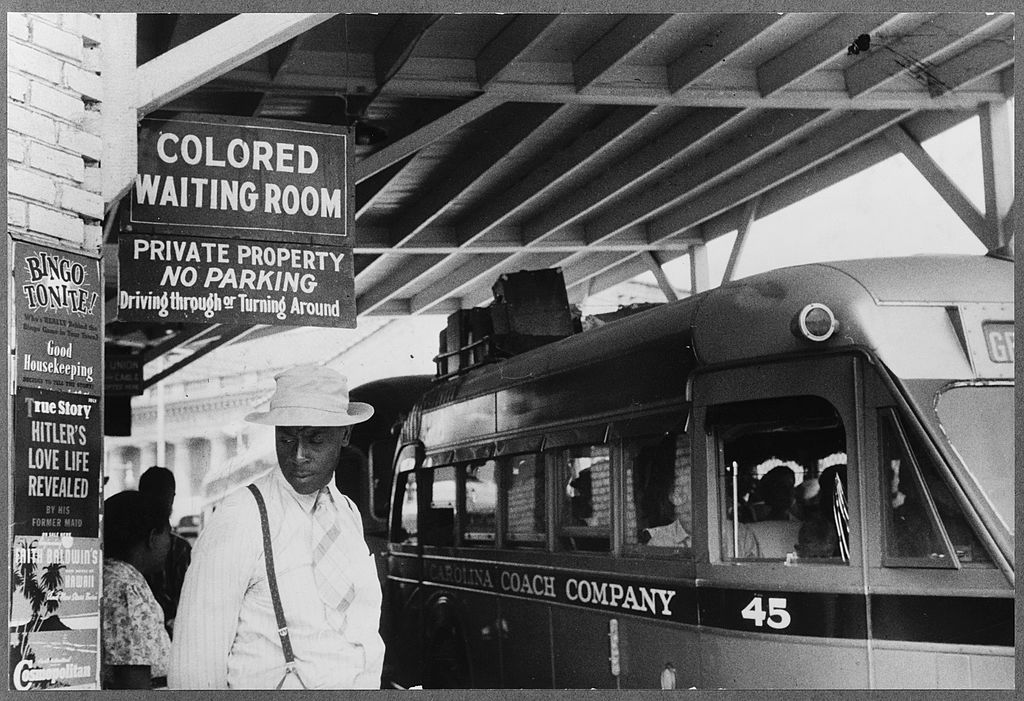
Black activists have drawn parallels with racist, Jim Crow-era segregation laws as they opposed an anti-trans bathroom bill in the state of Texas.
On Wednesday (30 July) Antonio Ingram II, a Senior Counsel at the NAACP Legal Defense and Educational Fund, spoke from a podium outside the State Capitol to oppose a bathroom ban that would block trans people from using facilities in line with their gender identity.
The podium bore the sign “Separate is NOT equal,” referencing the US doctrine that enabled racial segregation decades ago. Behind Ingram activists held signs reading, “It wasn’t about fountains, it isn’t about bathrooms,” also referencing Jim Crow-era segregation laws.
Between 1890 and 1915, the South established a new regime of oppressive racial apartheid laws known as Jim Crow. In parallel to this, there was an anti-immigration movement backed by both Populists and Republican “progressives.” Harvard President Lawrence Lowell stated the core belief of these movements: that “Indians, Negroes, Chinese, Jews and Americans cannot all be free in the same society.”
“As a Black American whose family originally hails from Texas, I personally know how state-sanctioned discrimination has harmed communities in Texas,” Ingram said, as reported by local media. “Segregation never increased safety. Segregation only served to isolate, erase, and endanger.

“Whether it was Jim Crow signs baring my ancestors here in Texas from water fountains and restrooms, or modern legislation policing where trans people can access basic resources, such as using the restroom, the intention is the same: to control and discriminate through exclusion.”
As well as Ingram, Verniss McFarland III of the Mahogany Project, which provides support services to trans and non-binary people in Houston, Texas, also spoke. “Not long ago, bathrooms were marked white and colored. Today, lawmakers are considering legislation that would prohibit transgender persons form using cisgendered bathrooms. Tell me how this is any different?,” McFarland said.
“This is not about safety or privacy. It’s about telling transgender people where they are in the hierarchy.”
The activists are opposing House Bill 32 aka the Texas Women’s Privacy Act. This proposes that all bathrooms, changing rooms and domestic violence refuges should be designated by biological sex. This would apply to public schools, government buildings and correctional facilities. The bill says biological sex is determined by external sex organs and chromosomes.
Any facilities that would fail to act in line with the proposed law would face fines and lawsuits, including by individual citizens who feel “affected” by a “violation” of the law. The bill also includes unsettling provisions inhibiting the state court’s to pronounce anything carried out under the act as “unconstitutional” or stop anyone from enforcing the law.

Gender neutral bathrooms are also disallowed under the proposed law. A similar piece of legislation – Senate Bill 7 – is currently making its way through the Texas State Senate.
The activists are not the first to draw parallels between anti-trans attitudes today and racist attitudes from the past. In May, one activist went viral for challenging Texas legislators over the passing of a bill that legally denies trans people exist.
“Do y’all ever get tired of being on the wrong side of history?”
In a viral clip, Nick Mollberg said, “If we were sitting here 50 years ago, 60 years ago, instead of talking about trans women going into bathrooms, you’d be talking about Black women going into white bathrooms. Do y’all ever get tired of being on the wrong side of history?” Mollberg also said, “I’m just going to call this bill what it is, it’s bigotry.
Texas has broken records for the number of anti-trans bills state politicians proposed since the 2025 legislative session began. More than 120 have already been filed with Trans Legislation Tracker currently monitoring 130 proposed new laws in the Lone Star State.
The TLT is currently charting the progress of 965 bills across 49 states. Of those, 121 have passed, 198 are currently active and 646 have been defeated. While that last figure is encouraging, the ferociousness with which Republicans and conservatives have attacked trans rights is demonstrative of a movement that shows little signs of slowing down.