The incredible, almost-forgotten story of the first man in Britain to come out publicly as gay
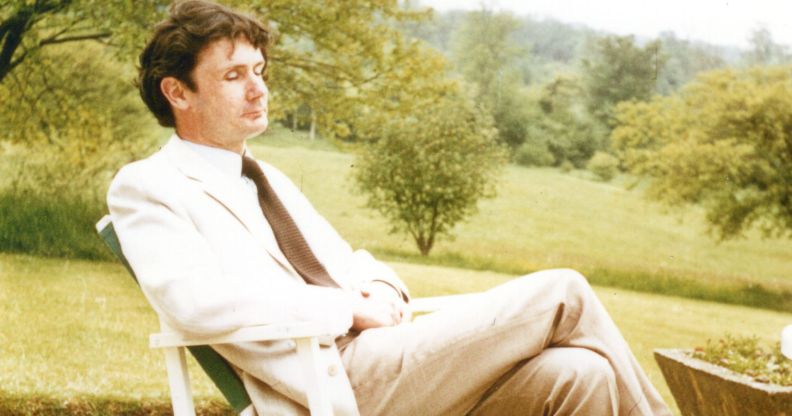
Roger Butler. thought to be the first gay man to come out publicly in the UK, in Ipsden, Oxfordshire. (Christopher Stephens)
In 2003, Christopher Stephens, then an Oxford University student, was asked by a peer whether he would take over as a reading volunteer for a blind man in the east of the city. He agreed.
Cycling to the home of Roger Butler on an October evening weeks later, Stephens didn’t know that he would eventually and inadvertently uncover a piece of British LGBTQ+ history that has laid buried for 65 years. Back in 1960, seven years prior to the partial decriminalisation of homosexuality, Roger had publicly and unabashedly outed himself as a homosexual; he’s believed to be the first man to have done so.
“It took us a while to break down some of the barriers. Plenty of gin and tonic and a bit of prodding,” Stephens says today of the first time the pair met. “Once we’d established that we had some similar interests and that we had sympathetic personalities, I suppose, we very quickly became friends… he was a really fascinating man.”
Stephens would continue to visit Roger at his home weekly until he moved away from Oxford to forge his own career path, but the pair’s bond had become something indescribable. Even after leaving the city, they stayed in touch via phone until Roger’s death in early 2011. Over their years together, Roger had tentatively peeled back the curtain on his time as a young, gay man in London, who had quietly beavered away as a leader of the law reform movement to decriminalise homosexuality.

Yet after his death, Stephens learnt that Roger had left him a pink folder filled with sealed letters and memoirs, addressed to him, divulging the full extent of his involvement in moving the needle on LGBTQ+ rights in the UK.
Now, Stephens has published those memoirs as The Light of Day, co-written with journalist Louise Radnofsky.
When Roger first arrived in London, it was through the Homosexual Law Reform Society that he first found a “gateway into a rich, vibrant gay social scene,” despite the confines of British law at the time. “Other than the fact that it’s all under cover, gay society doesn’t look that different,” says Radnofsky of the London queer scene described by Roger. “There are pubs and there are clubs and there are house parties in somebody’s basement in Peckham. A lot of it does not feel at all like the 1950s that we thought the 1950s were.”
Yet Roger became increasingly nettled by the way gay men were described, both by the press – as some scandalous, “unfortunate class” – and by heterosexual law reformers who would argue that “if you decriminalise [homosexuality], it might make it easier to get treatment for them,” explains Radnofsky. The life that Roger enjoyed as a gay man, contrasted with how the community was portrayed in the mainstream, didn’t sit easy with him. “That dissonance just shines through all of Roger’s writing,” says Stephens. “It’s what eventually really inspires him to say, ‘This is utterly ridiculous, and something needs to change.’”
It was in 1960, after one heterosexual magazine editor offered to publish Roger’s story anonymously that he made a move that would, perhaps unknowingly to Roger at the time, change history.
“Roger goes to the pub with his friends afterwards. He gets fired up with indignation and says, ‘Why the hell should we write letters under pseudonyms? What do we have to be ashamed of?’,” recalls Radnofsky. “And from this, what he thinks of as his crazy idea is born and it becomes this milestone in gay history.”
The “crazy idea” in question saw Roger Butler, along with friends Raymond Gregson and Robert G Morecroft brazenly write to The Spectator to declare that they were homosexual men.
“There is nothing sinful or disgraceful in being homosexual”
“Sir, we are homosexuals and we are writing because we feel strongly that insufficient is being done to enlighten public opinion on the topic which has for too long been shunned,” reads the letter, which Stephens found in archives – it was the only letter Roger did not keep for himself. “Despite the imputations of the ignorant or malicious, there is nothing sinful or disgraceful in being homosexual.”
It’s believed to be the first time a gay man publicly declared himself to be gay by choice.
The reason Roger decided to send the letter was simple: no other gay men would do so.
“He says over and over again in his writings that he just wishes someone famous would do this thing. He wishes that [author] E. M. Forster would write this letter. He wishes that [playwright] Noël Coward would write this letter. There’s a whole list of men that basically everyone knew was gay, but they weren’t willing to say it overtly,” says Stephens.
After the letter was published, a lot happened, and absolutely nothing happened, too.
The Sunday Pictorial, an anti-gay tabloid that would later become The Mirror, featured Roger and other gay men speaking publicly about their homosexuality. “For the first time [there is] a gay person giving a voice of a gay person to the argument for law reform. Immediately, he’s asked to be on that sort of public stage, and there are letters being written for months after in the press responding to it,” Stephens explains.
“So it really does have a splash then in the immediate [aftermath] and places Roger at the heart of the Homosexual Law Reform Society.”
In terms of legal repercussions though? There were none. “Nobody does come and arrest him, nobody does come knocking at his door to go through his things. He doesn’t lose his job,” says Radnofsky. “These are all real risks that he was running when he did this, and these are the sort of risks that kept absolutely everybody in terrified silence for decades.”
From then on, the gay liberation movement moved quickly, and seven years later, in 1967, homosexuality was decriminalised. Roger, now a pioneer, was at the party celebrating the gargantuan social change, but his life had become separated from the movement itself.
“He was nervous, I think, of claiming that he was really important”
In 1960, the same year he sent his letter, he faced his first major issue with his sight. After two ensuing surgeries, he was left completely blind in 1966, his early 30s, due to glaucoma. His focus had shifted onto another struggle for which society had yet to adjust to. He moved to Oxford, started a degree, and would eventually – more than three decades later – cross paths with Stephens.
The intricate story of the UK’s fight for gay liberation is one easily accessible online or in archives. Yet the name Roger Butler features in virtually none of it. Why had his role remained so invisible until now?
“He was nervous, I think, of claiming that he was really important,” reasons Stephens. “Roger felt he was just an ordinary person who’d done this thing, and it probably made a bit of difference, but he wasn’t the kind of person to go around telling the world about his achievements.”
The man Stephens came to know was “shy”, “contained” and “by the time I met him, it was many decades later and it was just this thing he’d done once.”
Roger made it clear that after his death, he would be pleased to see his memoirs put out into the world, yet he wasn’t seeking credit for his hidden role in the gay rights movement.
“I don’t want to undermine that in Roger, but we think he deserves credit. We want more people to know who Roger Butler is,” Stephens says. “We want his story to become one which is a part of an accepted history of how gay rights were won, but also to be an inspiration both to other communities, and to other gay people to say, ‘Oh he did it, even when it was illegal.’”
The Light of Day is out now.
Share your thoughts! Let us know in the comments below, and remember to keep the conversation respectful.