
Cabaret’s Marisha Wallace: ‘I was told I was too Black to lead a show’

Marisha Wallace on returning to Broadway and tackling the ‘new rise of fascism’ through Cabaret. (Getty)
“I’ve met some people recently in my cast and they made me feel really old. They were like, ‘I saw you in Aladdin when I was a kid!,” says theatre actress and current Cabaret star Marisha Wallace, erupting into a gloriously goofy cackle before her sentence is out. “I was like, ‘When you were a kid?! Ohhhhh. My. Lord!”
Wallace is barely 40, but her stage career has been long and illustrious enough to influence many a theatre kid along the way.
Aladdin was her 2014 Broadway debut, and she’s since starred in a roll call of blue-chip musicals: The Book of Mormon (performing with the late Gavin Creel); Dreamgirls (her big break, replacing an ill Amber Riley on the West End in 2016); Waitress (also on the West End, convincing her to stay in London permanently); Oklahoma! (her first Olivier Award nomination in 2023); Guys and Dolls (her second Olivier Award nomination in 2024). And so on.
“I feel like my life is a musical,” says an ebullient Wallace today on a rare day off, calling from New York. She’s back on Broadway, starring alongside her friend Billy Porter in Cabaret, for the first time since playing an egg in Something Rotten! in 2015. “I mean, when I tell people I grew up on a hog farm, that’s like the beginning of a musical, right?” Another explosive laugh.

Wallace spent childhood in North Carolina, among a family which vibrated with musicality. Her father built churches, then played guitar in them. Her mother directed the choir; her siblings played piano. Wallace’s instrument was her voice, which she’s played since age five.
Her improbable rise from church-going farm girl to West End darling was fraught with musical-worthy misgivings. A vocal cyst almost trammelled her career before it began. After years of singing at theme parks and on cruise ships, she finally brushed her Broadway dream with Aladdin, but had to reschedule her wedding as a result (“He never forgave me,” she said in 2024). Her relationship came to a tumultuous end in 2016 while her husband was mentally unwell. That year, Dreamgirls called and she cleared her New York apartment, knowing she’d never return. Fresh on the London dating scene, she was scammed of an eye-watering £60,000. But the West End gigs kept coming. Funny Girl, eat your heart out.
She doesn’t have her own musical yet, but close enough: she’s released Live In London, a live recording of her one-night-only show at London’s Adelphi Theatre earlier this year. She describes herself as “the queen of the 11 o’clock number” and this album is crammed with them. Wallace, a vivacious performer adept at vocal acrobatics, tears and trills through songs she’s performed throughout her career. It’s spliced with interludes where she shares the intricacies of her journey. “[People] see you on stage being amazing and they don’t know what it took to get you there,” she says. “People want to know how the sausage is made. So I’m like, ‘This is how sausage is made’.”
Wallace pauses throughout the album to honour those who’ve lifted her along the way. She talks tenderly of sharing the Adelphi stage with Creel during Waitress in 2019. The gay actor died last year of a rare cancer, aged 48. He was a light for her. “He taught me everything. He taught me how to be a leading lady,” she says. At the time, she was contemplating making London her permanent home. “That’s where Gavin got a lot of his success in London and then [he] went back to America and – finally, after all those years – got a Tony Award. So he was like, ‘Stay here and see what happens’, and I did.” She smiles, a sad but grateful smile. “He’s one of my angels up there guiding me.”
Then there’s Mrs Grantham, the teacher who took her to her first Broadway show. It was Disney’s Aida, led by Lisa Simone, daughter of Nina, and Wallace recalls sitting in awe realising that she could make money as a Black woman on stage. “I thank God for Miss Grantham every day,” she says. “It takes people like that to see it in these little Black kids who probably have never thought about that as an option, and that’s why diversity is so important. That’s why me being in these roles is political.”
There were few Black women on stage to look up to, she says, and even those who did inspire her – Audra McDonald, Lillias White, Kecia Lewis – weren’t given “the respect they truly deserve.”
“I’m so happy Kecia Lewis is finally getting her flowers after, you know, things that have been said about her in the media or whatever,” she says, possibly referring to Patti LuPone’s caustic comments about the star earlier this year. “[Lewis] was one of the people who took me under her wing. [She said] ‘Look, this is how you’re going to make it in this industry.’”

Wallace has made it, particularly in the UK. This year she secured her British citizenship, and so returning to America for Cabaret has been many things: surreal, healing, scary (“Because I manifested it!”). She doesn’t call it as such today, but she faced grim discrimination while previously trying to crack open Broadway’s stage doors.
“I was told I wasn’t good enough to lead a show before. I’ve been told, you know, ‘You’re not Black enough. You’re too Black. You’re too this. You’re too fat’,” she reveals. “I was always trying to prove everybody wrong and trying to be who everybody wanted [me] to be. But then it was just me becoming myself, and becoming the artist I wanted to be, is what brought me back?” She’s been doing this for 15 years, but still sounds incredulous at every opportunity. Cabaret is no different. “I got standing ovations after every song and it was like, ‘You were right. You were right!” That cackle fills the call once again.
Wallace and Porter starred in Cabaret on the West End earlier this year, becoming the first pair of Black actors to play Sally Bowles and Emcee full-time in a commercial production. Set in Berlin amid the insidious rise of Nazism, and reflecting on the impact of apathy in the face of fascism, it feels a little on the nose to be performing it under Trump’s presidency.

“I’m not gonna lie, it’s been heavy,” Wallace says. “The racism is real. Because I’ve been in the UK for so long, I forgot. It was not like this when I left the United States in 2016.” She decries the “new rise of fascism” and is dismayed at comments she’s seen suggesting she and Porter shouldn’t be in their roles.
“Do you know people don’t even believe there were Black people in Germany in the 1930s? Like, there’s people who’ve actually commented that they didn’t believe we were there, and we’ve always been there,” she despairs. She cites Josephine Baker as one example of an artist who fled the Jim Crow South to Europe in search of an entertainment industry free of systemic racism, only to be confronted by Nazism on arrival.
“That’s the story that hasn’t been told. Not only were there six million Jews who were killed, there was also Blacks, queers, Romani people, disabled people. Anybody who had mental illness was sent to the camps,” she bristles. “We were all persecuted together. We cannot let this happen again.”
Without changing lyrics or lines, Wallace and Porter have suggested they interpret Sally and Emcee as Americans stepping into European personas as a means of survival. Porter took his point one step further, suggesting during a recent interview that “Black people have replaced the Jews” in the current political climate in the US. The comment, unfortunately timed just days ahead of Cabaret’s opening night, sparked a social media furore with assumptions that he was minimising antisemitism. It snowballed into some questioning his position in the show, arguing he “does not understand the piece”, while others leapt to his defence, urging that his comments had been taken out of context, and he was being bashed for being a vocal, queer Black man.
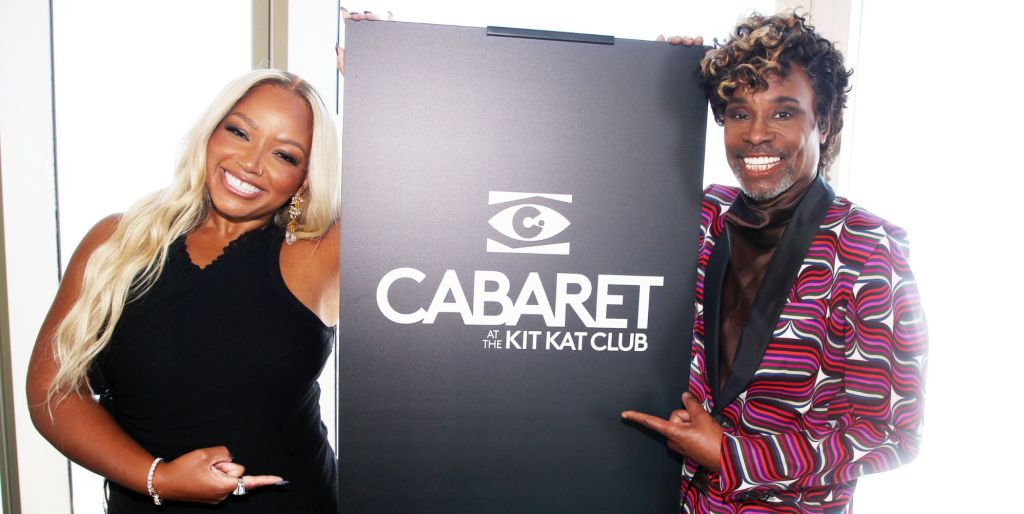
Wallace, reasonably, doesn’t want to speak for Porter. “Obviously, the Blacks are not replacing the Jews. The lines, the people and the characters are all still there. You have to ask him about what he said, but in the show, all the characters are the same,” she offers. As she mulls the uproar over, she sounds nettled. “This is what the fascists want. They want you to eat each other alive. They want to divide and conquer. I think unity is the way we beat these people. This is how we win. They love to see us in-fighting. They love it! Come on now.”
She says “everybody has all these opinions online” but in the room the response is rapturous. Despite the eye-wateringly pertinent subject matter, playing Sally Bowles – a woman who is fallible, ruthless in her ambition, and more emotionally vulnerable than her eccentricities would let on – healed something in Wallace.
“Sally has opened up the darkest parts of me,” she says. Much of her life has been spent “trying to be this clean, shiny version” of Marisha Wallace, always smiling, always grateful. “I think a lot of Black women feel like they have to be the strong Black woman, superwoman, look good, hair good, everything’s good. But then inside? When we’re at home and alone? We cry. We’re weak. We’re sad. We don’t always feel loved, you know? And that’s something I wanted to show on stage.” She’s used to hiding her emotions, she says, but on stage every night, she gets to leave it all on the floor. “Sally gets to be a mess, and I like it,” she says, alongside one final sweet laugh.
Cabaret ends in October and then the world is literally her stage. She knows some people would prefer it weren’t, but that’s what drives her. “I always say theatre was not made with me in mind,” she says.
“I’m going to keep disrupting this thing. I’m going to keep challenging it. I’m going to keep opening doors and breaking glass ceilings and trying to expand it because at some point, they’re going to have to give in.” A quick re-check of her résumé suggests they already have.
Live In London is out now. Cabaret is on at August Wilson Theatre until 19 October.