
Where do Reform UK and Nigel Farage stand on LGBTQ+ issues as poll lead grows?
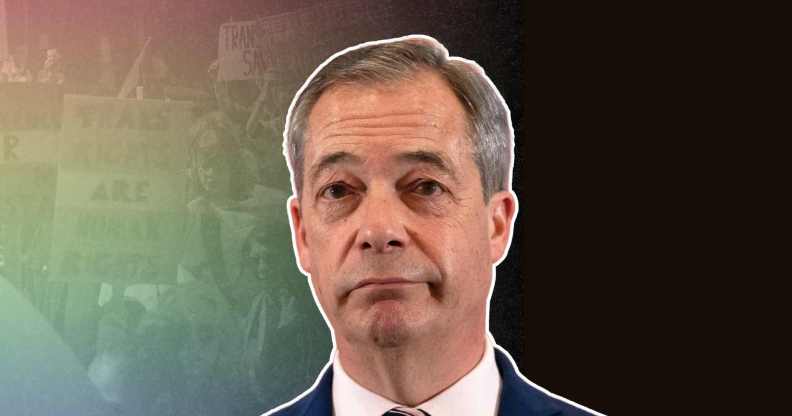
Reform would win the election if it was called today, a major poll suggests. What would this mean for LGBTQ+ rights in the UK? (Wiktor Szymanowicz/Future Publishing/Getty Images/Carl Court/Canva)
The popularity of Nigel Farage’s far-right, anti-immigration party Reform continues to grow in the UK, with polls suggesting it is now nearly neck-and-neck with Plaid Cymru in the Senedd.
The poll carried out by YouGov and ITV Wales found voting intention in the Senedd – the parliament in Wales– has seen Reform gain a four point boost to 29 per cent since a previous poll in April, with Keir Starmer’s Labour seeing its vote share fall by four points to 14 per cent.
In terms of other parties, the Conservatives are predicted to take 11 per cent in the Senedd vote, with the Lib Dems and Greens having 6 per cent each.
“Our polling also finds that Reform UK have taken the lead for the first time in Westminster voting intention,” YouGov states.
“Other parties remain on similar vote shares to those from five months ago, with Plaid Cymru taking 23 per cent, Labour on 18 per cent, the Tories 11 per cent, the Lib Dems on 9 per cent and Greens on 7 per cent.”
A previous survey, carried out by YouGov in June, predicted that if an election had been at that time then Reform would have dominated and become Westminster’s biggest party.
The findings of the YouGov research are not set in stone but simply an estimate of what could happen, based on the poll’s participants current voting intentions. The next general election in the UK is not anticipated to take place until 2029.
The survey had sample size of 11,500 people and marked the data analytics firm’s first Multilevel Regression and Post-stratification (MRP) poll since last year’s general election in July 2024 which saw Labour sweep to victory.
The results of the survey show that a year on, Starmer’s party would not hold onto power and, instead, Nigel Farage‘s Reform would win 271 seats – the most of any party.
The right-wing populist political party was founded in 2018 as the Brexit Party and has since rebranded and made a name for itself because of its controversial anti-immigration and eurosceptic policies.
“If an election were held tomorrow, the central projection from our MRP estimates that Labour would not only lose their majority, falling to 178 seats, but in doing so become second party by some distance in a hung parliament in which Reform UK would be the largest force,” You Gov’s director of political analytics, Patrick English, wrote at the time.
“According to our data and models, Nigel Farage’s party would come out of an election with 271 seats, an enormous improvement on their 2024 total of five, placing the party close to government.”

The data also suggested the Lib Dems would remain the third biggest party in Westminster and make some additional small gains to have 81 seats whilst the Conservatives, who were ousted by Labour at the last general election after 15 years in power, would be reduced to a mere 46 seats.
In Scotland, the Scottish National Party (SNP) would once again regain dominance and become the largest party north of the border whilst the Greens and Plaid Cymru would make some small gains.
According to the results of the survey, 26 per cent of voters would opt for Reform UK, 23 per cent for Labour, 18 per cent for the Conservatives, 15 per cent the Liberal Democrats, 11 per cent the Greens, 3 per cent the SNP, 1 per cent Plaid, and 2 per cent for other parties and independent candidates.
English went on to say Reform’s “meteoric rise” is driven by “impressive performances right across the country – including in Scotland”.
“In terms of seat totals, Reform UK would be the largest party in each of the East Midlands, East of England, North East, South East, Wales, West Midlands, and Yorkshire and the Humber under our central estimate, as well as being tied with Labour in the North West,” he wrote.
“Perhaps unsurprisingly, the new additions to the Reform UK column are almost exclusively constituencies which are estimated (by Professor Chris Hanretty) to have voted Leave in the 2016 EU referendum. Of these 266 Reform gains, just ten did not back Brexit: three in Scotland, two in Wales, and five in England.”
He added that around 51 per cent of those “turning out to vote in a hypothetical election being held now who voted Leave in 2016 would back Reform UK – the largest share of this segment of the electorate by a considerable distance”.

The YouGov survey came as Channel 4 was set to air a Dispatches documentary entitled Will Nigel Farage Be Prime Minister? on 26 June.
The documentary’s summary stated political journalist Fraser Nelson “goes beyond the headlines to explore the rise of Reform, assessing the impact of Nigel Farage and his young party on the existing political infrastructure”.
“As Reform builds momentum, Nelson examines the deeper forces behind its support – disillusionment, identity and a hunger for disruption – and assesses whether Britain might be on the verge of a political earthquake.
“Is Reform merely the nation’s biggest ever protest vote to date – or is it the start of a surge that will eventually see Farage become prime minister?”
What is Reform’s stance on LGBTQ+ rights?
Reform certainly does not have the best record when it comes to the rights of LGBTQ+ people.
Following the location elections in May, Reform announced that the 10 councils it controls across England – Durham, Kent, Lancashire, Staffordshire, Nottinghamshire, Derbyshire, Doncaster, North Northamptonshire, West Northamptonshire and Lincolshire – would be banned from flying the Pride flag.
Then-chairman Zia Yusuf said: “No other flags will be permitted to be flown on its flagpoles, balconies, reception desks or council chamber walls”
A Reform spokesperson also said at then time: “Reform UK will proudly fly the union jack, St George’s flag and county flags. Unlike Labour, we are proud of our country and history.”
Previous to this, a Reform member by the name of George Jones was caught on camera calling Pride flag displayed on a police car a “f**king degenerate flag”.
“You see that f**king degenerate flag on the front bonnet? What are the old bill doing promoting that crap? They should be out catching nonces, not promoting the f*****s,” he was caught saying.
In the party’s policy pledge, entitled “Our contract with you“, it states that the document is not just “another manifesto” but “sets out the reforms that Britain needs in the first 100 days following a general election, and thereafter”.
Within it, and as part of a introductory paragraph attacking immigration, multiculturalism and “divisive, ‘woke’ ideology”, Reform states “transgender indoctrination is causing irreversible harm to children”.
Further, it reaffirms this transphobic stance by vowing to ban so-called “transgender ideology” – a term used as an anti-trans dog whistle – in primary and secondary schools.
“No gender questioning, social transitioning or pronoun swapping. Inform parents of under 16s about their children’s life decisions. Schools must have single sex facilities.”
The pledge on single-sex spaces is repeated in the ‘children and families’ of the manifesto wherein the party states that single-sex facilities would be mandated in public toilets and changing areas.
In regards to social media and the Online Safety Bill, which subsequently passed and is now law, Reform states: Social media giants that push baseless transgender ideology and divisive Critical Race theory should have no role in regulating free speech.”
In the manifesto, Reform also attacks diversity, equality and inclusion, saying it would scrap all such related roles in UK police forces and overhaul the 2010 Equality Act.
“The Equalities Act requires discrimination in the name of ‘positive action’. We will scrap Diversity, Equality and Inclusion (DE&I) rules that have lowered standards and reduced economic productivity,” the party states.

Such promises in Reform’s policy document is unsurprising given the views of its voters, two-thirds (69 per cent) of which believe that trans people should not be able to legally change their gender via a gender recognition certificate (GRC) in the UK.
However, despite this anti-trans belief, 65 per cent of Reform UK voters believe that same-sex couples should be allowed to get married in the UK – a perspective which is in contrast with the party leader, Nigel Farage, who himself does not have the best record on LGBTQ+ rights.
In 2013, back when he was leader of UKIP, Farage said he would not expel members for voicing “old-fashioned” views about homosexuality, including those who describe it as “disgusting”.
The following year he said: ”I do not support same-sex marriages… while we’re under the auspices of the European Court of Human Rights. Come out of Europe, and we can have a sensible debate about same-sex marriages and how we conduct it.”
More recently, in July of this year, Farage branded equal marriage “wrong”.
“It is a settled issue. I didn’t support it. I thought it was wrong to introduce it to the public without even putting it in a manifesto,” he said.
“I was very surprised that David Cameron did that. I thought the civil partnership arrangement that we had was actually working equitably and fairly.
“So I thought the work that was done was wrong, but look, we have moved on.”
Following this, in September, Farage once again attacked same-sex unions.
The Reform leader, who ironically has been married and separated from two women, said “the most stable relationships tend to be between men and women”.
“I think one thing for certain is children who have two stable parents have a better chance in life. And the most stable relationships, maybe not my example, but the most stable relationships, the ones that last the longest, tend to be between men and women,” he said.
He continued: “I’m not absolutist about this in any way at all. I just happen to think of kids in the country not getting the start at home or at school that they deserve.”
On other LGBTQ+ topics, in 2019, Farage said people living with HIV should not be able to enter the UK, claiming that the country is “incapable” of treating people with the virus because of immigration.
He also praised Margaret Thatcher’s period as prime minister as a time of “real advancement for gay people in society”, claiming gays and lesbians “were not discriminated against the way they had been by nearly every prime minister before”.
When reminded of the abhorrent law that was Section 28, implemented by Thatcher’s government, Farage said that “was done because she feared some of the very, very extreme left-wing elements within the teaching union”.