
European Parliament votes in favour of EU-wide conversion therapy ban
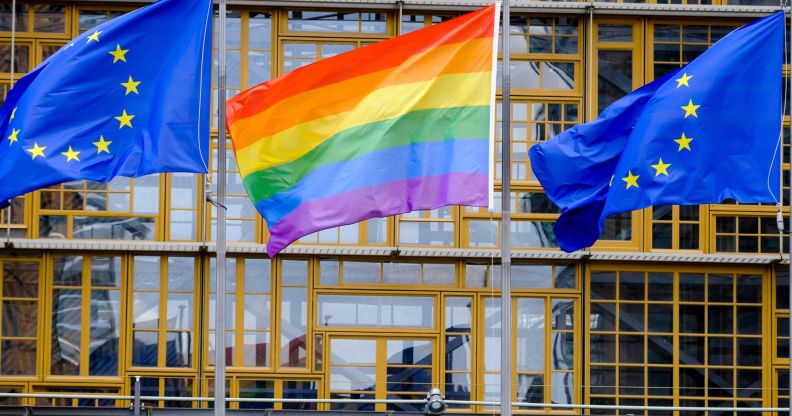
An LGBTQ+ Pride flag in between two European Union flags.. (Getty)
The European Parliament has voted in favour of a proposed EU-wide ban on so-called “conversion therapy” in a win for LGBTQ+ rights.
The vote, which took place on 29 April, is now being sent to the European Commission, the EU’s main executive body that can introduce the legislation.
The issue was discussed following a petition from the European Citizens’ Initiative. The petition in question featured more than 1.2million signatures, which have been collected since 2024, in support of a conversion therapy ban.
Ahead of the vote, the European Economic and Social Committee (EESC) held a debate on the topic earlier this week. The debate resulted in the committee calling for stronger enforcement of the European Union’s LGBTIQ+ Equality Strategy 2026-2030, as well as an EU-wide ban on conversion therapy.
In a statement published on 29 April, EESC president Séamus Boland said: “These so-called conversion practices or therapies are not only harmful, they are a profound violation of human dignity and fundamental rights.”

He continued: “Let us be absolutely clear: there is nothing to fix or cure. What needs to change is not people, but the systems, attitudes, and structures that deny them their dignity.”
Conversion therapy is a broad term which refers to several practices that attempt to change a person’s sexual orientation or gender identity.
Research suggests that conversion therapy takes place all across the world, and can range from forms of “talk therapy” to physical abuse or “aversion therapy”.
Conversion therapy is already banned in seven EU countries, including France, Germany, Spain, Portugal, Belgium, Greece and Malta. The latter was the first to ban the practice in 2016.
Most medical organisations view conversion therapy as a pseudoscientific and damaging practice. The American Psychiatric Association (APA) has described it as “harmful” and has instructed its members to “refrain from attempts” to change a person’s sexual orientation.
Studies have found that those who are subjected to conversion therapy have an increased risk of suicidal ideation.
Share your thoughts! Let us know in the comments below, and remember to keep the conversation respectful.