
Adrian Chiarella and Joe Bird on tackling conversion therapy in gay horror Leviticus
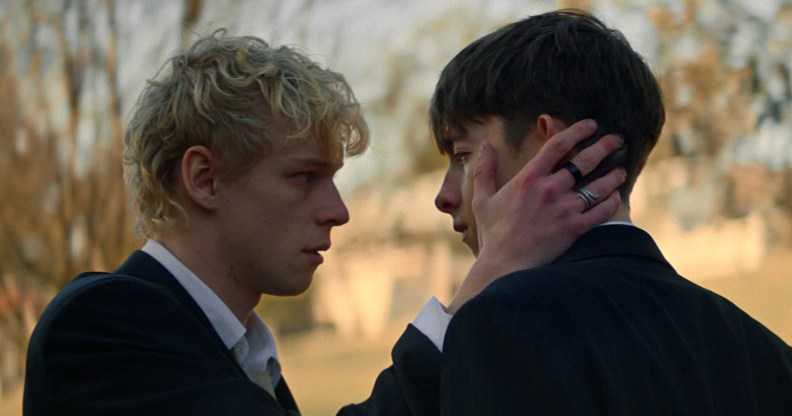
Leviticus releases in UK cinemas nationwide from 2nd September. (Neon)
Leviticus director Adrian Chiarella and star Joe Bird discuss building chemistry, tackling conversion therapy, and their perspective on fan theories.
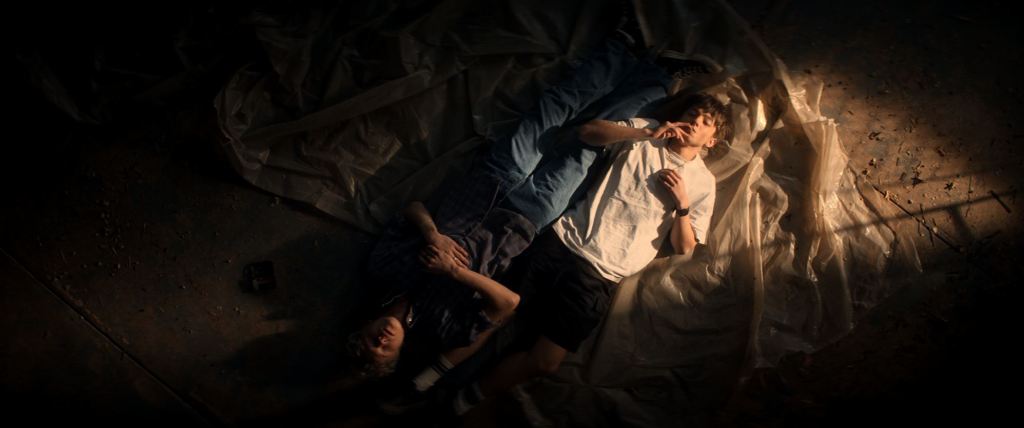
In Leviticus, two Australian teens’ desire for each other becomes monstrous. The coming-of-age supernatural horror, Adrian Chiarella’s directorial debut, is set in a deeply religious community in a small town in Australia. We meet blonde extrovert Ryan (Stacy Claisen) and the quieter, mousey-haired brunette Naim (Joe Bird) in an abandoned building. The pair are boyishly wrestling, playfully pushing and shoving until it gets heated; Ryan pins Naim to the ground, and suddenly they’re kissing.
Named after the Old Testament’s Book of Leviticus, often cited as justification for anti-LGBTQ+ perspectives, this bristling horror film sees homophobia as the fear that interrupts blossoming queer desire. When Ryan is discovered to be harbouring gay longing, his religious family forces him to undergo an exorcism that unleashes violent entities that shapeshift into the person that they love the most. For Ryan, that’s Naim. This allegory of so-called conversion therapy thrusts Leviticus into an enthralling exploration of homophobia as the monster in the darkness.
Naim finds himself torn between the soul-shifting freedom of being with Ryan, despite the dangers of his violent doppelganger trying to kill him, and the call of his deeply religious mother, Arlene (Mia Wasikowska), where he’s left with only glances across church pews at Ryan. Chiarella’s film straddles queer romance and social commentary, creating a haunting visual language that is beautifully portrayed by Bird and Claisen.
PinkNews chats exclusively with writer-director Adrian Chiarella and star Joe Bird about making Leviticus and tackling conversion therapy through the horror genre…
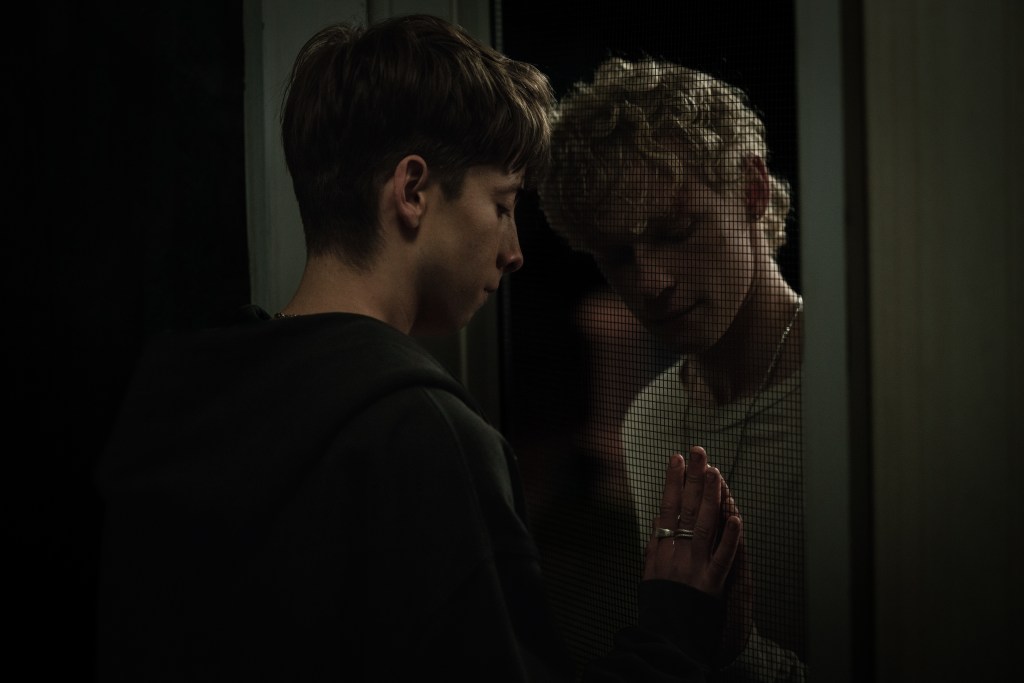
PinkNews: The film opens as a queer drama before descending into horror. That’s also the case with several scenes that begin with queer intimacy but switch into violence. How was it to pen that difficult tonal shift in a contained scene?
Adrian Chiarella: When I started this film, I knew it was a horror movie, but I wrote this very long sequence of the relationship between these two young men. I really needed to understand them, who they were and how they met, even if we weren’t going to put it in the film. Stepping through those key moments was about figuring out the most truthful way for the fear to come out. It took a while to solidify the idea of this entity, this horror movie monster, and what the rules of it were. But what never changed was the two lead characters and their relationship.
How were those scenes from your perspective, Joe, collaborating with intimacy coordinator Amy Cater and stunt coordinator Warwick Sadler, in moments that start as intimate queer scenes switching into violence?
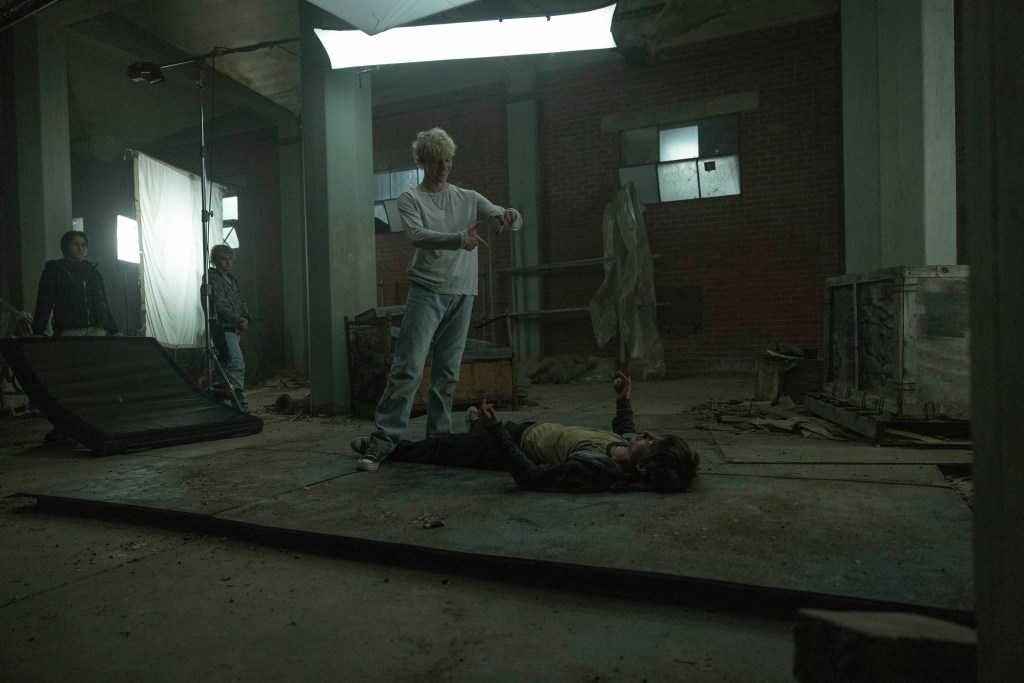
Joe Bird: A lot of these romantic, intimate scenes often do start off in that stunt area. We had a lot of stunt rehearsals and pre-production with Amy and Warwick on set, and it never felt too hard. We’d do the stunt scene and then go into the intimate scene, which would be a closed set. Nothing felt out of place, and it’s because of this guy [gestures to Chiarella], because he’s the mastermind.
Chiarella: Because the intimacy moments melded into the stunt moments, or vice versa, we had to have really clear transition points so that when they were doing a stunt, we had dozens of people on set for their safety, and when that scene switched into a moment of intimacy, everybody would have to leave. Knowing how to keep everyone as safe as possible through a repeat of each scene was quite a delicate thing to manage.
Bird: Also, whenever me and Stacy were doing the stunt scenes, we’d always make sure each other was safe. Having that open communication just works.
There must be a real foundation of trust between you and Stacy. I read you also got rehearsal time; how important was that in building your rapport and translating the connection onto set?
Bird: There’s such a big difference when you can really talk with your director and other actors, we almost rehearsed every single scene of the film in pre-production. Also, Adrian had us do an escape room, we held snakes, and me and Stacy just hung out. The best thing about doing this job with Stacy is that we were both looking to become friends. We didn’t just want to be coworkers. He’s going to be my friend for life, and we went through this whole thing together. It’s a really special thing in filmmaking when you kind of build a family.

How was that for you, Adrian, to see your characters be portrayed, be brought to life so beautifully by these two young actors?
Chiarella: It was terrifying writing a film like this with two young leads. You think, “God, where are we going to find these people? We could be looking for years.” It was such a huge relief when we found Joe and Stacy, and from their very first chemistry test audition together, they had such a natural connection.
Bird: I remember Stacy was wearing this cool shirt, and I thought, “he’s got good style.” We went shopping, and I got a shirt like that; he influenced my style. I had really bad style before I filmed, and hanging around Stacy really improved it.
You get an acting credit and a new wardrobe. Your other co-star Mia Wasikowska is also fantastic. Considering this is a horror, her character’s actions are some of the film’s most disturbing moments. She plays Arlene with an eerie calmness.
Chiarella: I have to credit Mia with a lot of that. I’d written her character as having big emotional reactions, but Mia brought in what felt more true, having seen a lot of people like this in her life. The only time you see her lose control is in one of her final moments on screen; she’s calling out to him at the gas station and you hear her voice crack. It was quite an amazing decision on Mia’s part to have that much restraint.
Bird: I want you to quote me when I say this: Mia Wasikowska is the actor of our generation. She’s just amazing, even when she, like, sends me off to do the ritual, when it pans back on her in the car, she just twitches her face. There’s so much going on behind her eyes.
Adrian, how was it for you to pen that parent-child dynamic and really dig into the nuances of their connection?
Chiarella: With Mia’s character, it was that particular shade of homophobia that’s like, “I’m not homophobic, I just want to protect you from other homophobic people.” The hardest part was the end of the character’s arc; I kept trying to give her a redeeming moment in the final scenes of the film, draft after draft. I almost needed permission of, “you don’t have to do that. You can be true to what this situation is for this parent. Like, do you think she’s going to change overnight?” If things are going to be patched up between her and her son, that’s something that’s going to take many years, outside the time span of this film. So I kept it true to what’s happening in the moment.
Underscoring this film is conversion therapy, which has been explored previously in Boy Erased and The Miseducation of Cameron Post. Leviticus takes on the explicit horror of the practice; how was crafting that visually?
Chiarella: The visualisation of the ritual with the boys was something I had the idea of with fire and flames, a motif throughout the film. It’s quite biblical; there’s a lot of imagery of fire in the book of Leviticus, so I wanted to draw on that. Fire also comes up as something more important later in the film.
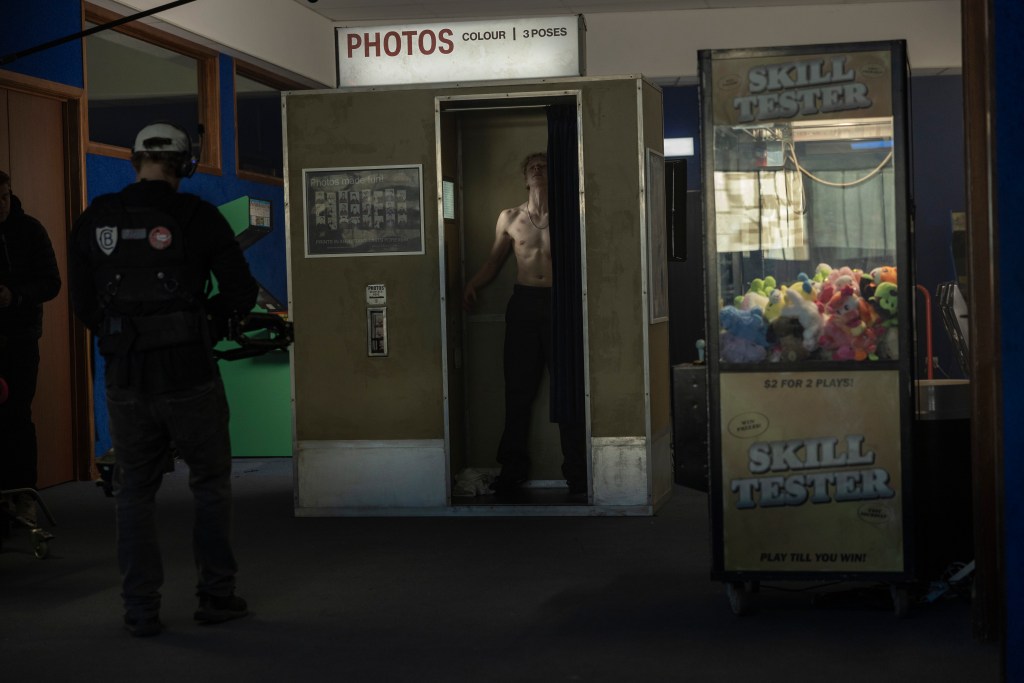
Bird: It’s a little foreshadowing… even the photo booth symbolism.
Chiarella: Yeah, I drew on this queer history of photo booths: in the 1940s they were the only safe spaces for gay men to hang out and have their photo taken because the photo developed instantaneously; no one else would see it. So they have a special place in queer history.
You’ve also really embraced the film’s fans, releasing material for them to make fan edits. Have fans interpreted or taken something from the film that you hadn’t considered?
Bird: There’s been lots of fan theories about a love triangle. People don’t know whether Naim’s first kiss was with Ryan or not. I’m going to put this to bed: my backstory is Naim probably lived in Melbourne before, and I reckon he had a little fling with someone that wasn’t really his type. So when he met Ryan, he was like, “Oh my god!” That’s my backstory to you, an exclusive for you.
Leviticus releases in UK cinemas nationwide from Wednesday 2nd September