Author V. E. Schwab on toxic lesbian vampires and being a messy gay

Bury Our Bones In The Midnight Soil by V.E Schwab is your newest vampire obsession (Jenna Maurice/Tor/Pan Macmillan)
If there’s something V. E. Schwab does well, it’s writing villains.
So who better to write a book that is all about toxic lesbian vampires?
Bury Our Bones In The Midnight Soil is your newest vampire obsession – and the most personal thing Schwab’s written since The Invisible Life of Addie LaRue.
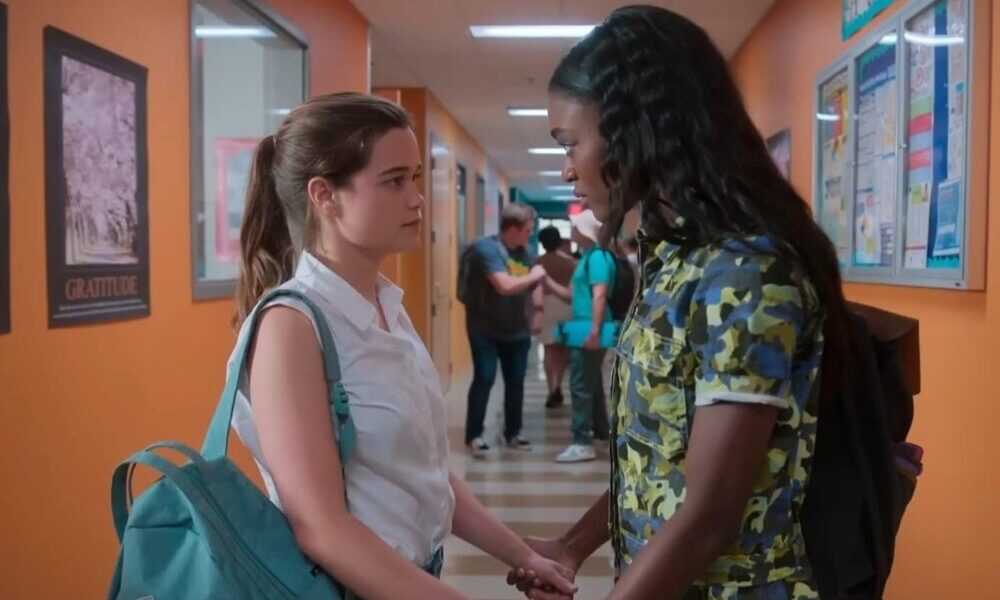
A best selling author of more than 25 books, Schwab is best known for her Shades of Magic series, the Villains series. She is also the creator of creator of far-too-soon cancelled Netflix supernatural teen drama series First Kill – which was based on Schwab’s short story of the same name.
PinkNews chatted with Schwab about her new novel, lesbian vampires and the importance of diverse queer stories in fiction.
PN: What was it that made you want to write about toxic lesbian vampires?
V. E. Schwab: Well, I am a toxic lesbian. No, I’m a messy gay, though.
In the wake of [The Invisible Life of ] Addie LaRue, I just had to have a little bit of a confrontation with myself about what you do with success. If success doesn’t make you more authentic, more ambitious, more bold, more unapologetic, I think you’re wasting it. It was the success of Addie LaRue which enabled me.
I watched the Interview with the Vampire series while I was revising [Bury Our] Bones In The Midnight Soil] and I was like ‘oh I really want to explore toxicity’. I want to explore the messiness within queer relationships because it exists there too. So all of these things were just kind of murky and mired and I wanted to write about immortals.
And then I was also just thinking about the ways in which horror and romance coexist for some bodies. Like there are bodies that move out into the world and by simple virtue of how they appear, they invite violence. We are endangered by simply existing. And because of that, I thought that one of the greatest forms of liberation that a queer person, a fem-presenting person, a person in a non-cis white male body could feel would be going from prey to predator. And I just wanted to explore the inherent queerness of the vampire lore.
It’s hard for me to say ‘oh this is why I wrote it’. It was just like 15 years of publishing, Addie LaRue, a love of vampire culture, a desire for messy gays, all of it just together.
I’ve always said that there would be no way I’d ever be a straight vampire.
V. E. Schwab: I will die on the hill that there are no straight vampires. I worked on a television show and the showrunner on the show was straight and she was so offended whenever I would make that statement and I was like no there are young vampires but you cannot tell me after a certain period of time that you are still only thinking about one aspect.
I think that it awakens you to the fact that loving a person is so much bigger than gender, that attraction is so much more complicated, right? All of these things. It’s about power. It’s about being seen. It’s about living long enough that your boundaries expand instead of constrict.
I completely agree, vampires are very hedonistic so it doesn’t make sense.
V. E. Schwab: So, all of my fantasy comes down to psychology. I’m really fascinated by the logic behind magic. I want it to feel realistic.
And the thing between Addie and Bones is that I don’t believe in the apathetic immortal. It doesn’t make narrative sense to me because every immortal still has a kill switch, right?
We often see these depictions of vampires as hedonists but also just so weary of life. And I don’t buy it. What keeps you going? And so I want to explore the passion of it, the hunger, the insatiability, but then also with bones I’m like, why are there not more of you?
So then from a psychological underpinning, there must be a self-destructive element here. What is a self-destructive element? Over time, maybe you don’t get fatigued, but you erode in a way that your animal instinct is all that’s left. A lot of the immortals that I write are an exploration of the way that humanity either strengthens or decays.
I found that was such an interesting part of the story, that when vampires get older, they just start to unravel and they can’t remember what it is to be human.
V. E. Schwab: It’s also individual. I wanted to make a rule that would apply differently to each person. Like Ezra is like 250 and he hasn’t started to decay. Whereas I think Alice is going to decay pretty quickly.
But it’s also about self-awareness. Like Charlotte’s entire section of the story is told from Charlotte’s point of view. So you are left to trust that she is still held on to her humanity that entire time. But so much of psychology and mental state and awareness comes down to how opaque we are to ourselves.
This whole idea is explored so well in Bury Our Bones In The Midnight Soil. I feel like from day one, Sabine was already so connected to that animalistic side of herself.
V. E. Schwab: Between the first draft and the revision, I write a note card that I try to distill something about my characters so that I can refer back to it as I’m taking the whole book apart. For this one, I have a note card that says, “Alice is in her head. Charlotte is in her heart. Sabine is in her hunger.”
The three of them represent these three stages of my own queer coming-out journey. Alice is still figuring out who she is. Charlotte is so desperate to be loved and Sabine just fully self-actualised and unapologetically who and what she is. So whenever people are like, “Who are you?” And I’m like, “Oh, I’m Sabine.” And then I realised that probably sounds wrong. I am not a murderous 500-year-old serial killer, but I’m where Sabine is in my queer journey.
Were there other things that you wanted each of the main characters to represent?
V. E. Schwab: I think it’s really important for readers to remember that there are no heroes in this book and that it’s not really meant to be about whether these are good or bad people. It’s meant to be about what we do with what happens to us. There are things in each character’s story that they don’t choose for themselves and it’s about what happens when the choice does become theirs.
I’m really curious to see who readers root for because I’ve seen it all across the board at this point and I have in my heart who I believe the villain is or not the villain but who I think the worst is. It’s so interesting when I see readers loving her.
The way that you deal with different types of grief in the book is really beautiful and interesting. Was it important for you to include those different elements of grief?
V. E. Schwab: I don’t think you can have a tale of immortality without a tale of mortality. It’s a very nucleic tale in that it really focuses on these three women but in becoming who they become they leave people behind and they lose people. For me, the saddest scene in the book is actually between Charlotte and Joselyn and this idea of having been in love with someone and having them not be brave enough. I have never really wanted to explore immortality without cost.
An immortality bargain, whether it’s a deal with the devil like an Addie LaRue or a vampiric transaction, is a transaction. It’s give and take and it’s gain and loss and I think it works better when we really appreciate the loss. Whether that’s symbolic of the versions of ourselves we have to lose to become new people, the versions of family that we lose because they can’t support us or aren’t willing to, the versions of lovers that we lose because we aren’t ready for them or they’re not good for like, or just human loss.
It really does help make all the characters feel so much more real.
I think all of my fantasy novels exist at the junction of the fantastic and the real. A Tolkien fantasy novel tells you when you pick it up that it will only exist in the pages of that book. Whereas I want to convince you that you’ve walked past Ezra.
I work really hard to let the magic exist by convincing you that it’s just part of life. The world is so big and strange and there’s so much we don’t understand. It’s easy to carve out a little bit of space for doubt.
I want to convince you that all of this strange and wondrous and magic and horror is just in lockstep with reality at all times. I think one of the ways that you do that is by making sure that the realism and the characters shouldn’t just feel like vampire archetypes because part of the story is about their individuality.
Writing toxic lesbians had to be the breaking of the monolith. This came about in part because I wanted to write a lesbian villain. I wanted to write a lesbian villain so badly because I want to be a villain. I want to be the villain in all the stories. So I wanted to write a lesbian villain and I was like, ‘Okay, how am I going to do this in a way that I get the space to explore queer villains?’ I’m going to make all three of them lesbians. I’m going to make everyone on the spectrum of this story lesbians.
That allowed me to then treat each one of them like an individual and ask the same grace of the reader so that it didn’t become ‘are you saying lesbians are bad?’ I’m saying they’re bad, good, and everything in between.
You had said before that after Addie LaRue, you wouldn’t put as much of yourself into a book again. What changed?
Oh god. I know. I famously said that I would never do that again not because it didn’t work but because it was just very scary.
Then I decided to put myself in all three of these women. I think the hope is this book is such a reckoning for me with myself. And weirdly, one of the best things that I have ever done for my own queer journey is to write this book. For some people, their gender and sexuality are a huge part of them, and for me, it’s never been a huge part. But because it’s never been a huge part, I’ve never felt very valid in it.
Because it didn’t define me for 27 years I still feel like I’m playing catchup and I still feel like I figured out sexuality but not gender. I still feel just like such a work in progress. I think I probably always will but because of that I kind of skirted my own self-awareness, my own themes, my own mirror. Without a book like this, I probably would have continued to do that. I needed to confront my own identity.
A lot of focus is put on queer joy in books, but there’s not a whole lot of queer joy in this book. How important do you think different types of queer stories are right now?
I think this is a queer joy book, which is a weirdass thing to say. It’s not a happy book, but it is a queer anthem. It’s a queer empowerment book. This is a book about queer power and that’s going to have horror and joy.
I think that queer stories are so important. But what I specifically need is that spectrum. I need queer existence. I need stories where queer characters get to be present regardless of their identity and it’s not a plot point. I think we need to have queer stories, period. And I think that means queer horror. I think that means queer fantasy.
Specifically, I get very excited anytime queer stories get to live in a genre because for so many years it felt like, ‘Okay, you can have a queer identity story or you could have a fantasy novel but the queer kids don’t get to be in the fantasy novel because they’re only relevant when we’re mining their trauma.’ Let queer people have adventures. Let them fly spaceships. Let them be vampires. Let them be things that don’t have to do with them being queer. Normalisation is quietly radical.
Bury Our Bones In The Midnight Soil is available from June 10, 2025.