
Remembering the lives tragically lost in horrific nail bomb attack on London’s Admiral Duncan gay bar
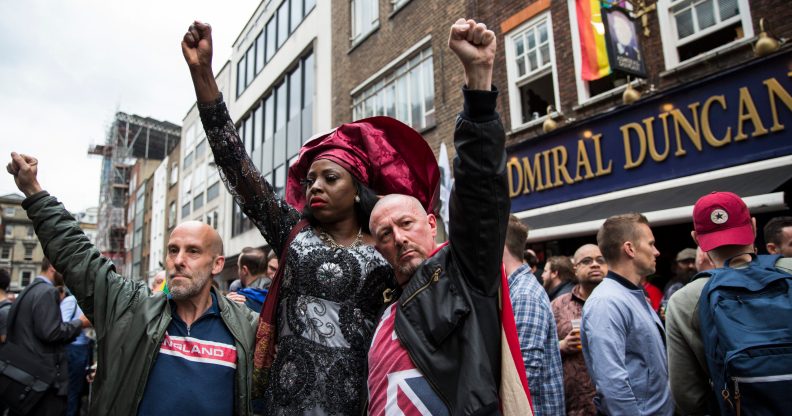
The Admiral Duncan continues to be a place for the LGBT+ community to come together and remember those they’ve lost. (Jack Taylor/Getty Images)
The Admiral Duncan, a popular LGBT+ pub in Soho, London, will never forget the awful day a nail bomb attack claimed the lives of three people and injured dozens more.
Friday April 30, 1999 was supposed to be the start of a glorious bank holiday weekend. The sun was shining, workers had clocked off in their masses and, as is their wont, headed straight for the pub to meet with friends.
There was a certain weight in the air, as in the weeks prior, two nail bombs had targeted vulnerable communities around London. But in the Admiral Duncan, at the end of Old Compton Street, Soho, it was mostly business as usual – until somebody spotted an unattended holdall. Moments later, at about 6.30pm, it exploded.
Andrea Dykes was 27 and pregnant. She was visiting the pub with her friend Nick Moore, 31, and her husband’s best man John Light, 32. All three were killed in the blast.
Another 79 were injured. Among those who survived were Thomas Douglas, who was stood at the bar talking to Dykes when the blast occurred and ended up losing both his legs. Also injured was pub manager David Morley, known to friends as Sinders.
Both men have since passed away – Douglas died in 2017, while Morley was fatally attacked by a group of teenagers in 2004.
Admiral Duncan bombing was the third attack in two weeks
The Admiral Duncan attack was the third bombing in two weeks targeting vulnerable minority communities in the capital.

On April 17, a nail bomb targeting London’s Black community exploded in Brixton, injuring 47 people. Another blast took place in Brick Lane, the centre of the city’s Bangladeshi community, on April 24, harming six people.
Westminster councillor Ian Adams had gone out to Soho the evening of the attack, approaching Old Compton Street a few minutes after the bomb exploded shortly after 6.30pm.
“There was a lot of disruption of the roads and some of the roads were closed and there was police tape towards the end of Old Compton Street. There was a certain eeriness about the place. There was no panic and there were a lot of people milling around,” he told PinkNews in 2019.
“I think the community was just there together as one and wanting to provide reassurance to one another that people were alright,” he said.
“This is a very extreme case of hatred being played out on our streets. But I’m very, very conscious that today, hate crime is just a heartbeat away.”
All three nail bombs were the work of confessed racist and homophobe David Copeland, who was 22 at the time. His brutal actions devastated the capital, leaving communities confused, scared and feeling under siege.
Days after the Admiral Duncan bombing, Copeland was arrested. During his trial, it emerged that he considered himself a neo-Nazi and was obsessed with Hitler and bombs. Psychiatrists diagnosed him with paranoid schizophrenia. He was found guilty and handed six concurrent life sentences.
In October 2015, he pleaded guilty to wounding with in intent after attacking an inmate at HM Prison Belmarsh, and was sentenced to three more years, though he will serve just 18 months.
Admiral Duncan memorial in 2026
Guests are invited to remember the three people who lost their lives, and the 79 who were injured, at the venue today, 30 April 2026, from 5pm.