
Trans people can be barred from gendered spaces in EHRC’s updated draft code
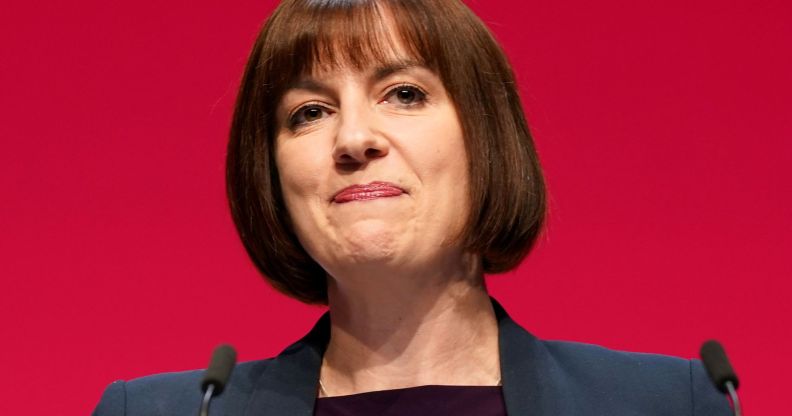
Minister for Women and Equalities, Bridget Phillipson. (Getty)
Bridget Phillipson, Minister for Women and Equalities, has presented the Equality and Human Rights Commission’s (EHRC) draft updated guidelines to Parliament.
Following the April 2025 Supreme Court ruling that said that in the Equality Act 20210, sex referred to “biological sex”, the EHRC’s guidelines have been updated.
The draft Code’s aim is to give organisations clear guidance on every day situations, such as who can use on-site toilets.
Phillipson said: “The Equality Act enshrines our rights in law so that people can live free from discrimination and harassment.
“Our focus has always been making sure organisations have clear, accessible guidance on how to implement the law.
“I thank the EHRC for their work updating the draft Code of Practice, and look forward to continuing to work with them to ensure people’s rights are upheld across our country.”
What it means for trans people
Both “sex” and “gender reassignment” are listed as protected characteristics in the Code. Its definition of a trans person is “a person who has the protected characteristic of gender reassignment”.
It states that associations can restrict entry to those who share a protected characteristic. In an example, it says it would be lawful to refuse a trans woman entry to a women-only association, as membership is “based on sex”.
It also gives guidelines on gender-based sports, saying: “Trans people should not be included in single-sex or separate-sex competitions for the sex with which they identify.”
In an example, based on a running club, which it describes as a “gender-affected activity”, it says: “A woman who participates may be able to bring a claim for indirect sex discrimination due to the provider’s decision to include trans women placing her at a particular disadvantage.”
It also says trans men can be excluded from women’s sports, such as boxing, if they have undergone testosterone treatment. “This is likely to be lawful if the gym can demonstrate that there would be a genuine health and safety risk and / or impact on fair competition if the trans man were allowed to join the competition,” it says.

However it says it may be unlawful to exclude trans people from gender-related activities based on their “biological sex” if not for reasons of “safety or fair competition”. It says: “If it is not necessary for these reasons, it is likely to be unlawful to exclude trans people from participating in the same way as members of their own sex.”
When it comes to single-sex services, these should be on the basis of “biological sex”, as per the Supreme Court ruling.
It uses the example of shopping centre toilets, having separate-sex facilities. It notes: “This disadvantages trans people because it means that a trans person cannot access a toilet catered towards their acquired gender. They also note that this option may cause safety risks and distress for trans users if required to use the toilets designated for those of the same biological sex. The service provider therefore decides to also provide toilets in individual lockable rooms with handbasins, which can be used by people of either sex.”
It adds that single-sex or separate-sex services cannot be defined as such if organisations allow women and trans women, or men and trans men to use them.
On the other hand, it says a trans man may be excluded from women-only services if it’s decided that women may object to his presence.
It is clear that there must be a toilet or changing, for example, that a trans person could use, though organisations are to use the guidelines to form their own decisions. It says: “The service provider should consider whether there is a suitable alternative service for the trans person to use. In the case of services which are necessary for everybody, such as toilets, it is very unlikely to be proportionate to put a trans person in a position where there is no service that they are allowed to use.”
Stonewall’s response
Stonewall said in response to the updated draft code: “Today the Equality and Human Rights Commission’s long-awaited Code of Practice on Services, Public Functions, and Associations was published by the Government.
”The updated Code is 340 pages long. We along with duty bearers need time to read and digest it and fully understand how services, public functions and associations can be inclusive in line with the law.
”Many trans+ people have already experienced the damaging impact of policies designed to exclude them and, for far too long, have been at the heart of a toxic culture war. The UK, once a leader, has plummeted in LGBTQ+ equality rankings in Europe over the last decade. Government and all Parliamentarians must take equality seriously.
”For Stonewall, trans+ inclusion is fundamental to our vision of a world where everyone everywhere has equal rights. The Equality Act 2010 exists to protect people from discrimination, enabling us all to live our lives freely and fully.
“The world is more polarised and hostile than ever. We need a clear vision for equality in the UK and a roadmap to get there. We will work with partners across business, civil society, parliament and beyond to ensure every single LGBTQ+ person has equal protection and treatment under the law.
”Stonewall’s purpose is to make the world a safe and equal place for all LGBTQ+ people to live, work and thrive. We will not rest until we achieve this.”
Share your thoughts! Let us know in the comments below, and remember to keep the conversation respectful.