
‘I wrote an article about peas and got accused of “neutering women”‘
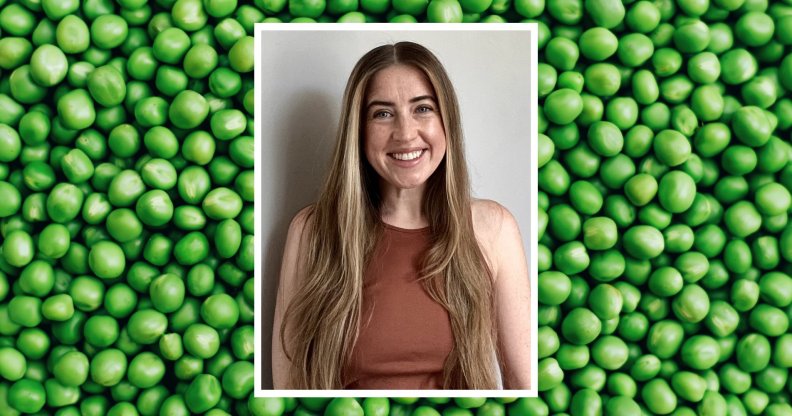
Dr Rachel Woods wrote an article about the health benefits of peas (Getty Images | Supplied)
Writing for PinkNews, Dr Rachel Woods shares how an innocent article about the health benefits of peas caused an unexpected controversy…
I recently wrote an article about the health benefits of peas.
If I am honest, I did not expect it to generate much interest, let alone controversy. In fact, the biggest issue I anticipated was being called a hypocrite by my family, because despite writing about their nutritional benefits, I do not actually like peas very much myself. My children love them though, so they still regularly appear on our dinner table.
So when I opened my emails the morning after publication and saw a flood of comments, I was surprised. For a brief moment, I thought perhaps people were more passionate about peas than I had realised.
Sadly, very few of the comments had anything to do with peas.
Instead, commenters had become fixated on a single phrase I used while discussing iron deficiency anaemia, which I described as being more common in “people who menstruate”. One commenter accused me of having “a pea for a brain”. Another accused me of “neutering women”. Comments continued throughout the weekend until they were eventually removed under the publication’s moderation policy.
‘Women were never excluded from that statement’
What struck me most was not that debates around gender exist. I was already aware of the hostility that sadly often surrounds trans inclusion. What surprised me was how little it took to provoke that debate. A small, scientifically accurate phrase in an article about vegetables was enough to provoke days of outrage.
I used the phrase deliberately, although without anticipating it would become controversial. Iron deficiency anaemia is more common in people who menstruate because menstruation involves blood loss. That is the relevant biological factor, not gender identity.
Of course, many women menstruate. But not all women do, including post-menopausal women and trans women. Equally, some people who menstruate are not women, including some adolescents, some trans men and some non-binary people. “People who menstruate” was simply the clearest and most accurate description of the group being discussed. Women were never excluded from that statement. Women are people.
In science communication, precision matters. If I had simply written that women are at increased risk of iron deficiency anaemia, it would have been less accurate. The biological mechanism involved is menstruation, not womanhood itself. Scientific language should aim to describe reality as clearly as possible, even when that reality is more nuanced than people expect.
This approach is also consistent with NHS guidance on inclusive communication, which recommends using gender-neutral language where appropriate.

This type of accuracy and inclusivity is particularly important in healthcare communication. If public messaging only refers to “women’s health” in situations where the actual issue relates to specific anatomy or biological processes, some people may incorrectly assume information does not apply to them. This can have real consequences.
‘Biology was not being denied’
For example, NHS guidance already recognises that trans and non-binary people may miss important screening invitations depending on how their sex or gender is recorded within healthcare systems. Some may receive invitations for screenings that are not relevant to them, while others may not receive invitations for screenings they do need. Trans communities already experience significant health inequalities and barriers to care, making clear and inclusive communication even more important.
Much of the backlash I received framed inclusive language as a denial of biology. But biology was not being denied. If anything, it was being described more precisely. Gender is a social construct relating to identity and lived experience rather than biological traits. Acknowledging this does not erase biology, it simply reflects the reality that human beings are more diverse and complex than labels sometimes allow.
Even within biology, sex is not as simple as it is sometimes presented. None of this will be new to many readers, but it is worth restating because public conversations about trans inclusion so often rely on an oversimplified version of biology.
While most people can broadly be categorised as male or female, biological sex does not always fit into binary categories. Chromosomes, hormones, reproductive anatomy, and secondary sex characteristics do not always align, and intersex variations are a naturally occurring part of human biology. This is exactly why medical communication often focuses on specific biological processes (such as menstruation) rather than less precise labels.
After all of this, I was left feeling unexpectedly guilty. I use inclusive language precisely because I do not want people to feel excluded. Yet I found myself wondering whether the hostility in the comments section would ultimately be more upsetting to some readers than the original wording would have been if I had simply written “women”.
At the same time, I do not think the solution is to retreat into less accurate language just because inclusion makes some people uncomfortable. Trans people and non-binary people are part of the population we serve, and they have just as much right to be included in science and healthcare communication as anyone else.
‘Accuracy and inclusion matter’
Science has historically excluded many minority groups. Medicine has often been built around assumptions about whose bodies, identities and experiences are considered “standard”. We should be making active efforts to improve that, not avoiding inclusive language to appease those who object to it most loudly.
As a medical educator, I also think carefully about the example we set for future healthcare professionals. Inclusive terminology is not about policing everyday conversation. No one is suggesting a doctor should refuse to call an individual patient a woman if that is how she identifies. But when producing broad public-facing information for diverse populations, accuracy and inclusion matter.
I know this because I have had to consciously adjust my own language over time, and I am still doing so. It would have been much easier if I had been taught to use inclusive language from the start of my education. That is not a criticism of those who taught me, but it does shape how I approach teaching now. During my own education, terms like “pregnant women” were used universally and largely unquestioned in teaching materials. Today, many educators consider whether phrases like “pregnant people” may be more appropriate in contexts intended to include everyone affected by that healthcare issue. That is not the erosion of science, just an attempt to communicate more accurately and respectfully.
All of this arose from an article intended simply to encourage people to eat more peas. Which, in case it has been lost in the discourse, remains good advice.
A single inclusive phrase in an 800-word nutrition article became enough to provoke an entire weekend of arguments about gender identity. Yet inclusion itself should not be remarkable. It should be ordinary. Routine. Uncontroversial.
As a science communicator, I see accuracy not as optional, but as essential, and I recognise that getting it right means being inclusive in how we communicate. The language we choose shapes who feels reflected in science and healthcare, and who feels left out. Biology does not exist in isolation from society, and ensuring science and medicine reach those who need them depends on how clearly and inclusively we communicate them. Science, healthcare and their communication are meant to serve everyone, and ensuring that they do is part of our responsibility.
Share your thoughts! Let us know in the comments below, and remember to keep the conversation respectful.