Malaysia censors non-binary presenter in Eurovision Song Contest Asia broadcast
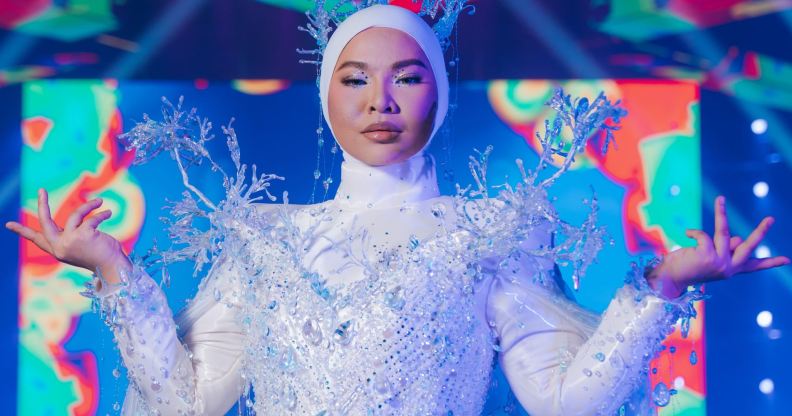
Aina Abdul represented Malaysia at Eurovision Song Contest Asia 2026 in Bangkok (Eurovision Song Contest Asia)
The Philippines‘ announcer was edited out of the broadcast of Eurovision Song Contest Asia in Malaysia, a country with tough conditions for LGBTQ+ people.
The first ever Eurovision Song Contest Asia aired on 14 November, held in Bangkok, Thailand. Eleven countries took part: Bangladesh, Bhutan, Cambodia, Laos, Malaysia, Mongolia, Nepal, Philippines, South Korea (as the Republic of Korea), Thailand, and Vietnam.
The format was much the same as the Eurovision Song Contest, with each country performing and then a representative presenting the jury votes via video link.
Philippines were the first country to announce their jury votes, with Vice Ganda appearing in an elaborate, feminine costume. Ganda is a non-binary comedian, host, singer, actor and LGBTQ+ advocate in the Philippines.
However, in Malaysia, their image was left out, with the logo of the show visible instead, as seen in footage shared on X.
LGBTQ+ rights in Malaysia
The lives of LGBTQ+ people in Malaysia are affected by strict laws, with gay sex criminalised under the country’s Penal Code. The punishment can be up to 20 years imprisonment and whipping. In June, the government declared it would replace references to “LGBT” to the Malay term “budaya songang”, which translates to “deviant culture”.

The publication, including printing or distributing, of LGBTQ+ material is also banned in Malaysia under “morality” guidelines.
Transgender people may be arrested for “public indecency”, facing further charges if they are Muslim under State Shariah law for “impersonating” women.

Eurovision Song Contest Asia
The first ever Eurovision Song Contest Asia saw the Philippines crowned winners, with Carmelle performing “Sobra-Sobra”. Carmelle won both the jury vote with 93 points, and the audience vote with 118 points.
Host country Thailand came second overall with Mang and Daou’s “Aroma”, while Vietnam rounded out the podium with Tóc Tiên’s “Em Tiên”.
Malaysia entered the contest with Aina Abdul singing “Blueset Sky”, with the country placing fourth.
Carmelle’s winning performance does not necessarily mean that the Philippines will host the show if it returns in 2027, a move away from the usual rules with Eurovision Song Contest.
Instead, countries will bid to host the show, which is similar to the process of the Junior Eurovision Song Contest.
Share your thoughts! Let us know in the comments below, and remember to keep the conversation respectful.